
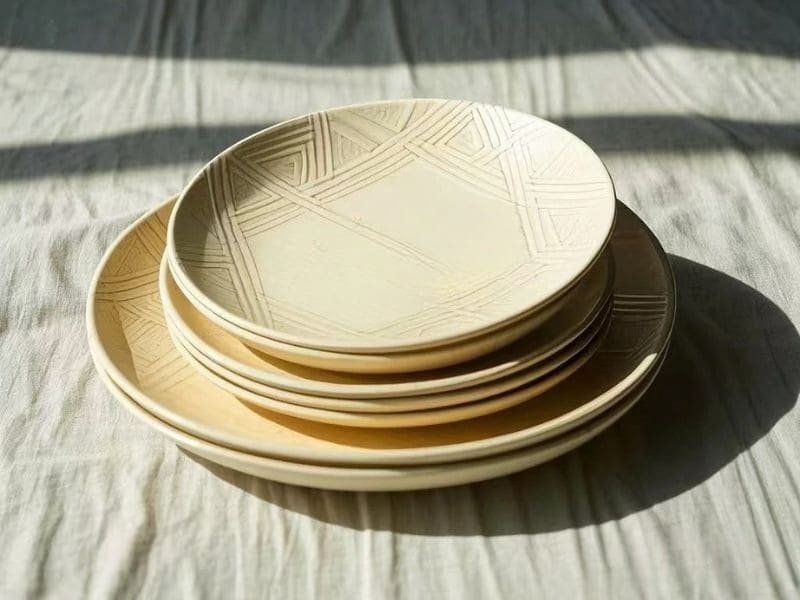
A plate labeled “bamboo” can look like a simple alternative to plastic. Turn it over, though, and you may find the words “bamboo fiber” and “melamine.” If you already own a set, or are choosing dinnerware for a restaurant or shop, the first question is what that combination means for food safety.
Bamboo melamine plates should not be assumed safe because they are labeled “natural,” “BPA-free,” or “food-grade.” They contain plastic resin, and bamboo-filled products have raised concerns about melamine and formaldehyde migration. In the EU, bamboo is not an authorised additive in plastic food-contact materials. These products are different from solid bamboo tableware.
The useful distinction is between the material, the rules in your market, and the way the finished plate will be used. Below, we explain what to check on an existing plate, what the authorities say, and which documents a buyer should request before ordering. A care label or a laboratory report needs to answer those questions for the actual product.
Updated October 11, 2026 · By Lance, Duramela · Approx. 12-minute read
What are bamboo melamine plates made of?
Bamboo melamine is a composite of bamboo powder or fibers and melamine-formaldehyde resin. The resin binds the filler into a rigid molded plate. The finished item is a plastic composite; its bamboo content does not make it a solid bamboo plate or a plastic-free product.
Names such as “bamboo fiber dinnerware,” “bamboo plastic,” and “bamboo tableware” do not describe one standard recipe. Ask for the binder and complete material specification. Do not assume that every product contains corn starch, or that a stated bamboo percentage tells you whether it is suitable for food contact.
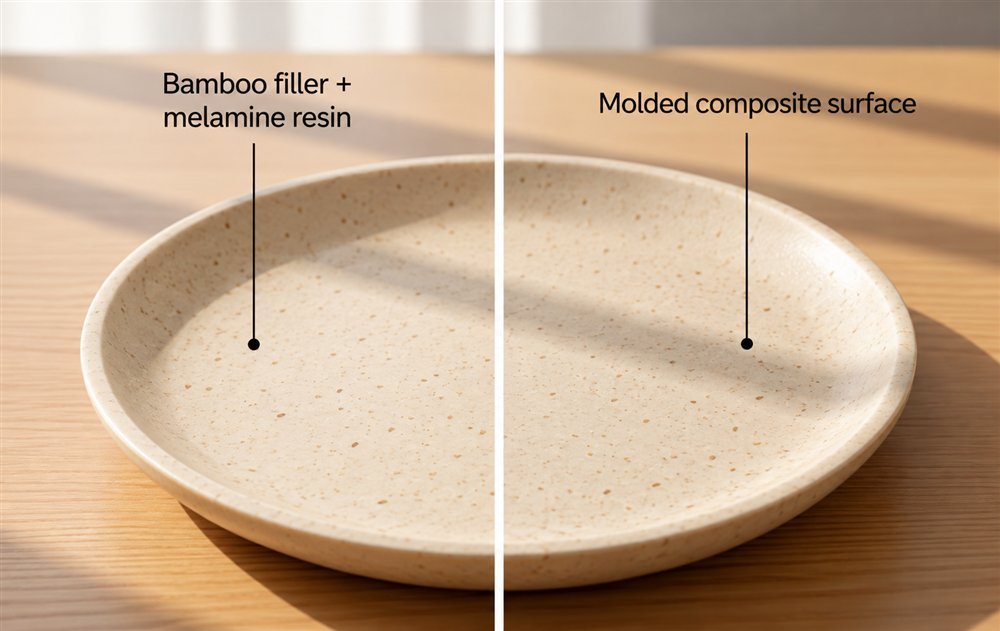
Two different constructions
Bamboo melamine: ground bamboo mixed into a plastic resin and molded into shape.
Solid bamboo: bamboo material shaped or assembled into an article. Check any coatings, adhesives, and food-use instructions separately.
What the material specification should tell you
Treating the resin as a harmless “glue” leaves out the finished product. Its formulation and processing matter, as do its intended conditions of use. A raw-material description alone cannot establish the suitability of a decorated, finished plate.
| Component | Role in the plate | Information to confirm | Material type |
|---|---|---|---|
| Bamboo powder or fiber | Filler mixed into the resin. | Identity, proportion, and suitability for the destination market. | Plant-derived filler |
| Melamine-formaldehyde resin | Binder that forms the molded structure. | Resin specification and evidence for the finished article. | Thermosetting plastic |
| Other fillers, if present | Part of the manufacturer’s formulation. | Full composition; do not assume a universal corn-starch content. | Depends on the recipe |
| Pigments and decoration | Color and printed design. | Whether the supplied color and print are covered by the documentation. | Additional constituents |
Can you identify it by its appearance?
A matte finish, small flecks, or a wood-look print may suggest a material, but none confirms its composition. Look for a material statement on the packaging or ask the seller for one. A photograph cannot show whether the plate contains a resin binder.
Are bamboo melamine plates safe?
There is no sound basis for a blanket “yes.” The question is not limited to visibly poor-quality products. Bamboo-filled melamine has raised concerns about the release of melamine and formaldehyde into food, and market restrictions apply even when the plate looks well made.
The German BfR’s tableware guidance reports higher and more frequent migration problems for bamboo-filled articles under hot-use conditions than for conventional melamine-formaldehyde articles. This does not tell you the exposure from a particular plate at home. It does explain why “good resin” alone is an inadequate answer.
For U.S. readers, the FDA’s melamine tableware guidance permits serving food on melamine-based tableware and advises against microwave heating. That guidance should not be presented as an FDA endorsement of every bamboo-filled formulation.
A seller’s “FDA tested” or “LFGB tested” claim needs the underlying report and its scope. It does not answer whether an ingredient is authorised in a particular market, whether the report covers the item being sold, or whether the tested conditions match your use.
Why are bamboo-plastic plates restricted in some markets?
Material authorisation and migration testing are separate checks. A passing test result does not make an unauthorised ingredient lawful. This distinction matters when the same catalogue is offered to customers in several countries.
| Market | Authority’s position | What this means for a buyer |
|---|---|---|
| European Union | Bamboo is not authorised as an additive in plastic food-contact materials under Regulation (EU) No 10/2011. | Do not order bamboo-filled plastic dinnerware for the EU market on the strength of a migration report alone. |
| Great Britain | The FSA and FSS advise businesses to stop selling bamboo-plastic food-contact products and consumers to stop using them for food. | Choose an alternative material and review the requirements for the finished product. |
| United States | FDA guidance addresses melamine tableware generally; it is not a product-specific clearance for bamboo composites. | Ask for the compliance basis for the exact composition and intended use, rather than relying on a generic “FDA” badge. |
Read the European Commission’s bamboo-plastic explanation and the FSA’s consumer and business advice for their respective scope. The restriction on bamboo used as a plastic filler is not a blanket ban on solid bamboo articles.
What increases melamine and formaldehyde migration?
Temperature, acidity, contact time, and repeated use affect migration. A plate’s ability to hold its shape is a different question from how much of a substance moves into food.
Microwave and oven heating
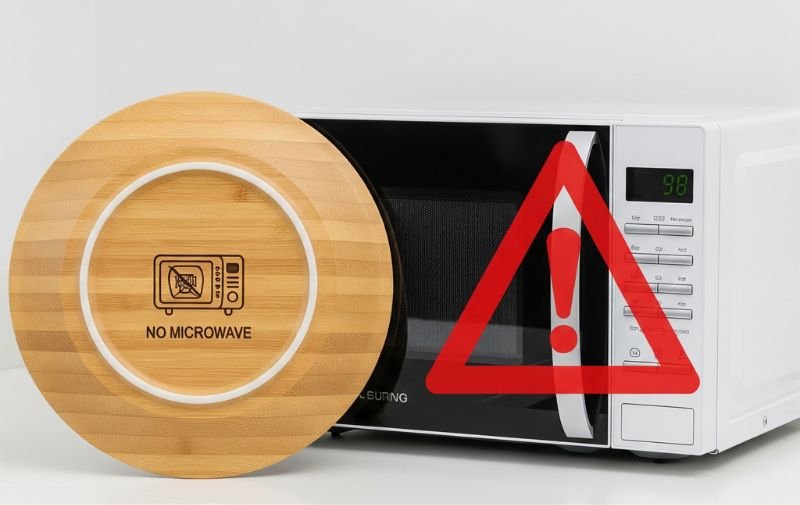
Do not use bamboo melamine plates to heat food in a microwave or oven. Use cookware explicitly intended for that appliance. The FDA’s advice against microwaving melamine-based dinnerware applies even if the plate has survived a previous heating cycle without visible damage.
Hot food, acidic food, and time
BfR advises against using melamine-formaldehyde resin utensils for hot food or hot drinks. Its explanation identifies hot, acidic conditions as a cause of resin degradation and increased substance release. A lukewarm snack and hot tomato soup held for a long time are different exposure conditions. That difference does not override a market’s advice to stop using bamboo-plastic products.
Repeated use and surface damage
Repeated hot contact can continue to affect the material; washing it once does not establish that future use is suitable. Remove cracked, chipped, or badly worn plates from food service. Inspecting wear is useful for everyday care, but an intact surface is not proof that migration limits are met.
Stains and smells are not a home safety test
A stubborn stain may be a reason to replace a plate, but it cannot tell you how much melamine or formaldehyde has migrated. The reverse is also true: a clean, odorless plate is not automatically suitable. Avoid home experiments with boiling water, vinegar, or microwaves to try to “test” or fix it.
What should you do if you already own these plates?
Start with the product identity. Keep a photo of the base, packaging, product name, and seller’s listing. Ask whether it is solid bamboo or a plastic composite, and which resin it contains. If the seller cannot answer, use another clearly identified food-contact item while you check.
The FSA advises consumers to stop using bamboo-plastic composites for storing or serving food. It suggests disposal in general waste or repurposing for non-food uses. Follow the advice of your local food-safety authority and any product recall; a dishwasher or cold-food label is not a substitute.
If you have already eaten from one, that fact alone does not establish that you suffered harm. The concern depends on exposure, including the conditions and duration of use. For a personal health concern, speak to a healthcare professional rather than trying to assess your exposure from the plate’s appearance.
For children’s dinnerware, be especially cautious about treating “bamboo” or “BPA-free” as a safety guarantee. Choose a clearly identified product suited to the child’s use and your market, and check its heating and care instructions before the first meal.
Bamboo melamine vs. other plate materials
Choose by the job the plate must do. Reheating leftovers, carrying restaurant meals, and serving a cold picnic lunch call for different checks. This comparison keeps bamboo composites separate from conventional melamine and from solid bamboo.
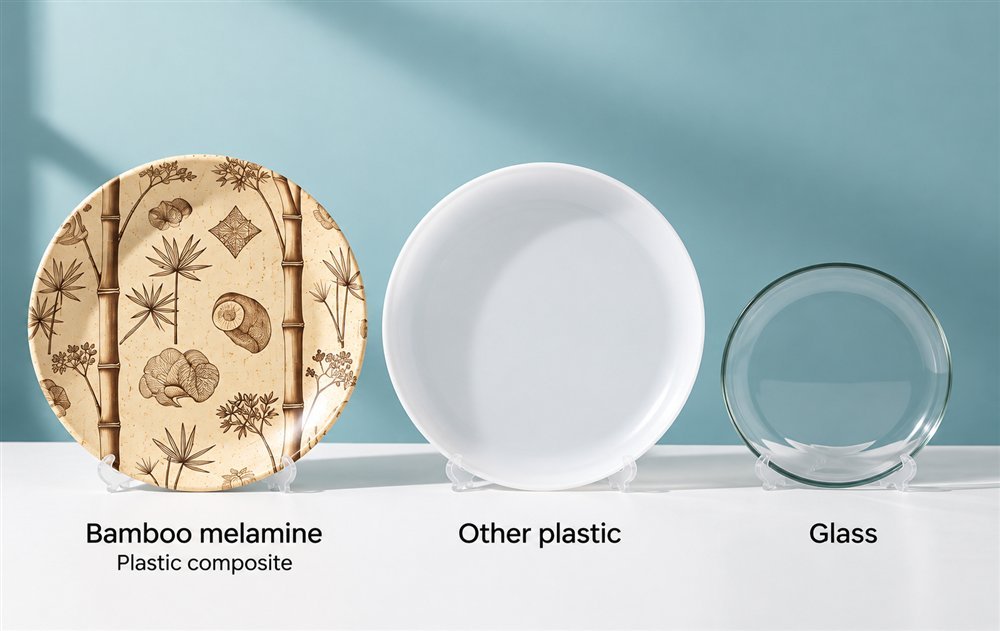
| Check | Bamboo melamine | Conventional melamine | Other plastic, such as PP | Ceramic or glass |
|---|---|---|---|---|
| Material | Bamboo filler in melamine-formaldehyde resin. | Melamine-formaldehyde molding material; confirm the full formulation. | Identify the polymer and the finished-product specification. | Check the article, glaze or decoration, and intended use. |
| Food-contact decision | Check restrictions first; a test badge does not settle authorisation. | Review applicable documentation and use limits. | Review documentation for the particular grade and article. | Review suitability for food contact, including decoration. |
| Microwave or oven | Do not use for heating. | Do not microwave; select separate heating cookware. | Use only as expressly specified for the appliance. | Do not assume all ceramic or glass is microwave- or oven-safe. |
| Service and handling | Light weight does not settle safety or legal status. | Evaluate a sample for weight, grip, stacking, and damage. | Check rigidity and repeated-use instructions. | Assess weight and breakage in your service routine. |
| Cleaning | A care label does not override withdrawal advice. | Confirm the model’s washing conditions. | Confirm dishwasher suitability and reuse limits. | Check the finish and dishwasher instructions. |
| End of life | Do not assume compostability or ordinary plastics recycling. | Do not place in recycling without local acceptance. | Local acceptance depends on material and item type. | Check local disposal; tableware differs from bottle glass. |
Where does solid bamboo fit? It is a separate option, rather than a safer grade of bamboo melamine. Ask about its construction and surface treatment. For a restaurant comparing plate sizes and handling, our restaurant plate guide covers the purchasing questions for conventional melamine products.
Are bamboo melamine plates biodegradable or recyclable?
Bamboo content does not establish that a finished resin-bound plate is biodegradable or compostable. The FSA warns against the environmental claims used for these composites and says they cannot be recycled through the usual route it describes. Follow local disposal instructions rather than putting them in a compost bin.
For a purchasing decision, ask what an environmental claim actually measures. Is a percentage the bamboo content by weight, the renewable content of a raw material, or a claim about the whole finished article? These are different statements. A supplier should be able to explain which one applies.
Likewise, a lower resin percentage does not by itself prove a lower overall environmental impact. Useful comparisons need a stated basis, including the expected service life and disposal route. Avoid printing “100% natural,” “plastic-free,” or “compostable” on packaging simply because the product name contains bamboo.
What should buyers check before ordering?
Start with the destination country and material authorisation before discussing colors, price, or minimum quantities. It is much easier to change a product specification before artwork and packaging are approved than after a shipment arrives.
Match the documents to the finished product
Request the full report, not just its cover or a laboratory logo. Use it alongside the specification and any applicable declaration of compliance. A practical review should establish:
- The manufacturer, tested sample, model, and material description match the proposed order.
- The report identifies the applicable requirements and destination market.
- The tested food simulants, contact times, and temperatures are relevant to the intended use.
- Repeated-use conditions are addressed where relevant, and the results and limits are visible.
- The supplied decoration and any later material changes remain within the documentation’s scope.
A report for a plain conventional A5 melamine plate should not be reused as proof for a bamboo-filled plate. Nor does a laboratory’s name establish which tests were run. If the scope is unclear, ask the issuing laboratory or a qualified compliance adviser to resolve the gap before committing to the order.
Read “BPA-free” as a limited claim
BPA and melamine are different substances. “BPA-free” does not mean melamine-free, formaldehyde-free, or approved for every food-contact application. Ask for the complete material name rather than making a purchasing decision from that one label.
Use sample inspection for the questions it can answer
| Check | What it can help you assess | What it cannot establish |
|---|---|---|
| Surface and print | Visible defects, finish consistency, and artwork placement. | Chemical migration or ingredient authorisation. |
| Weight and stacking | Handling, storage space, and fit with your service routine. | Whether the resin or filler is suitable for food contact. |
| Edges and damage | Rough rims, chips, cracks, and finishing defects. | That an undamaged plate passes laboratory requirements. |
| Odor | A reason to query or reject an unexpected smell. | That an odorless plate has acceptable migration results. |
For a quote, send the destination market, intended food and service conditions, required quantity, plate dimensions, and artwork. Keep the agreed material description in the purchase specification so it can be checked against the sample and shipment.
Do cleaning and care instructions make them safe?
No. Care instructions can help prevent misuse, but they do not resolve a material-authorisation problem. If the relevant authority advises against food use, switching to handwashing or cold food does not cancel that advice.
| Do | Do not |
|---|---|
| Identify the material and follow applicable local advice first. | Assume a “natural” or “food-grade” label settles the question. |
| Use cookware intended for your microwave or oven. | Heat food on bamboo melamine plates. |
| Check the exact product’s care instructions. | Assume every bamboo-composite plate is dishwasher-safe, even on the top rack. |
| Remove cracked, chipped, or badly worn items from food service. | Treat an intact surface or lack of odor as a migration test. |
| Follow the authority’s return, disposal, or non-food reuse advice. | Try to make a restricted product suitable by boiling, soaking, or sealing it yourself. |
Frequently asked questions
Is bamboo melamine the same as melamine-free bamboo?
No. Bamboo melamine contains a melamine-based binder. A product described as melamine-free needs its own material specification: it could be solid bamboo or a different composite. The absence of one resin does not identify everything else in the product.
Does an LFGB test report make it legal to sell in Europe?
A test report cannot override an ingredient restriction. Ask which finished article was tested and distinguish the results from the legal basis for placing that material on the market.
Can I use a U.S. supplier’s FDA report for an EU order?
Do not assume so. Requirements and report scope differ. Ask for documentation relevant to the destination, formulation, and intended use before approving the order.
Does a glass-and-fork symbol prove the plate is safe?
Do not use a symbol alone to settle the purchase. Check the material identification, supplier information, use limits, and applicable compliance documents. Keep the packaging until those details are clear.
What should I send a seller if the plate has no material label?
Send photographs of both sides, the product listing or order reference, and any packaging. Ask specifically whether bamboo is used as a filler in plastic and which binder is present. “Eco material” is not a complete answer.
What should you choose for your intended use?
Choose a clearly specified plate that is suitable for its market and intended conditions. For an existing bamboo melamine set, identify it and follow local authority advice. For a new order, settle the material and document requirements before selecting the decoration.
Duramela supplies conventional A5 melamine dinnerware for restaurant and wholesale projects. If you are comparing alternatives, share your destination country and how the plates will be used. We can discuss available models and the relevant product reports, including their scope, before you arrange a sample.
