
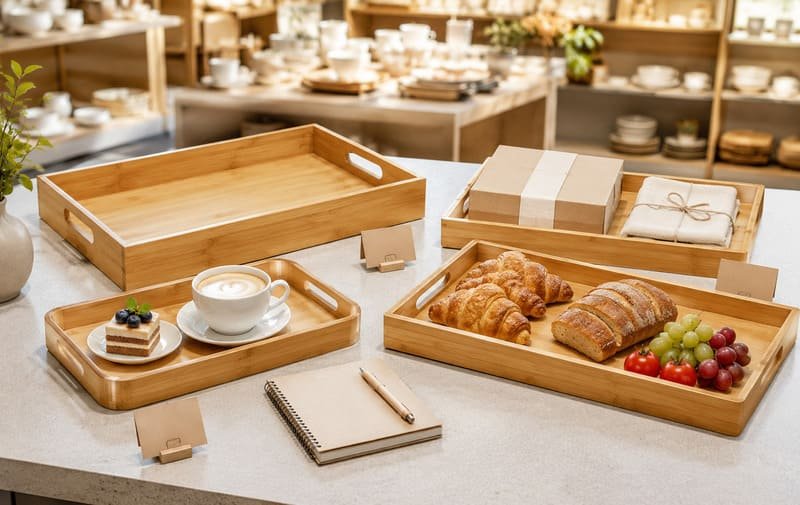
Buying bamboo trays sounds simple. Ask for size, get a price, place an order. Then samples arrive wrong, costs change, and delays start.
Before buying bamboo trays wholesale, I suggest buyers confirm the use case, material type, tray structure, surface finish, logo method, packaging, sample cost, shipping method, and target market requirements. Bamboo trays are not only a “size and price” product. Clear details help reduce sampling mistakes, quality complaints, and sourcing risk.
I often receive bamboo tray inquiries that look clear at first. The buyer sends one size and asks for the best price. Then I ask where the tray will be used, how it will be cleaned, whether it needs a logo, and whether it will touch food directly. The answer often changes the product direction.
This is why I always slow the conversation down before I talk about price. A lower price can look attractive on day one. But a wrong tray can become expensive after sampling, packing, shipping, and complaints.
If you are sourcing bamboo trays for restaurants, hotels, cafés, retail shelves, gift projects, or wholesale distribution, the right questions can protect your order before production starts.
Bamboo Tray Sourcing Questions at a Glance
Wholesale bamboo tray sourcing works better when buyers define the product before asking for the lowest unit price.
The most important questions are about use case, material, structure, finish, logo, packaging, sample approval, shipping method, and market requirements. If these details are unclear, different suppliers may quote different products, and the price comparison will not be fair.
| Question | Why It Matters |
|---|---|
| What will the tray be used for? | Determines structure, finish, packaging, and durability needs |
| Is it solid bamboo or bamboo fiber? | Affects production, compliance, price, and marketing claims |
| Is the tray a solid-board structure or joined side-wall structure? | Determines height, strength, and customization limits |
| Will it touch food directly? | Affects coating, testing, and food-contact documents |
| How will it be cleaned? | Affects finish choice and maintenance expectations |
| Do you need logo or full artwork? | Laser engraving is usually more realistic than color printing |
| How should it be packed? | Bulk packing and one-tray-one-box packing have very different costs |
| Do you need samples before mass production? | Helps confirm structure, finish, logo, and packing before bulk order |
| Do you need door delivery? | Important for hotels, restaurants, and cafés new to importing |
A good inquiry does not need to be long, but it should be specific. The clearer the product task, the faster a supplier can recommend the right structure and quote the right item.
Last Updated: June 5th, 2026 | Estimated Reading Time:10 minutes
By Lance, Marketing Director at Duramela
What Will the Bamboo Tray Be Used For?
Many buyers start with price. I understand that. But if the use case is unclear, the price is not very useful.
A bamboo tray quotation should start with the real use case. Restaurant service, hotel buffet use, café presentation, retail resale, gift packing, dry serving, and frequent cleaning may need different structures, finishes, packaging, and quality expectations.
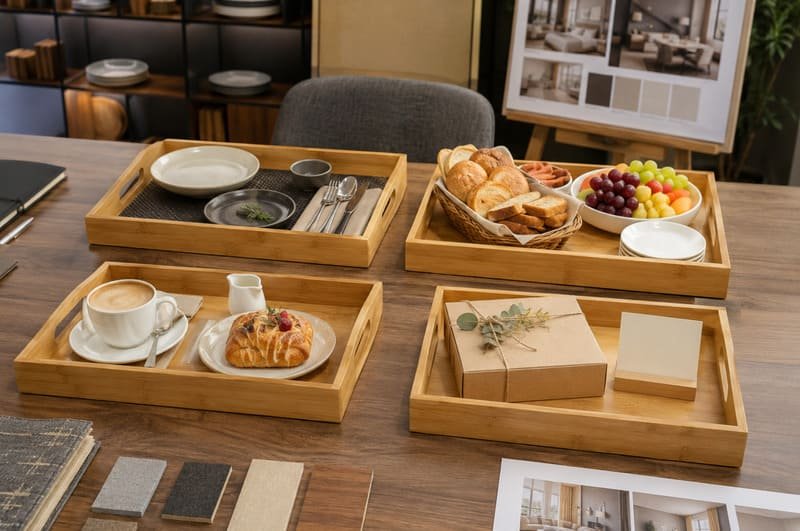
The first question I ask is simple:
“How will this tray be used?”
A bamboo tray for dry bread display is not the same as a tray used by waiters all day. A hotel buffet tray may need a stronger base and better surface protection. A retail tray may need cleaner appearance and nicer packaging. A gift tray may need a logo, an insert card, and a stronger printed box. A café tray may need a size that fits cups, plates, and counter space.
Here is a simple way to think about it:
| Use Case | Main Concern | Detail to Confirm |
|---|---|---|
| Restaurant service | Strength and cleaning | Tray weight, edge height, surface finish |
| Hotel buffet | Appearance and durability | Size, structure, stain resistance |
| Café presentation | Style and daily handling | Shape, color tone, logo method |
| Retail resale | Packaging and look | Individual box, barcode, carton protection |
| Gift project | Branding and presentation | Logo, sleeve, printed box, delivery date |
| Dry serving | Surface feel | Natural finish, food-contact position |
| Frequent cleaning | Finish performance | Water resistance, wipe-clean method |
I have seen buyers request the same tray for “food use” and “gift use” at the same time. These two needs may point to different choices. Foodservice buyers often care more about long-term use. Retail buyers often care more about shelf look and packaging.
A tray can serve both needs, but the specification must be built around that goal from the start.
Are You Buying Solid Bamboo Trays or Bamboo Fiber Trays?
Some buyers use “bamboo tray” as one broad name. That can create wrong expectations from the first email.
Solid bamboo trays and bamboo fiber trays are different product categories. Solid bamboo trays are made from bamboo material structures. Bamboo fiber trays are usually molded composite products with different production methods, performance, compliance concerns, and marketing limits. They should be quoted and discussed separately.
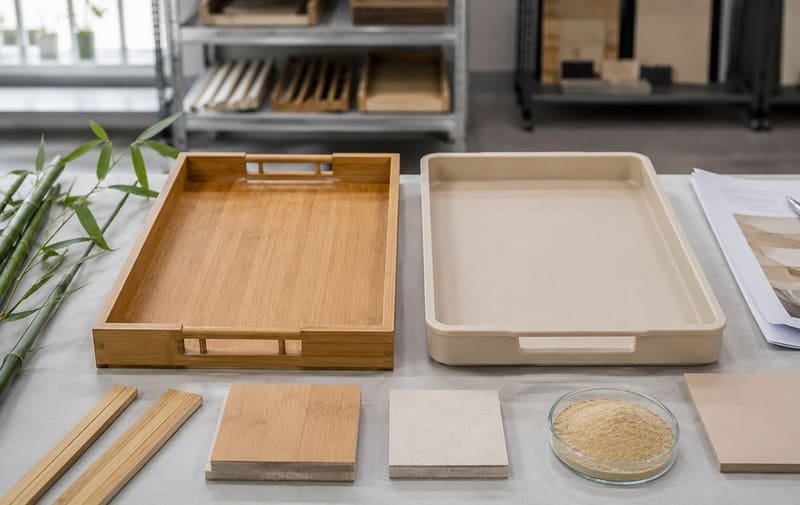
I always separate solid bamboo trays from bamboo fiber trays when I discuss wholesale projects. This is not a small wording issue. It affects mold needs, surface design, temperature use, structure, weight, cost, and claims that a buyer may use in the target market.
Solid bamboo trays often have a natural bamboo look. They can work well for serving, display, hospitality, and retail products that need a warm and natural style. Bamboo fiber trays are usually molded. They may allow more shape control in some cases, but they are not the same as solid bamboo.
If the product is a bamboo fiber or bamboo-melamine composite and will be sold as a food-contact product in the EU, buyers must be especially careful. The European Commission has taken action against plastic food contact materials containing bamboo additives, because these products can be misleadingly marketed and may create migration risks. Food Packaging Forum also explains that bamboo in plastic food contact materials is not authorized in the EU.
| Item | Solid Bamboo Tray | Bamboo Fiber Tray |
|---|---|---|
| Main look | Natural bamboo texture | Molded surface look |
| Production type | Cutting, joining, shaping, finishing | Compression molding |
| Shape freedom | Depends on structure | Depends on mold |
| Logo option | Laser engraving is common | Printing may be possible by project |
| Surface feel | Wood-like | More like molded tableware |
| Quotation basis | Size, structure, finish, packing | Mold, material, color, printing, packing |
| Common confusion | Buyers expect plastic-like printing | Buyers market it as pure bamboo too easily |
I do not suggest mixing these two products in one quotation request. If you ask ten suppliers for “bamboo trays,” some may quote solid bamboo. Some may quote bamboo fiber. Some may quote a low-cost item that does not match your usage. Then the price comparison becomes unfair.
A cheap price may only mean a different product.
Before asking for unit price, write the material type clearly. If you are not sure, send a reference photo and explain the target use. A practical supplier can then help identify the right category.
Which Tray Structure Fits Your Shape and Height?
A tray is not only length, width, and height. The way it is built affects what can be customized.
Bamboo tray structure affects cost, strength, and design freedom. A solid-board tray has height limits because its height is mostly controlled by board thickness. A joined side-wall tray can support more customized height, but it needs clearer drawings or reference photos.
When I review a bamboo tray inquiry, I do not approve quotation only from length, width, and height. I first check whether the buyer expects a solid-board tray or a joined side-wall tray, because these two structures are produced differently and cannot be priced the same way.
In production, I usually separate bamboo trays into two structure types.
1. Solid-Board Bamboo Tray
A solid-board tray is made mainly from a bamboo board structure. In this structure, the tray height is mostly limited by the board thickness and processing method. In many projects, the practical height is around 2 cm or slightly more, depending on the design.
This type is cleaner and simpler, but it is not suitable if the buyer expects high side walls.
2. Joined Side-Wall Bamboo Tray
A joined tray uses assembled bamboo panels. This structure gives more freedom for side height, raised walls, handles, and deeper tray shapes. It can support a more customized look, but it needs better control of joint quality, polishing, and surface finishing.
This is why a size such as “30 x 20 x 5 cm” is not enough by itself. I still need a reference photo or sketch to know which structure the buyer expects.
| Buyer Can Provide | Why It Helps |
|---|---|
| Exact size in millimeters | Reduces misunderstanding |
| Reference photo | Shows structure better than words |
| Simple sketch | Shows side height, handle, and edge style |
| Intended load | Helps judge strength needs |
| Target price range | Helps choose a realistic structure |
| Sample target date | Helps check if new development is practical |
I once received an inquiry for a “30 x 20 x 5 cm bamboo tray.” The buyer expected a deep tray with thick side walls and curved corners. Another supplier had quoted it as a flat shallow tray. The price gap looked strange.
The real issue was not price. The real issue was structure.
Photos and sketches help reduce this kind of mistake.
What Surface Finish Should You Choose?
Surface finish can look like a small detail. In real production, it changes cost, touch, appearance, maintenance, and use limits.
Bamboo tray surface finish should match the use case and target market. Clear lacquer, water-based coating, and food-grade wood wax oil can create different gloss, feel, cost, and suitability. Buyers should not assume every coating is food-grade just because the tray is made from bamboo.
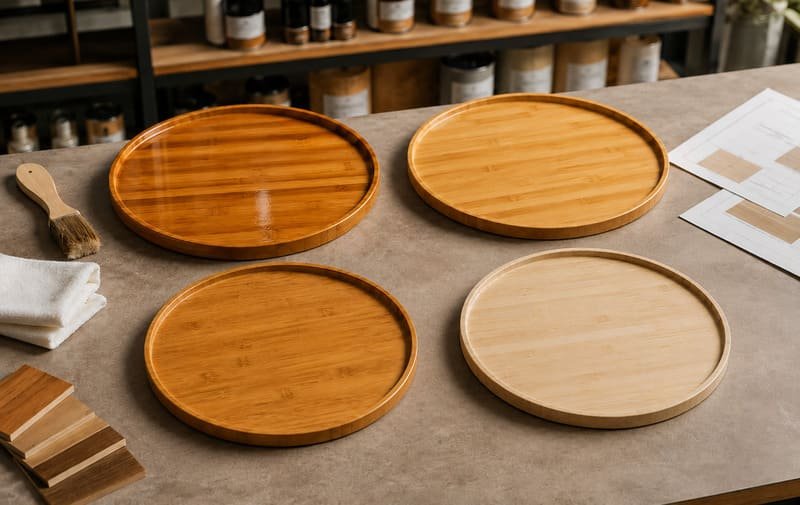
A bamboo tray surface is not only about looking shiny or natural. It affects how the tray feels in the hand. It affects whether the surface absorbs moisture. It affects cleaning expectations. It can also affect what a buyer may claim for food-contact use.
I am careful here because I am not a testing lab or legal authority. I can help provide product and document support based on the project. But the buyer should verify final requirements for the target market.
For cost-sensitive projects, some suppliers may quote a simple clear lacquer. It can make the tray look smooth and glossy, but buyers should not assume it is food-grade. For food-contact positioning, I usually discuss food-grade wood wax oil or water-based coating.
- Wood wax oil gives a more oily, natural hand feel.
- Water-based coating usually gives a cleaner gloss and smoother surface.
- Clear lacquer can be lower cost, but the food-contact suitability must be checked.
Guidance on wood and bamboo food contact materials also reminds manufacturers and buyers to consider oils, coatings, waxes, glues, and related materials when bamboo or wood products are used for food contact.
| Finish Option | Common Look | Possible Benefit | Point to Check |
|---|---|---|---|
| Clear lacquer | Glossy or semi-glossy | Lower cost, smooth look | Do not assume food-contact suitability |
| Water-based coating | Soft gloss or natural look | Cleaner surface positioning | Test and document needs |
| Wood wax oil | Natural, warm, slightly oily feel | More natural touch | Maintenance, cost, and test needs |
| Unfinished surface | Raw bamboo look | Simple and natural | Stain, water, and hygiene risk |
I usually ask how the tray will be cleaned:
- Will staff wipe it with a damp cloth?
- Will it be rinsed?
- Will it sit near wet food?
- Will it contact bread, fruit, coffee cups, or packaged items only?
- Will it be used in a restaurant or sold as a retail item?
These details matter. A surface that works for dry retail display may not work for heavy restaurant cleaning. It is better to discuss finish early than to change it after sampling.
Which Logo or Artwork Method Is Realistic?
Many buyers want custom branding. That is normal. But bamboo is not paper, plastic, or melamine.
Laser engraving is usually the most practical logo method for solid bamboo trays. It works well for logos, text, and simple patterns. I do not normally recommend screen printing or full-color surface artwork on solid bamboo trays unless the buyer is ready to test it carefully.
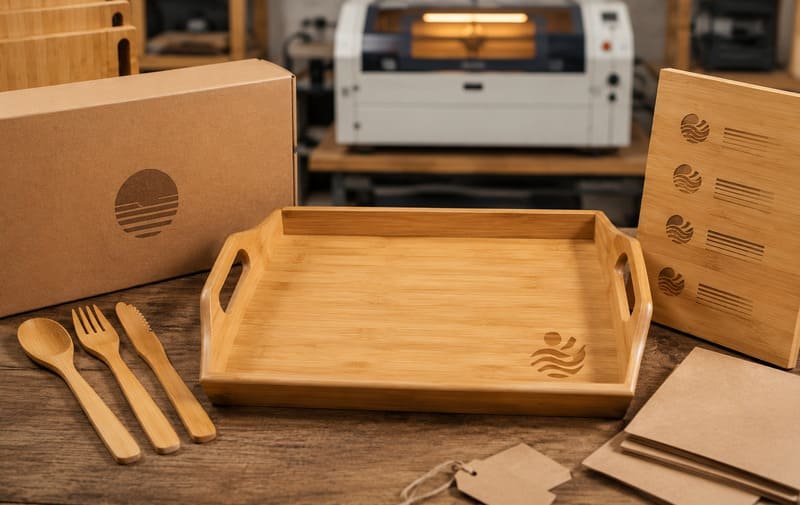
For solid bamboo trays, I often recommend laser engraving first. It is stable, clean, and suitable for many restaurant, hotel, gift, and retail projects. It can show a logo, brand name, simple line art, or short text. It also fits the natural character of bamboo.
The result is usually more tasteful than forcing a bright printed design onto a natural surface.
Solid bamboo has grain. Bamboo color may vary slightly. Laser color may also vary because natural material reacts differently. Very thin lines may not appear clearly. Very large engraved areas may look darker and may increase cost or production time.
For this reason, I do not normally recommend screen printing or full-color surface artwork on solid bamboo trays. Bamboo grain, coating, and surface absorption can make printing unstable and less durable. If the buyer needs colorful branding, printed packaging is often a better solution.
| Branding Method | Best For | Risk or Limit |
|---|---|---|
| Laser engraving | Logos, names, simple icons | Color is usually natural burn tone |
| Hot stamping | Some simple marks | Not suitable for every surface |
| Screen printing | Simple color logos only after testing | Not normally recommended for solid bamboo trays |
| Sticker label | Retail or gift packaging | Not permanent on product |
| Printed packaging | Strong brand look | Box MOQ and printing cost must be confirmed |
If a buyer wants a colorful full-surface pattern, I ask whether the pattern is required on the tray surface or only on the packaging. Many times, printed packaging gives a better result for retail branding and avoids the risk of poor printing on bamboo surface.
For restaurant and hotel buyers, a small laser logo is often enough. It shows the brand without making the tray look busy.
What Packaging Details Should Be Confirmed Early?
Packaging is often discussed too late. That can create cost changes and shipment problems near the end.
Bamboo tray packaging should be confirmed before sampling or mass production. Buyers should decide bulk packing, one-tray-one-box packing, printed boxes, logo packaging, inserts, barcode needs, and export carton protection early to avoid delays and surprise costs.
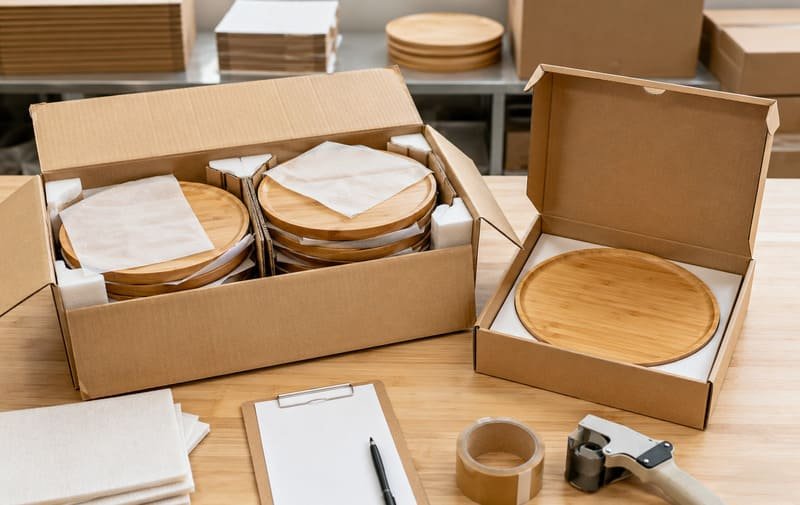
I always ask about packaging early because it affects both price and production planning. A tray for restaurant internal use may only need safe bulk packing. A retail tray may need an individual box, label, barcode, product photo, and instruction card. A gift tray may need a printed box with a nice opening experience.
These are not the same supply chain tasks.
For hotel and restaurant internal use, bulk packing is often enough if the carton protection is safe. For retail, e-commerce, or gift projects, the buyer may need one bamboo tray in one individual box. These two packing methods have very different costs, carton sizes, packing labor, and shipment volume.
Small-volume orders can also face limits from packaging suppliers. Custom printed boxes often have their own MOQ. If the tray order is small, the box cost may become high. A buyer may think the tray price is expensive, but the hidden cost may come from custom packaging.
| Packaging Type | Good For | Cost Level | Detail to Confirm |
|---|---|---|---|
| Bulk packing | Restaurants, hotels, wholesale | Lower | Quantity per carton, inner protection |
| Individual polybag or paper wrap | Basic resale | Low to medium | Material choice, label needs |
| One tray in one box | Retail, e-commerce, gift projects | Medium to higher | Box size, barcode, printing |
| Printed gift box | Gift and brand projects | Higher | MOQ, artwork, color proof |
| Master carton protection | Export shipping | Required | Drop risk, stacking, carton strength |
International shipping can be rough. Cartons may be stacked, moved, and handled many times. Bamboo trays can still get corner damage if packing is weak.
I suggest buyers confirm:
- carton thickness;
- inner dividers;
- corner protection;
- packing quantity;
- carton size and weight;
- e-commerce repacking needs if applicable.
Packaging is not only a cost. It is part of the product experience.
Should Small Hotel or Restaurant Buyers Ask for Door Delivery?
Many hotels, restaurants, cafés, and bars want only a few hundred bamboo trays. They may not have experience importing directly from China.
For hotels, restaurants, cafés, and bars buying a few hundred bamboo trays, door delivery can be more practical than arranging import by themselves. Buyers should ask whether the supplier can quote DDP or door-to-door delivery, including freight, customs, duties, and local delivery where available.
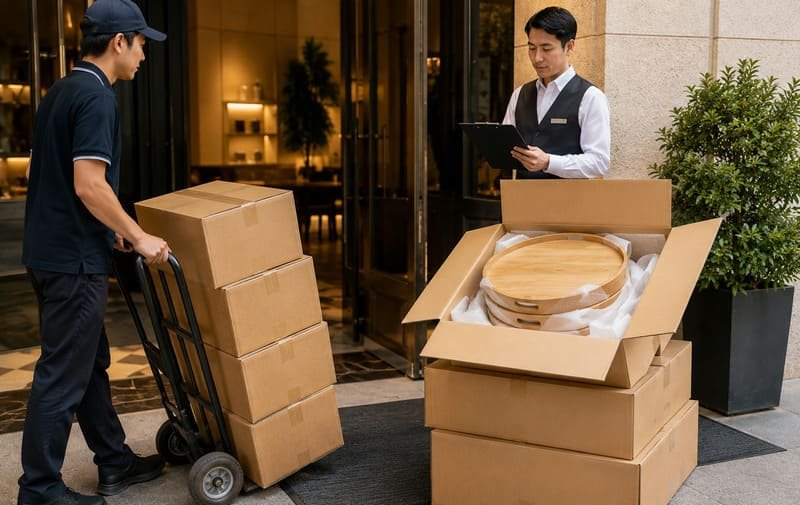
I often meet hotel or café buyers who want 200, 300, or 500 trays for one project. They may not have an import department. They may not know how to handle customs clearance, duties, port charges, or local trucking.
In this case, EXW or FOB pricing may not help them understand the real landed cost. I usually ask whether they need delivery to their door.
DDP is not always the cheapest option, but it can make the first order easier because the buyer sees the full cost more clearly. Buyers should still ask what is included and what is not included. The International Chamber of Commerce explains Incoterms and delivery terms, which can help buyers understand why EXW, FOB, CIF, DAP, and DDP are not the same.
| Shipping Term or Method | Best For | Buyer Should Confirm |
|---|---|---|
| EXW | Experienced importers | Buyer handles most export/import steps |
| FOB | Buyers with forwarders | Port, freight, duties, local delivery |
| CIF | Sea freight to destination port | Port charges and customs still matter |
| DAP / door delivery | Buyers needing simpler delivery | Duties/taxes may not be included |
| DDP door delivery | Small hotels, restaurants, cafés new to import | Whether freight, duties, customs, and final delivery are included |
For small B2B buyers, the best quote is not always the lowest product price. It is the quote that makes the real delivered cost clear.
What Compliance and Market Requirements Should You Verify?
A supplier can help with documents. But the buyer should still check the rules in the target market.
Before ordering bamboo trays wholesale, buyers should verify target-market requirements for food contact, coatings, wood or bamboo import, labeling, environmental claims, and retail channel rules. A manufacturer can support documents, but buyers should not assume every bamboo tray is automatically compliant everywhere.

I like to be careful when discussing compliance. I can explain what documents may be available or what tests may be arranged for a project. But I do not act as a legal adviser.
Different countries can have different rules. Different sales channels can also have different document needs. A restaurant buyer may care about safe food-contact use. A retail buyer may need labels and packaging marks. An e-commerce platform may ask for specific test reports. An eco-focused brand may need to verify what claims are allowed.
Bamboo trays also need clear positioning:
- Is the tray for direct food contact?
- Is it for packaged food only?
- Is it for dry food display?
- Is it a decorative serving tray?
- Is it a retail product with packaging claims?
These uses may call for different checks. The surface finish also matters because the coating may be part of the food-contact discussion.
For food-contact questions, buyers can review general food-contact substance evaluation principles from the FDA. For Europe, buyers should check EU food contact material requirements. If the brand wants to make “eco,” “natural,” “green,” or similar claims in the U.S., the FTC’s guidance on environmental marketing claims is also useful.
| Requirement Area | Buyer Should Ask |
|---|---|
| Food contact | What tests or documents are needed in my market? |
| Coating | Is the finish suitable for the intended use? |
| Labeling | What product labels or packaging marks are required? |
| Wood/bamboo import | Are there special import rules for bamboo items? |
| Environmental claims | Can I legally use “eco,” “natural,” or similar claims? |
| Retail channel | Does my customer or platform require extra reports? |
I suggest buyers talk to their importer, local consultant, retailer, or testing agency if the order is for a regulated market. This does not slow the project down. It helps reduce problems later.
It is also better to confirm document needs before sampling, because material and finish decisions may change after compliance review.
If you are sourcing a full bamboo serving collection rather than trays only, it may also make sense to review matching bamboo dinnerware so the material, finish, packaging, and market documents stay consistent across the line.
Practical Buyer Questions Before Ordering Bamboo Trays Wholesale
Many problems come from small questions that were never asked. I prefer to clear them before sampling.
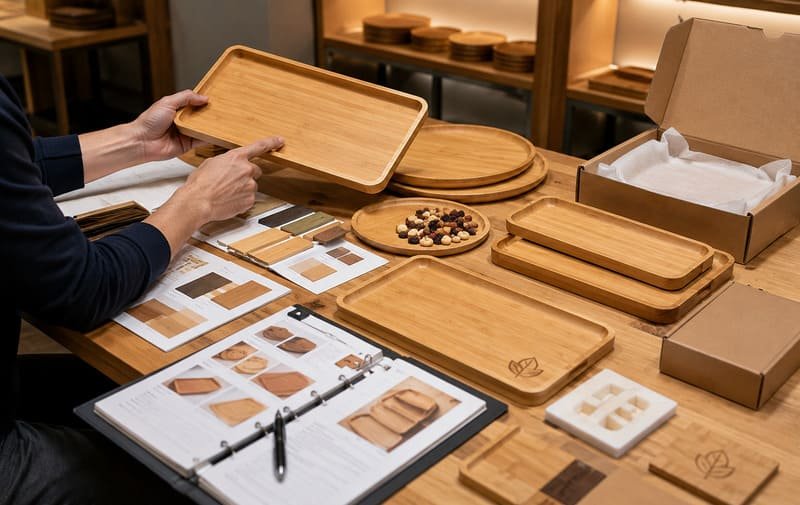
Buyers should ask practical questions about MOQ, sampling, sample cost, lead time, logo approval, cleaning limits, packaging, shipping, door delivery, and document support before ordering bamboo trays wholesale. These questions help both sides set realistic expectations.
Can I get a low MOQ for bamboo trays?
Sometimes yes. It depends on size, structure, finish, logo, and packaging.
A simple existing style may support a smaller trial order. A custom shape, special finish, joined side-wall structure, or printed box may need a higher quantity because material setup and packaging supplier MOQ are involved.
Is bamboo tray sampling necessary?
I strongly suggest sampling for custom projects.
A photo can show shape. It cannot fully show hand feel, weight, surface gloss, edge finish, structure, packaging, or laser logo effect. Sampling helps reduce risk before mass production.
How much does a bamboo tray sample usually cost?
For many custom bamboo tray projects, a sample cost around USD 118 or EUR 102 is common in our communication, including courier delivery for buyer confirmation.
The exact cost depends on tray size, structure, finish, logo, and destination. If the project needs a new structure, special packaging, unusual surface treatment, or complicated sample work, the sample cost may be different.
Can bamboo trays go into a dishwasher?
I would not assume that.
Many solid bamboo trays are better cleaned by hand or wiped with a damp cloth. Frequent soaking, high heat, and strong detergent may damage the surface or structure. Buyers should state the cleaning method early.
Can I print full-color artwork on solid bamboo trays?
It may not be practical for many projects.
Laser engraving is often more stable. If colorful branding is important, printed packaging may be a better choice. If printing on the tray is required, it needs testing before order confirmation.
Why is a reference photo needed if I already gave the size?
Because bamboo tray size does not explain structure.
A solid-board tray and a joined side-wall tray can have the same length and width but completely different height, cost, production process, and strength. A photo or sketch helps avoid wrong sampling.
Can I pack one bamboo tray in one box?
Yes, but it changes cost and shipping volume.
Bulk packing is common for restaurant and hotel internal use. One tray in one individual box is more common for retail, e-commerce, and gift projects. Buyers should confirm this early because packaging can affect quotation, carton size, and shipping cost.
Can a hotel or restaurant buyer get door delivery?
Yes, in many cases buyers can ask for DDP or door-to-door delivery.
This is useful for hotels, restaurants, cafés, and bars buying a few hundred trays and not familiar with importing. DDP is not always the cheapest option, but it can make the total landed cost clearer because freight, customs, duties, and local delivery may be included.
Is solid bamboo always the best eco choice?
I avoid broad claims.
Solid bamboo can be a good natural material option for many buyers. But environmental claims depend on material source, finish, packaging, transport, and target market rules. Buyers should verify claims before using them in marketing.
What should I send to get an accurate quote?
I suggest sending size, quantity, reference photo, structure notes, logo file, finish preference, packaging method, target market, and expected use.
If the tray will touch food directly, say so clearly. If it is for retail, also mention barcode, box, and label needs.
These questions may look basic, but they save time. They also help prevent one common problem: the buyer compares prices from different suppliers without comparing the same product.
A quote is useful only when the specification is clear.
What Should You Prepare Before Asking for a Bamboo Tray Quote?
A good quote starts with a good request. I always prefer clear details over long messages.
Before asking for a bamboo tray quote, prepare the intended use, cleaning method, size, quantity, reference photo, material type, structure, logo method, finish preference, packaging plan, shipping method, and target-market document needs. This helps suppliers quote the right product instead of guessing.
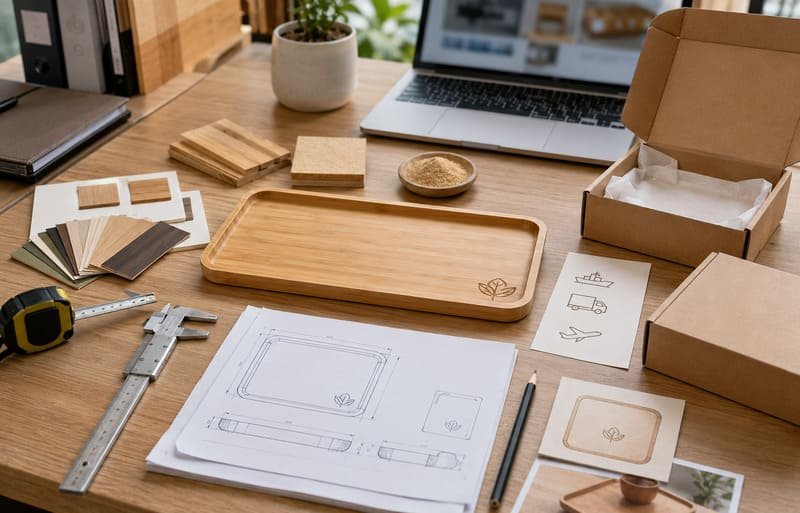
Here is the checklist I suggest buyers prepare before sending an inquiry:
| Quote Detail | What to Prepare |
|---|---|
| Intended use | Restaurant, hotel, café, retail, gift, dry serving, buffet, or resale |
| Cleaning method | Wipe only, light rinse, frequent cleaning, or other method |
| Size and quantity | Length, width, height, order quantity, and number of designs |
| Reference photo or sketch | Front view, side view, handle detail, edge style |
| Material type | Solid bamboo tray or bamboo fiber tray |
| Structure expectation | Solid-board, raised edge, joined side wall, handle, deep tray |
| Logo or artwork | Laser engraving file, logo size, position, or packaging branding |
| Surface finish | Natural look, clear lacquer, water-based coating, wood wax oil |
| Packaging method | Bulk packing, one tray one box, printed box, gift box, barcode |
| Shipping method | EXW, FOB, DAP, DDP, or door delivery request |
| Target market needs | Food-contact, labeling, environmental, import, or retail documents to verify |
I also suggest buyers state what matters most. Some buyers care most about price. Some care most about natural appearance. Some care most about food-contact positioning. Some care most about retail packaging. A supplier can make better suggestions when the priority is clear.
If you are not sure about the tray structure, send a photo of the style you like. If you do not know the finish, explain the use case. If you are not sure whether laser engraving is acceptable, send the logo and ask for a sample effect. If you need documents, explain the country or sales channel.
These small details help reduce guessing. They also make supplier communication faster and more practical.
For buyers ready to compare existing designs, a standard bamboo Tray product range can be a useful starting point before developing a fully custom structure.
Conclusion
Buying bamboo trays wholesale becomes easier when you define use, structure, finish, logo, packaging, shipping, and market needs before asking for price.
A bamboo tray is not only a rectangle with a size. It may be a restaurant service item, a hotel buffet piece, a café presentation tray, a retail product, or a gift item. Each use case changes the structure, finish, logo method, packaging, and documents.
My practical advice is simple:
Do not ask only for the cheapest bamboo tray price. Ask whether the tray structure, finish, logo, packaging, sample, shipping method, and target-market documents match your real project. That is how you avoid wrong samples, surprise costs, and production delays.
