
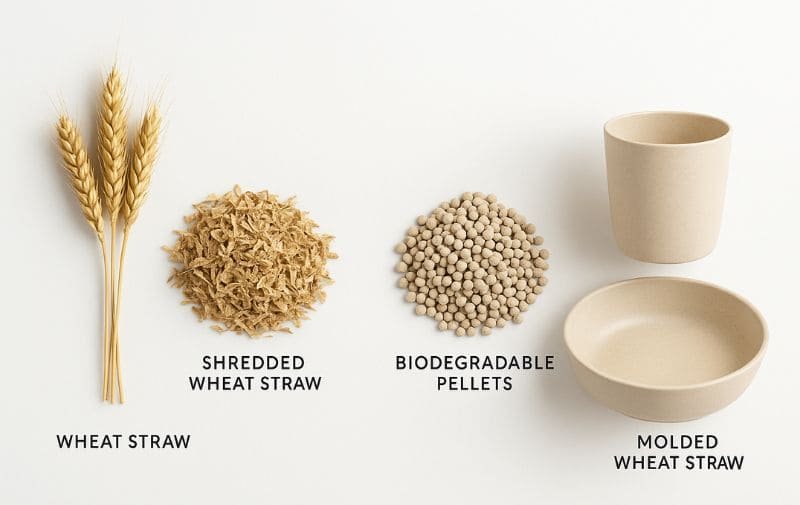
Reusable wheat straw dinnerware often combines wheat straw fibers with a plastic binder such as polypropylene (PP). It can look natural and feel lightweight, but the name does not mean the finished plate is plastic-free, compostable, or suitable for microwave heating.
The useful questions are simple: what holds the fibers together, what use has the finished product been tested for, and what happens to it when you no longer need it? Those answers matter more than its beige color or a leaf symbol on the packaging.
This guide focuses on reusable plates, bowls, and cups. Disposable molded-fiber tableware is a different category and should not be assumed to have the same care instructions or disposal route.
What is wheat straw dinnerware made of?
Wheat straw is the stalk left after grain harvesting. In reusable composite dinnerware, processed fibers act as a filler within a polymer. The binder holds the article together; the fiber content, additives, design, and manufacturing process also affect its properties.
Many reusable products use PP, but “wheat straw” is not a standardized recipe. Other resin systems exist. A 2024 tableware migration study examined melamine-related products, including items labeled wheat straw. Its findings should not be treated as a test of every wheat straw and PP product on the market.
Read the composition, not just the product name
| Component | Why it is there | What to confirm |
|---|---|---|
| Wheat straw fiber | Provides the plant-derived part of the composite and can affect texture and stiffness. | The actual percentage by weight, rather than a percentage copied from another product. |
| Polymer binder | Forms the matrix around the fibers. PP, PLA, and melamine-based formulations are different materials. | The resin name and the finished article’s intended uses. |
| Colorants and other additives | Help produce the selected color and processing characteristics. | Whether the documentation covers the formulation and color being purchased. |
A label that says only “natural wheat straw” leaves an important question unanswered. Ask for the full material description. A higher fiber percentage is not, by itself, proof of better durability, greater safety, or a lower overall environmental impact.
If the item contains PP or another plastic binder, it contains plastic. “BPA-free,” “plant-based,” and “plastic-free” describe different things and should not be used interchangeably.
Why does it have a speckled look and lightweight feel?
Visible fibers can give these products a speckled, matte appearance. Colors, surface finish, weight, and flexibility vary with the formulation and mold. You cannot identify the binder or confirm food safety by looking at a plate.
For a set you will use every day, look beyond the photograph. Check the rim against your grip, the depth against your usual portions, and the base against the table. A plate that looks large can have a relatively small eating area inside a wide rim.
For buyers building a matching range, compare actual samples of the plate, bowl, and cup together. Slight differences in shade or texture are much easier to notice side by side than in separate product photographs.
How is wheat straw dinnerware made?
For thermoplastic composites such as wheat straw and PP, production generally involves preparing the fiber, blending it with resin, and molding the blend. The exact process depends on the material system.
- The straw is cleaned, dried, and reduced to a suitable fiber or particle size.
- The prepared fiber is blended with the selected polymer and other formulation ingredients.
- The compound is molded into the plate, bowl, or cup. Thermoplastic blends can be injection molded; other resin systems use different processes.
- The finished articles are checked against the agreed specification, including dimensions, appearance, and intended food-contact use.
This is different from turning plant pulp into a disposable molded-fiber plate. Similar product names can hide different construction methods, coatings, service lives, and disposal requirements.
Is wheat straw dinnerware safe to use?
The material name alone cannot establish safety. Look for a finished product intended for food contact, with traceable material information and instructions that match how you plan to use it. Temperature, food type, and contact time matter.
The FDA explains that its evaluation of food-contact substances considers migration and exposure under the intended conditions of use. A raw material description or a generic “FDA tested” logo does not tell a buyer which finished article was tested or under what conditions.
What does BPA-free tell you?
It addresses a specific substance claim. It does not establish that the product contains no plastic, produces no migration, or can be used at any temperature. Ask for documentation relevant to the complete formulation instead of treating one label as a complete safety assessment.
What about children and hot food?
For children’s dinnerware, choose products intended for the child’s age and use, and follow the care instructions. Low weight and resistance to breakage can be practical features, but they do not replace a food-contact assessment. Do not use an unspecified serving temperature or a generic online microwave time as a product instruction.
For hot soup, acidic sauces, or extended food storage, check that the stated use conditions cover that application. If the supplier cannot explain them, choose a product with clearer documentation.
Check the destination market when importing
Requirements differ by market. The European Commission’s plant-filled plastics guidance explains the issue with unauthorized plant additives in plastic food-contact materials. An importer should verify the authorization of the actual formulation as well as relevant testing. A report for ordinary melamine, or for a different fiber blend, does not automatically cover a wheat straw composite.
Can it go in the microwave or dishwasher?
Only use the finished product in a microwave or dishwasher when its instructions explicitly allow that use. The presence of PP is not enough to decide. Follow any limits on time, power, temperature, loading, and drying.
| Use | What to check | If the information is missing |
|---|---|---|
| Microwave reheating | An explicit microwave-use instruction for the exact article, including any limits. | Transfer the food to a container labeled for microwave use. |
| Dishwashing | Permitted wash and drying conditions. Household and commercial cycles may differ. | Ask the supplier; do not assume a home-dishwasher claim covers restaurant equipment. |
| Hot or acidic food | Permitted food types, temperature, and contact duration. | Choose tableware with documented suitability for the intended meal. |
| Oven or direct heat | Express authorization for that exact use. | Keep the article away from ovens, stovetops, flames, and grills. |
The FDA’s tableware heating advice says plastic tableware without a microwave-safe designation should not be used to heat food. It also advises against heating food on melamine-based dinnerware in a microwave.
Does it break, scratch, or stain?
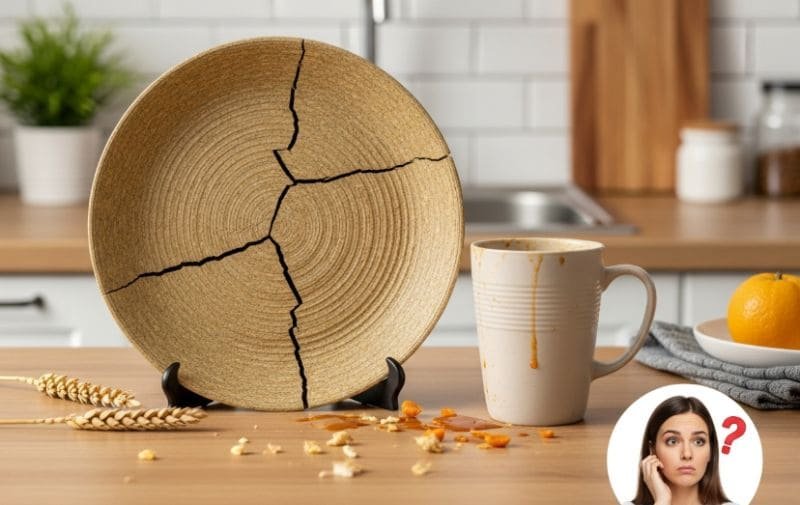
Lightweight composite tableware can be convenient where drops are likely, but “unbreakable” is too broad a promise. Thickness, rim design, material, wear, and the surface it lands on all affect the outcome. Do not assign a universal lifespan to the whole category.
Evaluate staining and surface wear with the foods and utensils you normally use. Tomato sauce, curry, coffee, and repeated knife contact are useful things to include in a practical sample review. This is an appearance and usability check, not a substitute for laboratory food-contact testing.
How should you clean and store it?
Wash before first use and after meals, following the product’s instructions. Use a soft sponge and an appropriate detergent; avoid abrasive pads or improvised chemical treatments unless the manufacturer permits them. Let pieces dry before stacking.
Remove plates with cracks, sharp damage, peeling surfaces, or significant wear from food service. If an odor persists after normal cleaning, stop using the item and ask the supplier about it. Neither smell nor a home cleaning test can prove chemical safety.
Is wheat straw dinnerware really eco-friendly?
Using agricultural fiber can replace some polymer in a formulation. That is a narrower claim than saying a finished plate is better for the environment overall. Its impact also depends on production, transport, how often it is reused, washing, and disposal.
For an environmental comparison, ask what is being compared: two plates of equal function, a reusable set versus disposables, or different material recipes? A fiber percentage alone does not answer all of those questions.
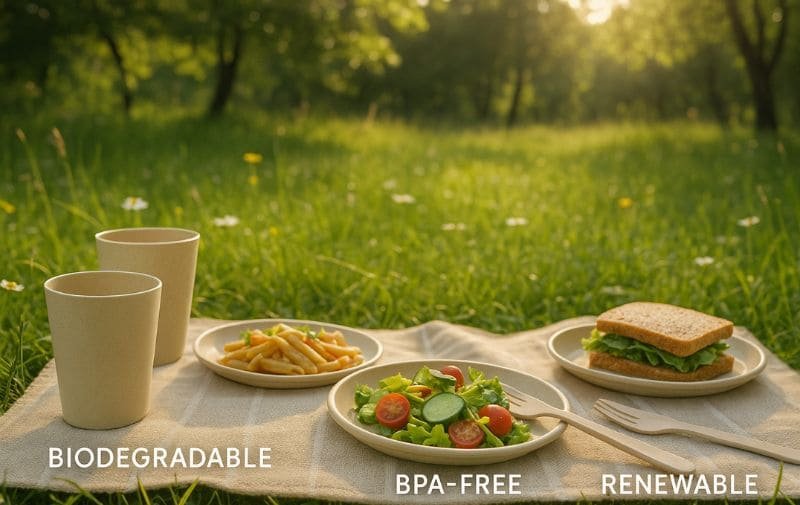
Biodegradable, compostable, and recyclable are different claims
A PP-based wheat straw composite is not made compostable by adding plant fiber. A product containing PLA also needs evidence for the finished article and specified composting conditions. The resin name is not a compostability certificate.
The FTC’s environmental claims guidance requires reliable support for compostability claims covering the entire product. Claims also need appropriate qualifications about disposal conditions and access to facilities.
| Claim | What to ask for | What it does not prove |
|---|---|---|
| Contains wheat straw | Documented fiber content and the full formulation. | That the article is plastic-free or suitable for compost. |
| Commercially compostable | Evidence covering the complete article and a facility that accepts it. | That it will decompose in a home compost pile or ordinary litter. |
| Recyclable | Confirmation that the local collection and processing system accepts this composite article. | That a resin identification symbol guarantees local acceptance. |
| Reusable | Care instructions and performance suitable for repeated use. | A guaranteed service life or a quantified carbon saving. |
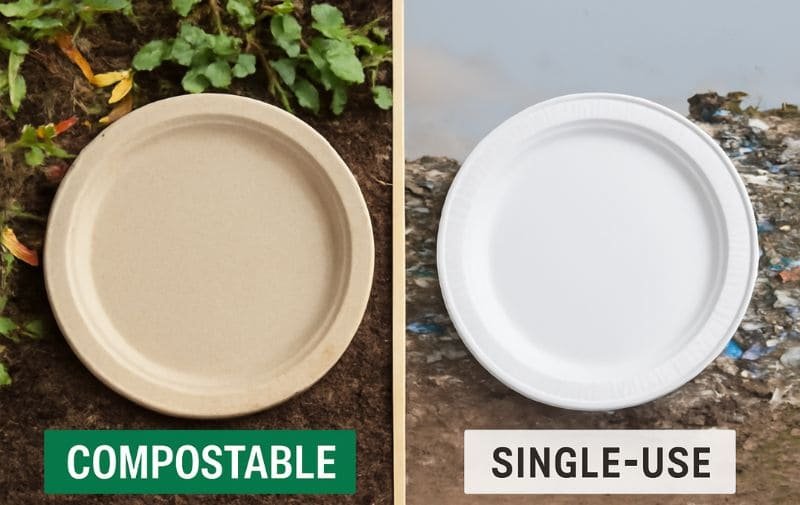
At the end of its useful life, follow the local waste authority’s instructions for that material. Do not put an unverified composite into food-waste collection or home compost simply because it contains straw.
Wheat straw vs. plastic, melamine, and ceramic dinnerware
Wheat straw and PP dinnerware is itself a plastic composite. A useful comparison therefore names the other material and the job it needs to do. There is no single winner for reheating, outdoor handling, restaurant presentation, and disposal.
| Material | Why consider it? | What needs checking? |
|---|---|---|
| Wheat straw and PP composite | Lightweight sets and a speckled appearance for everyday or outdoor dining. | Actual formulation, heating and washing instructions, surface wear, and disposal options. |
| PP tableware | Lightweight reusable formats without an added plant-fiber component. | Microwave permission for the finished article, rigidity, staining, and cleaning conditions. |
| Melamine tableware | Rigid serving pieces, varied shapes, and decorative printing for table service. | No microwave reheating. Match food-contact reports and care instructions to the selected product. |
| Ceramic or glass | A heavier table setting and options specifically designed for reheating. | Microwave or oven labeling, decoration, breakage, and thermal-shock limitations. |
| Disposable molded fiber | Single-service applications where collection and disposal have been planned. | Coatings, food suitability, and evidence for any compostability claim. |
If the choice is mainly for restaurant service, our melamine and plastic plate comparison discusses those materials in more detail. Keep microwave requirements separate from serving requirements when choosing a range.
When is wheat straw dinnerware a practical choice?
It can be worth considering when you want a lightweight reusable set and the particular product’s instructions fit your routine. It is a poor match if your main requirement is guaranteed plastic-free construction and the material specification lists a plastic binder.
For home use, check everyday portions, cupboard space, and cleaning instructions. For camping or picnics, look at stackability and weight, and keep tableware away from cooking flames. For children, evaluate the actual grip, rim, and stability as well as the intended age and use.
For a restaurant, a household product listing is not enough. Review samples with the people who wash, carry, and store your plates. Check the actual dishwasher cycle and whether the supplier can keep the same model available for replacements.

Compare the cost of a usable set
A low price per piece can hide a different size, weight, pack quantity, or printing specification. Compare equivalent items and include packaging, freight, and any testing or artwork setup required for the order.
For a reusable service, replacement availability and performance in your own washing routine also matter. A small sample review can reveal awkward stacking or an unsuitable eating area before you commit to a full order. It cannot establish a lifetime cost without real replacement and usage data.
What should you ask before buying in bulk?
Send suppliers the same brief so you can compare like for like. Include the product type, dimensions, quantity, design, destination country, and intended use. Ask them to identify any assumption in their quote.
- What is the complete material? Request the resin type, fiber content, and a specification tied to the model being quoted.
- Which food-contact documents cover this item? Check the sample description or photo, material, report date, test conditions, and results. Ask whether the color and printed version are covered.
- What uses are allowed? Obtain written guidance for hot food, reheating, washing, drying, and repeated use.
- What supports the environmental claim? Ask for evidence for the whole product and its intended disposal route, not just the resin supplier’s brochure.
- What can be checked on a sample? Agree on the model, color, print, sample cost, and the features to review before bulk approval.
- How is the minimum order calculated? Clarify quantities per size, model, color, and print. Do not assume an MOQ for another material applies.
- What is included in the delivered cost? Confirm packing, carton quantities, freight terms, timing, and arrangements for repeat orders.
A useful sample check: measure the usable area inside the rim, weigh a piece, stack several together, and run the permitted washing routine. Photograph the sample before and after review. Record practical observations separately from laboratory test results.
For example, a report identifying a plain PP cup does not by itself answer whether a printed wheat straw composite dinner plate is covered. Ask the supplier or testing laboratory to explain the report’s scope before accepting it for a different article.
Choose the product behind the label
Wheat straw dinnerware can offer a lightweight, reusable format with a distinctive appearance. Its suitability depends on the complete material, finished-product evidence, and your intended use. Check those details first, then compare handling, design, price, and replacement options.
Comparing plates for restaurant service?
Duramela supplies custom melamine dinnerware. Our restaurant plate page shows a customer project and explains printing, samples, and order options for melamine plates. These details apply to that range, rather than to every material discussed in this guide.
Explore Restaurant PlatesOther common questions
Does wheat straw dinnerware contain melamine?
Some plant-fiber tableware uses melamine-based resin; other products use PP or another binder. The category name does not settle this. Ask for the composition of the exact model instead of assuming all wheat straw products share one recipe.
Is wheat straw dinnerware gluten-free?
Do not infer a gluten-free or wheat-allergy suitability claim from the name of the material. If this matters to you, request product-specific information from the manufacturer and discuss suitability with your clinician. This guide does not establish allergen safety for an individual product.
Does it release microplastics?
A product containing a plastic binder is not plastic-free. We do not have product-specific particle-release testing for the items pictured here and cannot quantify release during use or compare brands on that basis. Treat an unsupported “zero microplastics” claim cautiously.
How long does a wheat straw plate last?
There is no reliable lifespan for the entire category. Formulation, thickness, cleaning, handling, and frequency of use differ. Follow the maker’s replacement guidance and remove damaged pieces rather than relying on an advertised number of years.
Can I pour boiling water into a wheat straw cup?
Only if that particular cup’s instructions cover it. A general food-contact statement or a microwave symbol does not explain every hot-liquid application. Choose a cup with a stated use that matches what you serve.
Is it better than ordinary plastic?
That depends on the comparison. Added straw changes the formulation and appearance, but does not automatically improve food safety, service life, or disposal. Compare the two finished products against the same requirements.
Recommended reading and sources
- FDA: How food-contact substances are evaluated
- FDA: Tableware and microwave use
- FTC: Environmental claims and the Green Guides
- European Commission: Plant additives in plastic food-contact materials
- Liu et al., 2024: Migration study of labeled melamine, bamboo, and wheat straw tableware
- What is rPET dinnerware?
