
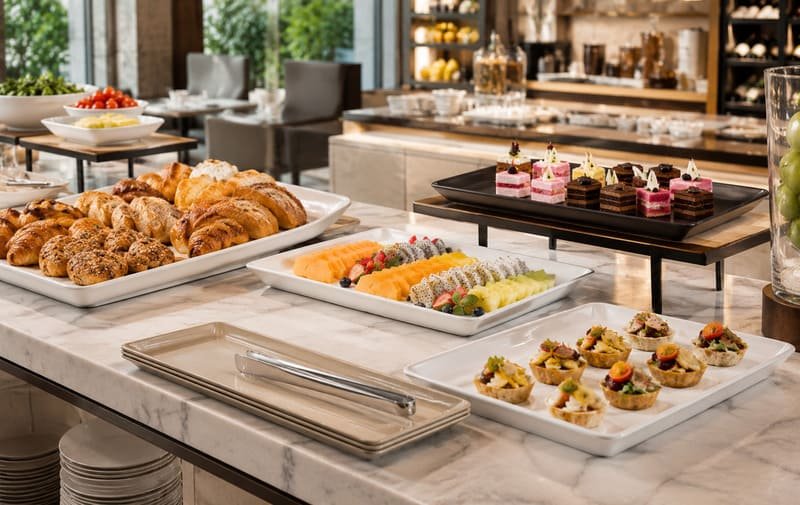
When hotel buyers and restaurant operators contact me about buffet tray selection, the first question is often about melamine. They want to know if melamine trays will break less than ceramic, look professional, and hold up under daily use.
Behind this question is usually a bigger concern: they are tired of replacing broken ceramic trays, dealing with inconsistent replacement supply, or worrying about guest safety when heavy trays slip or break during buffet service. Many of them have heard melamine might solve these problems, but they are not sure whether it actually fits buffet use.
Melamine trays can be a good choice for many buffet displays, especially for cold food, room-temperature food, moderate warm service, lighter plated presentations, and settings where break resistance matters. However, they are not suitable for every buffet task. The real answer depends on food temperature, load weight, presentation style, cleaning routine, heat source exposure, and whether the supplier can meet your procurement needs with consistent quality and clear food-contact documentation.
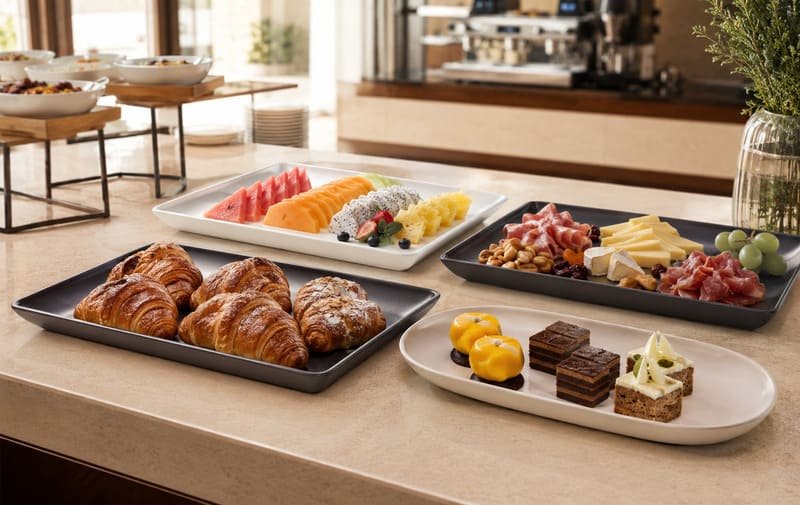
Before deciding whether melamine trays fit your buffet display, you need to ask what the tray must actually do. Buying melamine because it costs less than ceramic is a mistake if it does not match your service environment.
Buffet display is not one-size-fits-all. A hotel breakfast buffet, dessert table, salad station, carving station, banquet display, and chafing dish area all create different demands. That is why I always start with the buffet station first, not the material name.
When I review a buffet tray sample, I do not only check the color. I load it with real plates, bowls, serving utensils, food props, and sometimes decorative risers. Then I check flexing, edge grip, stack height, surface cleaning, and how it looks under buffet lighting. This practical test tells me much more than an empty catalog photo.
Buffet Tray Fit Map by Food Station
Buffet buyers often ask whether melamine trays are “good” or “not good.” I prefer a more practical question: which buffet station are we talking about?
Melamine trays work best for buffet stations where the food is cold, room-temperature, or moderately warm, and where the tray is used for display, carrying, grouping, or presentation. They are not the right choice for direct heat, open flame, hot oil, chafing dish bases, microwave use, oven use, or prolonged high-temperature food contact.
| Buffet Station | Melamine Fit | Why |
|---|---|---|
| Breakfast pastries | Strong fit | Dry, light, room-temperature food |
| Bread and sandwich station | Strong fit | Easy display, easy replenishment |
| Fruit and salad bar | Strong fit | Cold display and easy cleaning |
| Cheese and charcuterie | Strong fit | Good visual styling and lower breakage risk |
| Dessert station | Strong fit | Works well for cakes, cookies, and plated sweets |
| Cold appetizer display | Strong fit | Good for grouping and color coordination |
| Warm bread station | Good fit | Moderate warmth only; avoid direct heat |
| Buffet riser display | Good fit | Check tray stability and load weight |
| Carving station | Limited fit | Heavy hot meat and juices may need ceramic or stainless steel |
| Chafing dish area | Not suitable as heat base | Fuel burners and heating elements require heat-rated equipment |
| Soup station | Not suitable for direct hot liquid service | Use stainless steel, ceramic, or proper soup equipment |
| Heat lamp station | Conditional | Depends on heat distance, surface temperature, and supplier guidance |
This map is the fastest way to avoid sourcing mistakes. A melamine tray can be excellent for pastries, fruit, salads, desserts, and room-temperature appetizers. The same tray can be the wrong choice if a hotel uses it under fuel burners or for direct hot soup service.
Last Updated: June 4th, 2026 | Estimated Reading Time: 8 minutes
By Lance, Marketing Director at Duramela
What Buffet Task Must Your Tray Perform?
When restaurant managers or hotel procurement staff review tray options, they often start by comparing materials. That is useful, but the better starting point is understanding what the tray must do in actual service.
A buffet tray may need to display food, carry food, group small plates, support replenishment, fit a buffet riser, survive repeated washing, or maintain a consistent visual style across the buffet line. The tray task should decide the material and shape.

A breakfast buffet that serves pastries, fruit, cheese, and cold cuts has very different tray requirements from a dinner buffet with hot roasted meat, gravy dishes, soup equipment, or chafing dishes. A casual café buffet serving sandwiches has different needs from a hotel banquet buffet serving formal plated appetizers.
Before selecting any tray material, I suggest clarifying several operational questions:
- What food will be placed on the tray?
- Is the food cold, room-temperature, warm, or very hot?
- How heavy is the loaded tray?
- Will the tray be carried frequently by staff, or will it mostly stay on the buffet table?
- Will guests handle the tray directly?
- Will the tray sit near a heat lamp or chafing dish?
- How often will the tray be washed?
- Will it go through a commercial dishwasher?
- Do you need matching colors, coordinated designs, or branded presentation?
- How important is stackability and storage space?
- What happens if the tray breaks or wears out?
- Do you need a stable replacement supply?
In direct conversations with buyers, the biggest sourcing mistakes usually happen when someone treats the tray as just a plate carrier. Buffet trays face different stress from dinner plates. They hold more weight, get moved around more often, and are handled by both staff and guests.
If you choose a tray based only on appearance or price without considering actual buffet use, you will likely face problems later.
Matching Tray Material to Food Temperature
Food temperature is one of the most important factors in tray selection. Many buffet operators assume that melamine trays work the same way as ceramic or stainless steel, but they do not.
Melamine trays are suitable for many cold, room-temperature, and moderate warm serving tasks. They work well for breakfast buffets, salad bars, dessert stations, sandwich displays, cheese and charcuterie presentations, and plated appetizers. They can also work for warm food that is not directly heated on the tray, such as bread baskets or plated dishes that have cooled slightly after leaving the kitchen.
However, melamine trays are not cookware. They should not be used as a heat base, microwave tray, oven tray, chafing dish support, or surface for very hot oil, deep-fried food, direct flame, or prolonged high-temperature acidic food contact.
The U.S. FDA states that foods and drinks should not be heated on melamine-based dinnerware in microwave ovens and discusses melamine migration concerns under certain high-temperature and acidic conditions (FDA). The Centre for Food Safety in Hong Kong also advises that melamine-ware should not be used for cooking, microwave heating, conventional oven heating, hot oil, deep-fried foods, or storage of highly acidic foods (CFS).
Here is a simple reference table:
| Buffet Food Type | Melamine Tray Suitability | Better Alternative if Not Suitable |
|---|---|---|
| Cold salads, fruit, cheese | Yes | – |
| Pastries, bread, sandwiches | Yes | – |
| Plated appetizers at room temperature | Yes | – |
| Desserts, cakes, cookies | Yes | – |
| Warm bread or mild warm display | Yes, if not directly heated | – |
| Hot meat with gravy | Limited / not recommended for direct hot contact | Ceramic or stainless steel |
| Soup tureens | No for direct soup service | Stainless steel or ceramic |
| Chafing dishes with burners | No as heat base | Stainless steel |
| Food under intense heat lamps | Conditional | Stainless steel or ceramic if surface gets too hot |
| Open flame or direct heat | No | Stainless steel or heat-rated equipment |
When buyers ask whether melamine is heat-resistant, my answer is: yes, within normal serving use, but not for cooking or direct heating. This distinction is very important for buffet operations.
Load Weight and Structural Strength
Another common buffet concern is weight. Buffet trays often carry more weight than individual dinner plates. A loaded tray might hold multiple dishes, garnishes, serving utensils, food covers, or decorative elements.
Melamine trays are usually lighter than comparable ceramic trays, although actual weight depends on size, thickness, and design. This makes them easier to carry and reduces handling pressure when staff move trays between the kitchen and buffet area.
However, lighter does not mean every melamine tray is strong enough for every display. A properly molded melamine tray with suitable thickness and structural design can carry substantial weight, but very heavy buffet presentations should always be tested.
If your buffet display involves large roasted meat platters, ice displays, heavy risers, or multi-layer dessert arrangements, test the tray under actual load before committing to a large order. Some buyers still prefer ceramic or stainless steel for these situations because the added weight and heat resistance may fit the station better.
My Loaded Buffet Tray Test
| Test | What I Check |
|---|---|
| Static load test | Does the tray flex too much under full food weight? |
| Carry test | Can staff carry the loaded tray safely? |
| Edge grip test | Does the tray edge feel stable when lifted? |
| Buffet table fit | Does the tray fit the display space, risers, and layout? |
| Utensil contact test | Do serving spoons or tongs scratch the surface too easily? |
| Wash cycle test | Does the surface remain clean and stable after washing? |
| Stack test | Does the tray stack without trapping water or scratching? |
| Lighting test | Does the color look right under buffet lighting? |
This is where real sample testing matters. A tray that looks strong when empty may flex when loaded. A tray that looks elegant in an office may look too light or too glossy under buffet lighting.
Why Melamine Works Well for Many Buffet Displays
After clarifying the task requirements, many hotel and restaurant buyers find that melamine trays fit a large portion of their buffet needs. The reasons are practical, not just about cost.
Melamine works well for many buffet displays because it is break-resistant, lighter than many ceramic alternatives, easy to coordinate visually, stackable, and suitable for repeated cleaning when used according to supplier instructions. These benefits are strongest in cold, room-temperature, and moderate warm buffet stations.
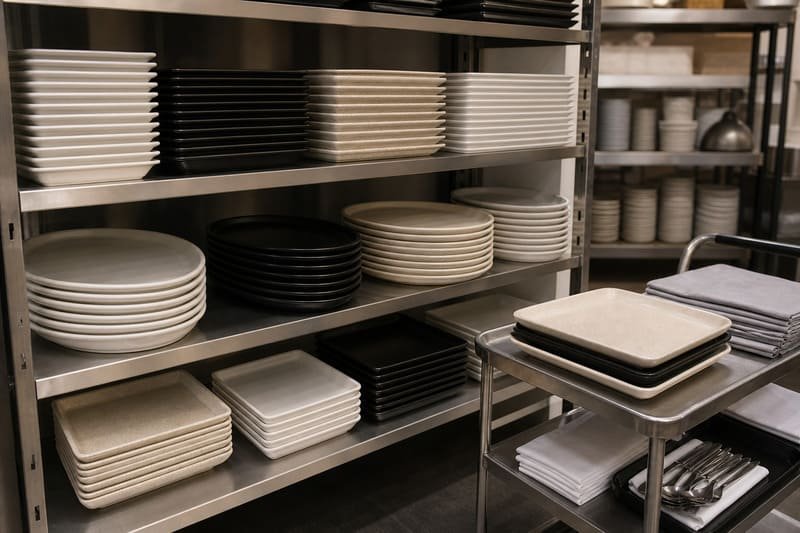
First, melamine trays help reduce breakage pressure compared with ceramic trays in many daily buffet situations. Buffet service involves frequent handling, stacking, cleaning, and accidental bumps. Ceramic trays can chip or shatter when dropped, creating safety concerns for both staff and guests.
Melamine does not break the same way. It can still crack or chip if dropped from a high point or hit sharply, but it is more forgiving in everyday handling.
Second, melamine trays are usually lighter than comparable ceramic trays. When banquet staff need to move loaded trays back and forth, weight matters. Lighter trays can help reduce fatigue and make setup faster, especially during breakfast service, banquet turnover, and large event preparation.
Third, melamine trays are strong for repeatable design. From a production point of view, melamine is useful for controlled molds, consistent colors, and repeatable printed designs when the supplier manages artwork and batch matching properly.
Fourth, melamine trays are easy to stack and store. Many buffet operations have limited back-of-house space. Stackable trays save storage space and make buffet setup faster.
Fifth, many commercial melamine trays are designed for dishwasher cleaning. However, buyers should follow supplier guidance for wash temperature, detergent, drying, and stacking. The FDA Food Code emphasizes that foodservice equipment and utensils should be cleanable, maintained, and kept in good repair for safe operation (FDA Food Code). In practical terms, damaged trays should be removed from service instead of kept in circulation.
For many buyers, stable supply and lower replacement pressure are just as important as the first purchase price. When you source from a reliable supplier, you can reorder the same tray design over time without worrying about sudden color changes, mold retirement, or inconsistent replacement batches.
For buffet stations that need rectangular, stackable, and easy-to-coordinate presentation pieces, a dedicated Buffet Tray is usually a better starting point than adapting a general plate or shallow platter.
Visual Presentation and Branding
Buffet presentation is not only about function. Many buyers also care about appearance, brand identity, and guest experience.
Melamine trays can support a wide range of visual styles:
- solid white for clean hotel breakfast displays;
- black or charcoal for premium dessert stations;
- ivory or cream for warm hospitality settings;
- wood-grain effects for natural buffet concepts;
- marble or stone patterns for upscale presentation;
- custom logos for hotel or restaurant branding;
- seasonal artwork for banquet or event programs.
For buyers who want a coordinated buffet look, melamine offers flexibility. You can match tray colors with plates, serving bowls, risers, table linens, or buffet station themes. You can also choose different tray shapes and sizes while maintaining the same design language.
Some buyers worry that melamine looks cheap or plastic-like. That concern is valid if they choose thin, low-quality trays with poor surface finish. However, properly molded A5 melamine trays with smooth surfaces, clean edges, and careful color selection can look professional in many buffet settings.
Many hotel buffet guests do not notice the material difference unless they pick up the tray and compare the weight. What they notice first is whether the display looks clean, coordinated, and well maintained.
Where Melamine Trays Have Limits
Melamine trays work well for many buffet situations, but they are not a perfect replacement for all materials. Being clear about limits helps buyers avoid problems later.
Melamine trays should not be used with open flame, ovens, microwaves, direct heating equipment, chafing dish burners, hot oil, fryer-direct foods, or prolonged high-temperature acidic food contact. If heat resistance is the main requirement, stainless steel or ceramic is usually the better choice.
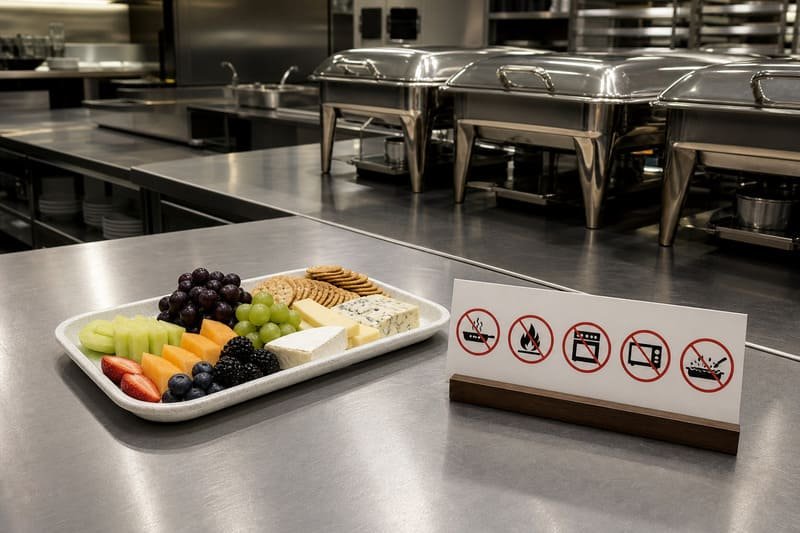
As mentioned earlier, melamine trays should not be used as heat-contact equipment. If your buffet includes chafing dishes with fuel burners underneath, use stainless steel trays or heat-rated buffet equipment instead.
Melamine trays also should not be used for prolonged contact with very hot liquids. If you are serving hot soup, hot gravy, or steaming-hot food directly in the tray, prolonged heat exposure may damage the surface, affect appearance, or make the tray harder to clean over time.
For luxury buffet settings where visual weight and premium feel matter more than practicality, some buyers may prefer ceramic, porcelain, wood, or stainless steel. Ceramic trays offer a heavier, more substantial feel. Wood trays offer a natural rustic look. Stainless steel works better around heat and heavy service equipment.
Another limit is scratching. Melamine trays are scratch-resistant in normal use, but not scratch-proof. Over time, heavy metal serving utensils, rough stacking, abrasive cleaning tools, or harsh handling can leave surface marks. This is normal wear, but buyers should know what to expect.
The CFS guidance also reminds users not to clean melamine-ware with abrasive detergents or tools that may damage the surface (CFS). For buffet operations, this means staff training matters.
Finally, if your buffet display requires very large, custom-shaped trays that are not available in existing molds, new mold development may be required. Melamine mold development involves upfront cost and may not be practical for small trial projects.
When I Would Not Recommend Melamine
| Buffet Need | Better Choice | Why |
|---|---|---|
| Chafing dish base | Stainless steel | Direct heat and burners require heat-rated material |
| Hot soup or gravy service | Stainless steel or ceramic | Better for prolonged hot liquid contact |
| Open flame display | Stainless steel | Melamine is not for flame exposure |
| Oven-to-buffet service | Ceramic or stainless steel | Melamine is not oven-safe |
| Very heavy carving station | Stainless steel or heavy ceramic | Better stability and heat tolerance |
| Luxury handcrafted look | Ceramic, porcelain, wood | Better visual weight or natural texture |
| Rough metal utensil use | Stainless steel | More resistant to harsh scraping |
A good supplier should be comfortable explaining these limits. If someone says melamine is suitable for every buffet task, I would be cautious.
What Should the Buyers Confirm Before Ordering?
For hotel procurement managers and restaurant buyers, product quality is only part of the sourcing decision. You also need to manage procurement risk, supplier reliability, and compliance requirements.
Before ordering melamine trays for buffet display, buyers should confirm material, food-contact documentation, sample performance, temperature use limits, loading behavior, surface finish, stacking, packaging, reorder stability, and whether the supplier can support consistent quality over time.
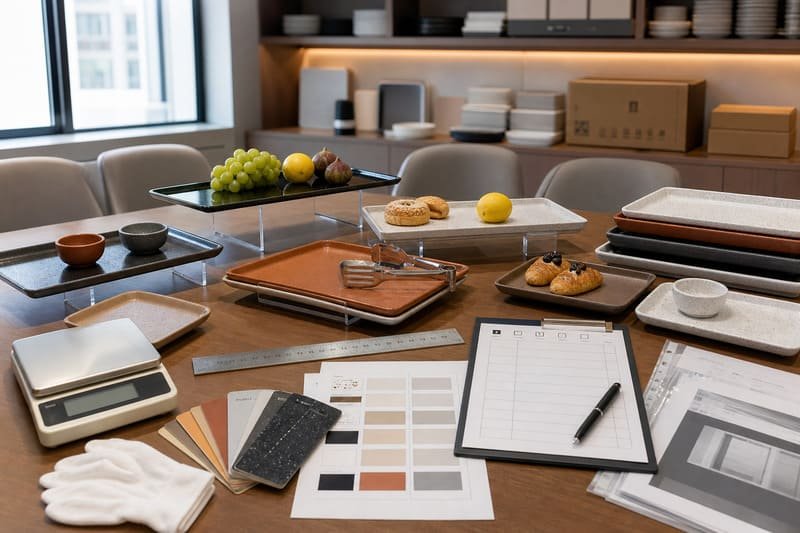
When selecting melamine trays for buffet use, I suggest asking your supplier these questions:
- What material is used?
- Is this tray intended for food contact?
- Can the supplier provide food-contact documents for the target market?
- Does the test report match the exact product, color, and material?
- Is the tray suitable for dishwasher cleaning?
- What are the heat-use limits?
- Can the tray be used near a heat lamp?
- Can the tray carry the expected loaded weight?
- How consistent is color matching across production batches?
- Can you reorder the same design later?
- Is the surface smooth, easy to clean, and suitable for buffet use?
- Can the supplier provide sample trays before a large order?
- How is the tray packed for international shipping?
Food-contact documents should match the destination market. FDA-related documentation, EU or LFGB-style testing, BPA-Free declarations, and California Proposition 65 reviews are not interchangeable. FDA guidance on food-contact substances emphasizes that safety assessment depends on chemistry, intended use, and potential migration evaluation (FDA Guidance). For EU buyers, the European Commission provides information on the food contact materials framework (European Commission).
If selling into California, buyers should review official Proposition 65 information from OEHHA and confirm whether any warning or evaluation is required.
One common procurement mistake is ordering trays based only on price without checking sample quality first. A low-price tray may look similar in product photos, but the actual material quality, surface finish, color accuracy, and structural strength can vary significantly between suppliers.
Testing samples under real buffet conditions — loading, washing, handling, stacking, and display lighting — helps reduce the risk of ordering trays that do not perform as expected.
Another important consideration is replacement supply. Buffet operations usually need to replace trays over time due to wear, accidental damage, or business expansion. If your supplier cannot provide stable reorder support, or if the mold gets retired after a few months, you may face difficulties maintaining a consistent buffet display.
For buyers who need custom-printed trays, logo branding, or specific color matching, confirm artwork approval procedures, color sample checks, and printing quality control before production. Custom printing mistakes can be expensive and time-consuming to fix.
A general melamine tray line may be suitable for multiple foodservice tasks, but buffet buyers should still confirm size, station use, load weight, and cleaning workflow before bulk production.
Buffet Tray Procurement Checklist
| Confirmation Item | What to Check | Why It Matters |
|---|---|---|
| Food station | Breakfast, dessert, salad, carving, chafing, etc. | Determines whether melamine is suitable |
| Food temperature | Cold, room temperature, moderate warm, very hot | Avoids heat misuse |
| Load weight | Real loaded tray weight | Prevents flexing and handling issues |
| Surface finish | Smooth, easy to clean, scratch-resistant | Affects appearance and cleaning |
| Stackability | Stack height and airflow | Saves storage and improves drying |
| Dishwasher guidance | Supplier instructions | Prevents surface damage |
| Food-contact documents | Target-market reports | Supports compliance |
| Artwork proof | Logo, color, pattern, positioning | Prevents branding errors |
| Packing strength | Carton, inner protection, export handling | Reduces shipment damage |
| Reorder support | Mold and color availability | Keeps buffet displays consistent |
Common Buyer Questions About Melamine Buffet Trays
Buffet buyers often ask practical questions because trays must work every day, not only look good in a product photo.
The most common questions involve heat lamps, chafing dishes, dishwasher cleaning, service life, food-contact safety, quality differences, and whether hotels should test trays before placing a large order.
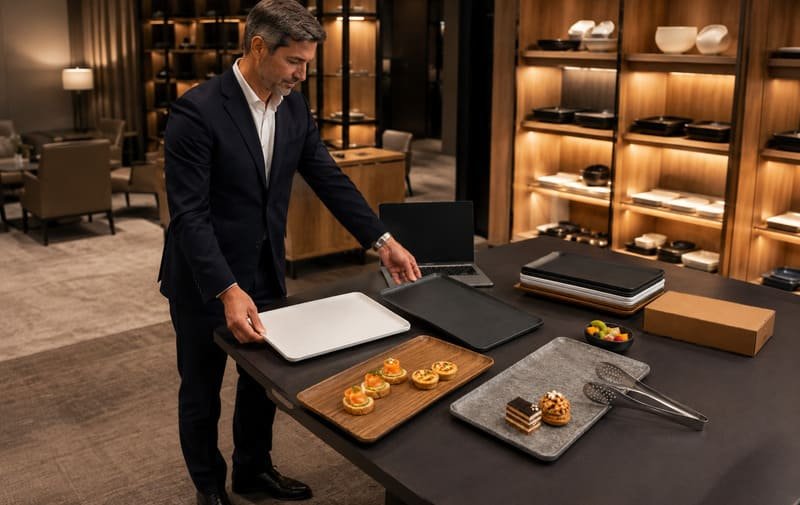
Can melamine trays go under heat lamps?
Sometimes, but only if the tray is not exposed to excessive direct heat and the supplier confirms the intended use. If the heat lamp creates high surface temperature or the tray sits close to the heat source for long periods, stainless steel or ceramic is safer.
I recommend testing the tray with the actual heat lamp distance, buffet layout, and service time before bulk ordering.
Can melamine trays be used with chafing dishes?
Not as a direct heat base. Chafing dishes with burners or heating elements should use stainless steel or other heat-rated equipment.
Melamine trays may be used nearby for cold or room-temperature display pieces, but not as the heated support surface.
How long do melamine buffet trays last?
Service life depends on use frequency, load weight, washing conditions, handling, surface finish, storage, and whether the tray is kept away from heat misuse.
Well-made melamine trays can last through many service cycles, but rough stacking, harsh detergents, heavy metal utensils, abrasive cleaning tools, and direct heat exposure will shorten their appearance life.
Are melamine trays safe for food contact?
They can be safe for food contact when made from suitable food-contact melamine, supported by target-market documents, and used according to supplier instructions.
They should not be used for cooking, microwaving, hot oil, open flame, direct heating equipment, or prolonged high-temperature acidic food contact.
Can I wash melamine trays in a commercial dishwasher?
Many commercial melamine trays are designed for dishwasher cleaning, but buyers should confirm the product specification.
Avoid abrasive tools, strong chemicals, and very high-temperature or steam cycles beyond supplier guidance. If the tray has special printing or surface finish, test samples before placing a large order.
What is the difference between cheap and high-quality melamine trays?
Low-quality trays may show thin walls, rough edges, uneven color, weak structure, poor polish, or unclear material documents.
High-quality trays usually have better material control, stronger thickness balance, smoother polishing, cleaner edges, better color consistency, and clearer documentation. Testing samples is the best way to see the difference.
Should hotels test buffet trays before bulk ordering?
Yes. I strongly recommend testing trays with real food weight, serving utensils, buffet risers, washing process, stacking, and display lighting before mass production.
A tray that looks good when empty may flex, scratch, or look different once used in a real buffet setting.
Conclusion
Melamine trays work well for many buffet displays, but not all. They are strongest in cold, room-temperature, and moderate warm buffet stations where break resistance, lighter handling, visual consistency, stackability, and easy cleaning matter.
They are not the right choice for direct heat, chafing dish bases, open flame, microwaves, ovens, hot oil, or prolonged high-temperature acidic food contact. For those situations, stainless steel, ceramic, or heat-rated equipment is safer.
My practical advice is simple:
Choose melamine trays for buffet display when the tray is used for presentation, grouping, carrying, and repeated service — not cooking or direct heating. Test real food weight, cleaning, stacking, and lighting before bulk ordering, and make sure your supplier can support consistent quality and food-contact documentation.
