
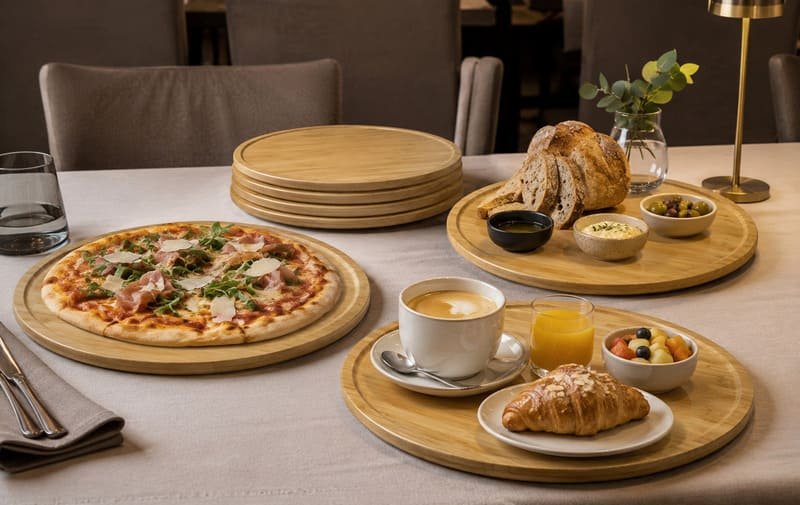
Ordering custom bamboo trays sounds simple. But many buyers end up with wrong sizes, unclear logos, unstable stacking, or unusable bulk orders because they skipped a few key steps upfront.
Customizing bamboo trays works best when you define the use case, tray structure, exact size, rim design, surface finish, logo method, quantity, sample requirements, packaging, and delivery terms before contacting a supplier. Pure bamboo trays usually do not need expensive compression molds like melamine products, but they still have real MOQ requirements, branding limits, structure constraints, and care restrictions that affect the final product.
I work directly with restaurant, hotel, gift, and design-brand buyers on bamboo tray customization. Most of the confusion I see comes from buyers who start with a visual idea but have not thought through the practical side.
A nice reference photo is helpful, but it is not enough. A factory still needs to know:
- what the tray will be used for;
- whether it is for food, coffee, pizza, cutlery, amenities, or gifts;
- the exact size and structure;
- rim height and usable flat area;
- whether stackability is required;
- surface finish and food-contact expectations;
- logo method;
- MOQ and sample plan;
- packaging and shipping needs.
This guide covers what factories actually need from you, what is realistic for solid bamboo trays, and what to watch out for before you place an order.
Last Updated: June 30, 2026 | Estimated Reading Time: 8 minutes
By Lance, Marketing Director at Duramela
Custom Bamboo Tray Specification Map
A custom bamboo tray project should begin with a clear specification, not only a reference picture.
Before asking for a bamboo tray quote, prepare the use case, shape, size, thickness, rim details, surface finish, logo method, quantity, packaging, and sample requirements. These details help the supplier judge feasibility, cost, and production risk before making a sample.
| Specification | What to Prepare | Why It Matters |
|---|---|---|
| Use case | Pizza tray, dinner tray, serving tray, cutlery tray, food tray, amenity tray, gift tray | Determines structure and finish |
| Shape | Round, rectangular, square, oval, custom shape | Affects cutting, polishing, and cost |
| Size | Diameter or length × width | Controls material use and packaging size |
| Thickness | Center thickness, rim thickness, total height | Affects hand feel, strength, and weight |
| Rim design | Flat rim, raised rim, curved edge, angled edge | Affects stacking and food presentation |
| Stackability | Nesting depth, bottom fit, storage space | Important for restaurants and hotels |
| Surface finish | Water-based coating, wax oil, lacquer | Affects food-contact positioning and care |
| Logo method | Laser engraving, simple branding, packaging print | Affects appearance and sample approval |
| Packaging | Bulk box, individual inner box, printed box | Affects cost and shipping volume |
| Quantity | Trial order, wholesale order, repeat order | Affects MOQ and unit cost |
This map is the fastest way to reduce confusion. If the supplier receives only one photo and one target price, the quote will probably be a guess.
Case Study: Custom Round Bamboo Pizza Trays for a Swedish Restaurant
A real project explains bamboo tray customization better than theory. One of our Swedish restaurant clients wanted custom round bamboo pizza trays for daily restaurant service.
The client did not only need a round bamboo tray. They needed a tray that could present pizza cleanly, stack safely, reduce storage space, avoid sliding gaps, and arrive individually protected. That meant the specification had to include diameter, rim height, center thickness, rim rise, nesting depth, surface finish, and packaging.
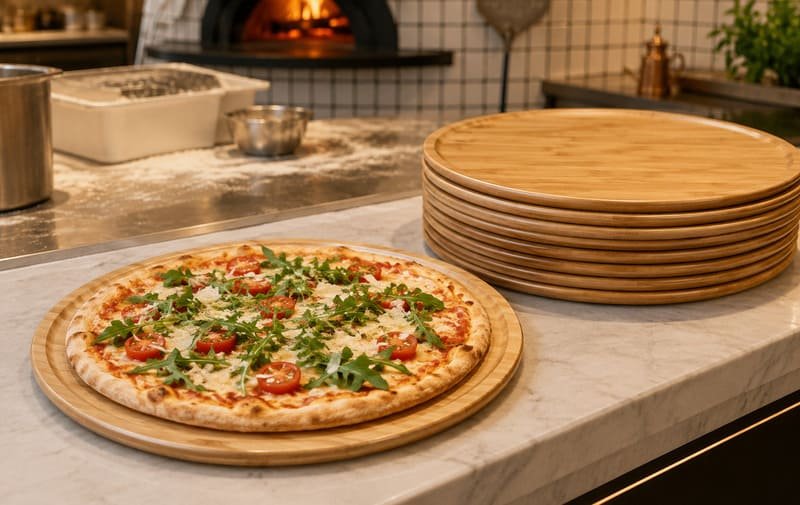
The buyer’s main requirements were:
- round shape for pizza service;
- stackability to reduce kitchen storage space;
- raised rim with a gentle curve;
- stable nesting to prevent sliding and gaps;
- water-based eco lacquer finish;
- individual inner box packaging for each tray.
Here is the final specification we discussed:
| Parameter | Specification |
|---|---|
| Material | 100% bamboo |
| Use case | Round bamboo pizza tray / bamboo dinner tray for restaurant service |
| Total diameter | 350 mm |
| Total height at outer rim | 10 mm |
| Approx. overall thickness | 0.95 cm |
| Center flat thickness | 6 mm |
| Rim rise | 4 mm |
| Usable flat serving area | 330 mm diameter |
| Radius from center | 165 mm |
| Surface plane | Flat serving surface, 6 mm from underside |
| Nesting depth | 1.5–2.0 mm |
| Rim design | Raised rim with gentle curve |
| Surface treatment | Water-based eco lacquer |
| Packaging | One tray in one individual inner box |
In this project, the nesting depth was not a small detail. It mattered because the restaurant needed the trays to stack safely without sliding and without leaving large storage gaps. If the nesting depth is too shallow, the trays may move when stacked. If it is too deep, the stack may become tight, harder to separate, or more difficult to dry.
This is why I always ask restaurant buyers whether the tray needs to stack, nest, or fit a service shelf. For a decorative gift tray, nesting may not matter. For a busy restaurant using round bamboo trays every day, it matters a lot.
If you are planning bamboo trays for restaurant use, this is the level of detail I suggest preparing before sampling.
What Is the Tray Actually For?
This is the first question I ask every buyer, and many people are surprised that it matters so much.
The tray’s intended use — serving food, pizza, coffee, bar drinks, hotel amenities, cutlery, or gifts — directly affects size, shape, thickness, surface finish, rim design, packaging, and whether features like anti-slip bases or stackable nesting are needed.
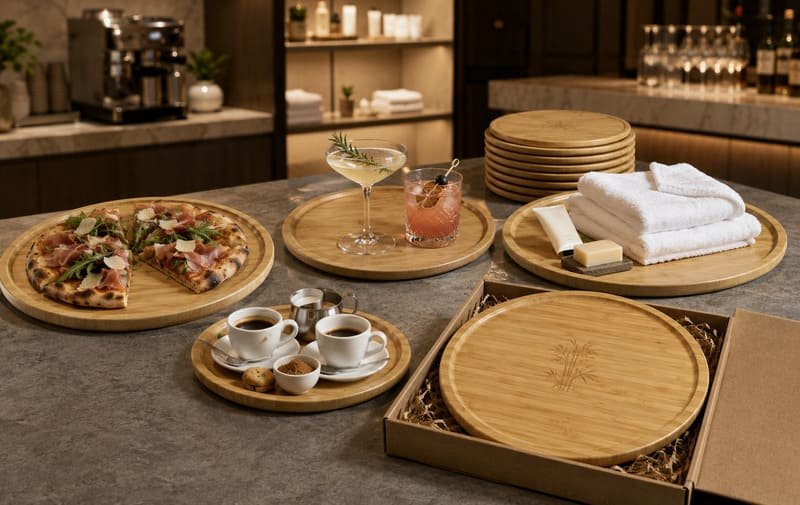
A bamboo tray for pizza service has completely different requirements from a bamboo cutlery tray, hotel amenity tray, café coffee tray, or corporate gift tray.
Here is how the use case changes key decisions:
| Use Case | Size Range | Weight Priority | Surface Finish | Logo Method | Stackability / Anti-Slip |
|---|---|---|---|---|---|
| Pizza / food serving | 300–400 mm | Medium to high | Water-based coating or food-contact finish | Laser engraving | Stackability often important |
| Coffee / café tray | 200–280 mm | Medium | Clear coating, water-based coating, or wax oil | Laser engraving | Anti-slip may help |
| Bar drinks tray | 250–350 mm | Medium | Coating with better moisture resistance | Laser engraving | Anti-slip often useful |
| Hotel amenity tray | 300–450 mm | Premium hand feel | Wax oil or water-based coating | Laser engraving | Usually optional |
| Bamboo cutlery tray | Custom compartments | Structural accuracy | Smooth coating | Logo or no logo | Compartment design matters |
| Gift / branded tray | Variable | Medium | Natural or premium finish | Laser engraving or packaging print | Usually less important |
| Bamboo food trays for eating | Depends on menu | Medium | Food-contact finish | Subtle logo | Rim and cleaning method matter |
If you are buying a serving tray for direct food presentation, you should also confirm whether it will touch dry food, oily food, wet food, or only packaged food. This affects surface finish and care instructions.
For cafés or bars, anti-slip rubber feet or a textured underside may be useful, but they should be confirmed as a design feature from the beginning. For high-end restaurants, tray weight and hand feel may matter more than pure lightness.
What Can You Actually Customize on a Bamboo Tray?
Pure bamboo trays are more flexible in dimensions than molded melamine products, because they usually do not need expensive compression molds. But customization still has real limits, and knowing them early saves time.
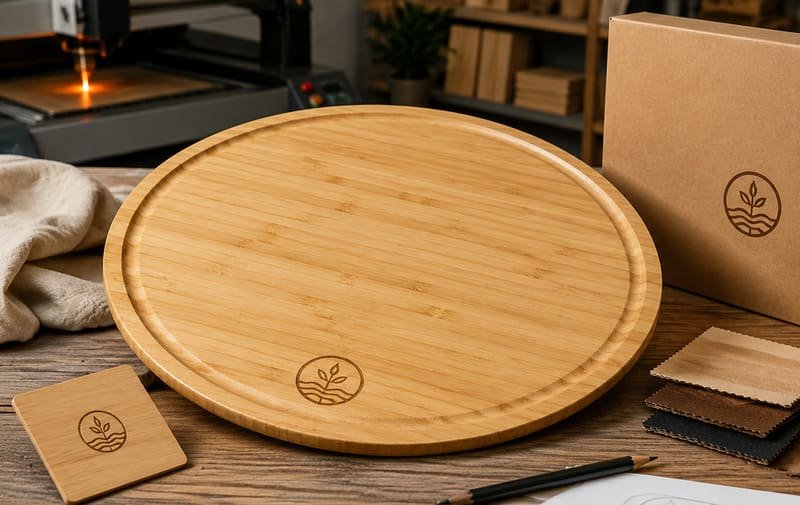
Pure bamboo trays can be customized in size, shape, thickness, rim design, surface finish, logo placement, and packaging. However, they are not suitable for full-surface colorful printing, exact Pantone surface matching, dishwasher-heavy service, or complex molded shapes. Laser engraving is usually the most practical branding method.
Size and Shape
Because pure bamboo trays do not need rigid compression molds like melamine products, dimensions are more flexible. Round, rectangular, square, oval, and many simple custom shapes are workable.
However, “flexible” does not mean unlimited. The supplier still needs to understand:
- overall dimensions;
- height and rim details;
- center thickness;
- rim thickness;
- handle design if needed;
- stackability or nesting requirement;
- intended load and use environment.
Laminated bamboo material can provide useful structural performance, but the tray design still depends on how the bamboo is cut, joined, shaped, and finished. Research on laminated bamboo material helps explain why material structure matters in bamboo products.
Surface Finish
Surface finish affects both appearance and care requirements.
| Surface Finish | Look & Feel | Food Contact Positioning | Durability | Care |
|---|---|---|---|---|
| Clear lacquer | Natural wood look, low to medium sheen | Must be checked with supplier | Moderate | Hand wash only |
| Water-based coating | Smooth, light sheen, clean look | Can be a better direction, but still needs verification | Good | Hand wash only |
| Food-grade wax oil | Oily, matte, warm texture | Often preferred for natural food-contact positioning | Good | Hand wash only |
| Painted finish | Solid color | Depends on paint system | Varies | Hand wash only |
I always recommend confirming food-contact compliance with your supplier for whichever finish you choose, especially if you are importing into markets with specific requirements.
Guidance on wood and bamboo food contact materials is useful because coatings, oils, waxes, adhesives, and glues may all matter when bamboo products touch food. FDA guidance on food-contact substance evaluation also explains why intended use and chemistry matter for food-contact materials.
Do not assume any finish is automatically certified just because the tray is bamboo.
Logo and Branding
This is where many buyers have unrealistic expectations. Pure bamboo is not a flat white surface like melamine. It has natural grain, color variation, and texture.
That means:
- laser engraving works very well and gives a clean, professional result;
- simple line patterns or brand marks engrave better than complex illustrations;
- full-surface colorful printing is not normally recommended for pure bamboo trays;
- exact Pantone color matching on the bamboo surface is not realistic;
- natural color variation between individual trays is normal.
Natural bamboo variation is part of the material. Research on bamboo anatomical variation also shows why bamboo structure and appearance can vary.
If your brand identity relies on specific Pantone colors, photographic artwork, or full-color graphics on the tray surface, pure bamboo may not be the right material. In those cases, printed packaging may be a better branding solution.
What Are the Real MOQ and Sampling Requirements?
A lot of buyers come to me expecting to order 50 or 100 custom bamboo trays. That is usually not realistic for production runs.
For most custom pure bamboo trays, the realistic minimum order quantity is often around 500–1,000 pieces, depending on size, structure, finish, logo, and packaging. Sampling before bulk production is necessary because bamboo color, rim shape, stacking, logo effect, hand feel, and packaging must be physically checked.
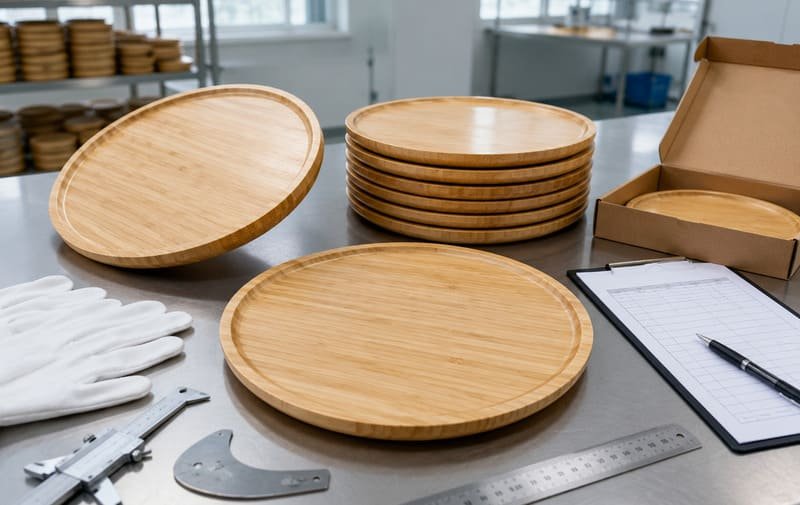
Unlike melamine products, pure bamboo trays usually do not require expensive compression molds. However, that does not mean there is no development cost. Custom cutting tools, jigs, fixtures, special polishing, sample work, or special structures may still create development expenses.
Here is a rough guide:
| Order Type | Typical MOQ | Sample Fee | Notes |
|---|---|---|---|
| Standard size, no logo | Around 500 pcs | Sometimes lower or waived | Fastest lead time |
| Custom size + laser logo | Around 500–1,000 pcs | Project-based | Confirm size and logo before bulk |
| Custom size + finish + packaging | Around 1,000 pcs | Project-based | Longer sampling and approval time |
| Special structure or custom packaging | Project-dependent | Higher | Needs full spec review |
Sampling should be treated as a risk-control step, not a formality.
Before approving bulk production, I always recommend confirming:
- dimensions match your specification;
- rim height and rim curve are correct;
- flat serving area is usable;
- stacking and nesting work properly;
- hand feel and weight are acceptable;
- logo position, depth, and effect are right;
- surface finish looks and feels correct in real lighting;
- packaging fits and protects the tray properly;
- care instructions are clear.
For many projects, sample production may take around 2–3 weeks, depending on structure and finish. Bulk production may take around 4–6 weeks after sample approval, depending on quantity and complexity. These are practical project ranges, not fixed promises.
Skipping sample confirmation is the most common reason buyers end up unhappy with bulk orders.
What About Packaging and Delivery?
Packaging is often an afterthought for buyers, but it is a real customization decision that affects cost, presentation, and minimum quantity.
Packaging options for custom bamboo trays range from bulk brown cartons to individual inner boxes with printed inserts. Your choice affects unit cost, MOQ, lead time, shipping volume, and how well the tray is protected during transport and storage.
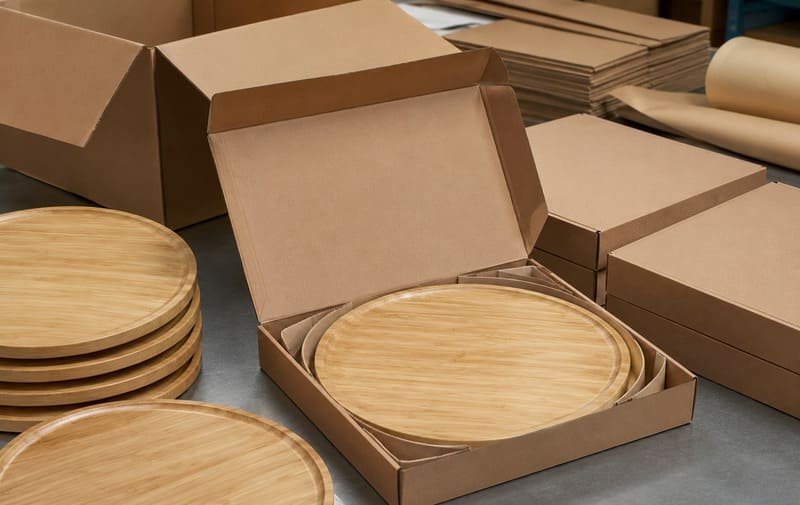
Packaging Options
| Packaging Type | Best For | Cost Impact | MOQ Impact |
|---|---|---|---|
| Bulk brown carton | Wholesale, internal restaurant use | Lowest | No major change |
| Individual inner box, plain | Restaurants, retail, basic resale | Low to medium | Slight increase |
| Individual inner box, printed | Gift, branded retail, design brands | Medium | Often higher MOQ |
| Gift set box | Corporate gifts and premium retail | Higher | Project-dependent |
The Swedish restaurant client chose individual inner boxes for each round bamboo pizza tray. That decision made sense for their service model because trays could be stored and handled individually without scratching each other.
For smaller buyers — including independent restaurant owners or small hotel groups doing their first import — door-to-door delivery may be easier than handling customs clearance independently. Air freight is faster but costs more and is usually only worth it for samples or urgent orders. Sea freight is usually more economical for bulk orders.
If you are comparing EXW, FOB, DAP, or DDP pricing, it helps to understand basic Incoterms and delivery terms. The cheapest product price is not always the lowest delivered cost.
When Are Bamboo Trays Not the Right Choice?
Bamboo trays are attractive and useful, but they are not the right answer for every project.
Bamboo trays are not suitable for microwave use, dishwasher-heavy service, long soaking, full-color surface artwork, exact Pantone surface matching, direct high-moisture contact, or very complex molded shapes. If these features are required, another material may be more practical.
| Requirement | Better Alternative | Why |
|---|---|---|
| Dishwasher-heavy operation | Melamine or plastic | Bamboo should not be machine washed repeatedly |
| Microwave use | Microwave-safe ceramic or plastic | Bamboo should not be microwaved |
| Full-color surface artwork | Melamine, ceramic, printed packaging | Bamboo surface is not ideal for this |
| Exact Pantone tray color | Plastic, melamine, painted material | Natural bamboo color varies |
| Wet or saucy food contact | Food-contact tested tray or another material | Bamboo is better for dry or semi-dry serving |
| Very complex molded shape | Melamine or plastic | Bamboo is cut and shaped, not molded like plastic |
| Very low custom quantity | Existing stock item | Custom work needs setup and sampling |
This section is important because a good supplier should tell you when bamboo is not the best material. If a buyer wants a full-color dishwasher-safe tray with exact Pantone color and complex molded curves, I would not recommend solid bamboo.
Common Buyer Questions About Custom Bamboo Trays
Custom bamboo tray buyers usually ask practical questions about dishwasher use, mold fees, logo methods, food safety, MOQ, round trays, stackability, and lead time.
The most useful answers are the ones that connect the tray to real use: food service, storage, logo durability, packaging, and maintenance.
Can bamboo trays go in the dishwasher?
No. Solid bamboo trays are best cleaned by hand or wiped with a damp cloth.
Avoid soaking, dishwashers, microwaves, and high heat. Dry the tray promptly and store it in a ventilated place. Wood-like food-contact items should be washed and dried properly, and bamboo trays need the same careful approach.
Do bamboo trays need a mold fee?
Usually, pure bamboo trays do not need expensive compression molds like melamine products.
However, custom cutting tools, jigs, fixtures, sample work, or special structures may still create development costs. It is better to ask the supplier what kind of setup cost applies to your specific design.
Can I get my logo printed in color on a bamboo tray?
Full-color surface printing is not normally recommended for pure bamboo trays. Laser engraving is the standard method and gives a clean, professional result.
If colorful branding is important, printed packaging may be more practical than printing directly on the bamboo surface.
Are bamboo trays food-safe?
They can be suitable for food contact when the bamboo, adhesive, coating, finish, and intended use match the target-market requirements.
Always confirm food-contact compliance with your supplier, especially if the tray will touch food directly or be imported into a regulated market. For EU buyers, review the relevant EU food contact material requirements.
Can you make round bamboo trays for pizza or dinner service?
Yes. Round bamboo trays can be customized for pizza, dinner service, food presentation, and restaurant table use.
Buyers should confirm total diameter, rim height, usable flat area, center thickness, rim rise, nesting depth, finish, and packaging before sampling. The Swedish restaurant pizza tray case is a good example of this.
Can bamboo trays be stacked?
Yes, but stackability must be designed.
The tray needs the right rim shape, bottom structure, and nesting depth. In the Swedish pizza tray project, the nesting depth was specified at 1.5–2.0 mm to reduce sliding and storage gaps.
Can I use bamboo trays for wet or saucy food?
I do not recommend long direct contact with wet or saucy foods unless the finish and food-contact testing support that use.
Bamboo trays work better for dry or semi-dry serving, pizza, bread, pastries, coffee cups, packaged food, amenities, and display use.
What is the typical lead time for custom bamboo trays?
Sample production is often around 2–3 weeks, depending on structure, finish, and logo. Bulk production may take around 4–6 weeks after sample approval, depending on quantity and complexity.
If individual packaging or printed boxes are required, add time for packaging proofing and approval.
Can I order fewer than 500 pieces?
Sometimes, but it depends on the structure, finish, logo, and packaging.
Quantities around 300–500 pieces may be possible for some simpler projects, but unit cost will be higher. Below 300 pieces is usually difficult for custom bamboo tray production.
Conclusion
Custom bamboo trays become much easier when you define the use case, size, rim structure, finish, logo method, quantity, sampling plan, and packaging before contacting a factory.
The Swedish restaurant pizza tray project shows why details matter. A “round bamboo tray” became a real production specification only after we confirmed diameter, total height, 0.95 cm thickness, 6 mm center flat area, 4 mm rim rise, 1.5–2.0 mm nesting depth, water-based eco lacquer, and individual inner box packaging.
My practical advice is simple:
Do not start with only a photo and a target price. Start with how the tray will be used, what it must hold, how it should stack, how it should feel, and how it should be packed. That is how a custom bamboo tray becomes a product your restaurant, hotel, or brand can actually use.
