
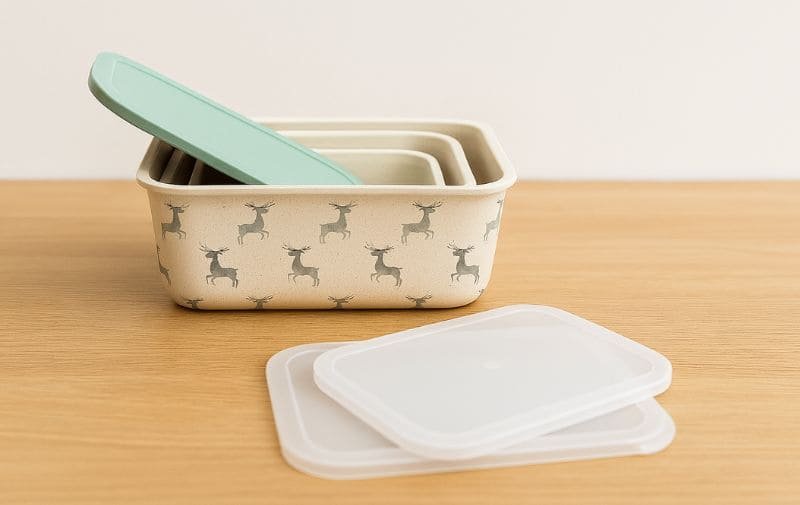
A bamboo food container may be a wooden-looking box, a smooth printed lunch box, or a glass jar with a bamboo lid. These products share a name, but their food-contact surfaces and care requirements can be very different.
Bamboo food storage containers do not all have the same safety profile. Solid bamboo boxes need suitable materials, finishes and use conditions. Bamboo-fiber plastic composites raise separate migration and regulatory concerns, including EU restrictions and UK advice against food use. For a glass or metal container with a bamboo lid, check the body and lid separately.
Start with what will touch the food: bamboo, a coating, plastic, glass or metal. Then check the intended food, storage time and cleaning instructions. Those details tell you more than an “eco-friendly” label, whether you are buying one container for your kitchen or sourcing a range for retail.
Updated October 12, 2026 | By Lance, Duramela
What kind of bamboo food container do you have?
Most reusable products sold under this name fall into three groups. A molded container containing bamboo powder is different from a box assembled from bamboo boards. A bamboo lid does not make the glass jar beneath it a bamboo-fiber product.
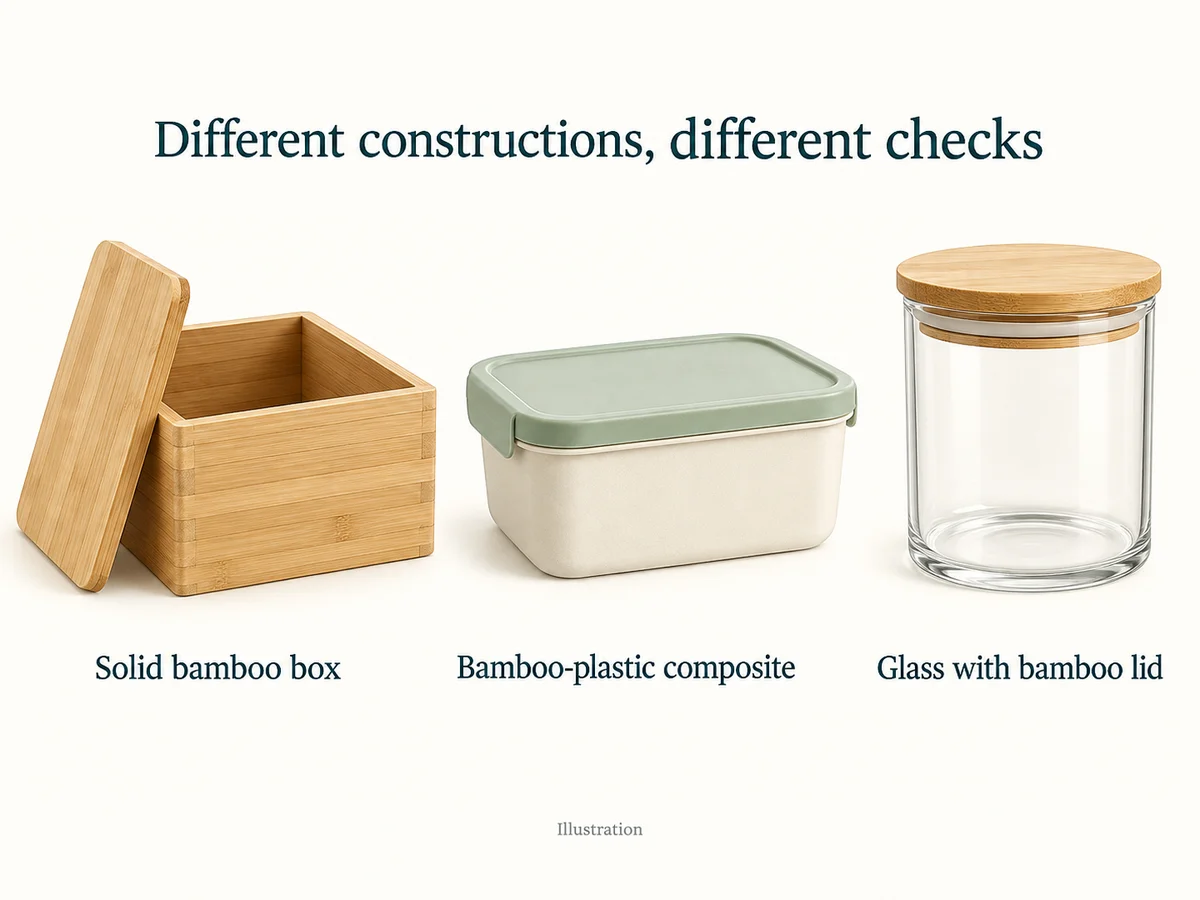
| Construction | What it is | What to check |
|---|---|---|
| Solid or laminated bamboo box | Bamboo pieces or boards formed into a box. Laminated boards can contain adhesive and a surface finish. | Interior finish, adhesive, seams, intended foods and moisture exposure. |
| Bamboo-fiber plastic composite | Bamboo powder or fiber mixed with a plastic binder, often melamine-formaldehyde resin, then molded. | Exact composition, market authorization and applicable product testing. Do not assume it is plastic-free. |
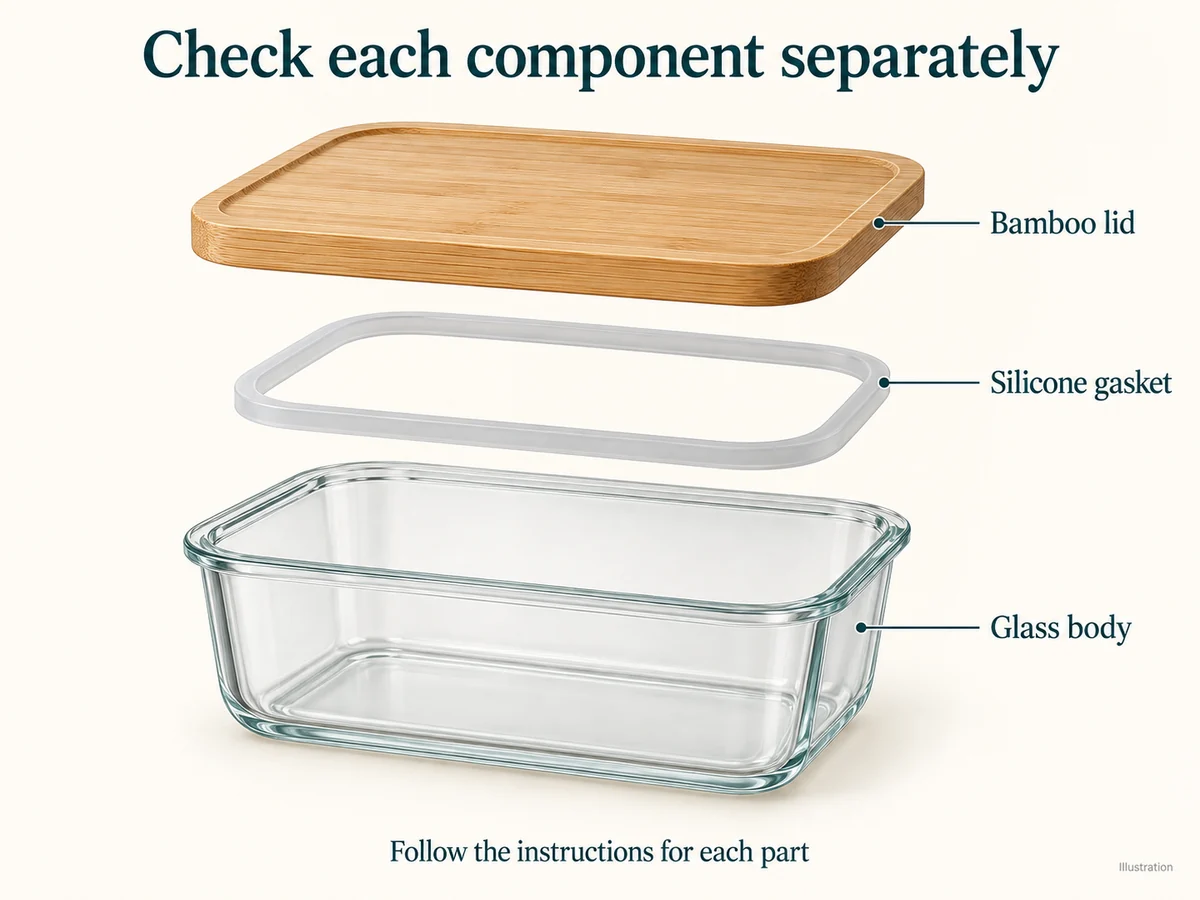
| Glass or metal body with bamboo lid | The body and lid are separate materials. A gasket may provide the seal. | Instructions for each component, including lid coating, gasket and cleaning. |
Appearance helps you ask the right questions, but it cannot confirm composition. Ask for a material specification rather than guessing from a bamboo pattern or a smooth surface. Molded bamboo pulp packaging is another category; instructions for disposable pulp packaging do not establish the suitability of reusable bamboo-plastic containers.
What is in a bamboo-fiber container?
In bamboo-plastic composites, plant material acts as a filler and the resin binds it into a rigid shape. There is no universal bamboo-to-resin percentage. The formulation must come from the supplier for that product. The lid may be polypropylene, silicone or another material, so it needs its own identification.
Are bamboo-fiber plastic containers safe?
Do not treat bamboo-plastic composites as automatically suitable for food storage, even when they are advertised as A5, BPA-free or natural. The addition of bamboo and the intended use both matter.
The European Commission’s bamboo-plastic enforcement guidance explains that plastic food-contact products containing unauthorized bamboo additives cannot legally be placed on the EU market. This is not a blanket ban on solid bamboo boxes or bamboo lids.
In the UK, the Food Standards Agency and Food Standards Scotland advise against using bamboo-plastic composites for food or drink. Their concerns include the release of melamine and formaldehyde, particularly with heat or acidic foods. Keeping a composite container cool does not override that advice.
For other markets, ask which requirements apply to the actual formulation and finished article. A test report for ordinary melamine dinnerware cannot automatically be transferred to a bamboo-filled product. Nor does one supplier’s report establish that every product described as “bamboo fiber” is suitable.
Why A5 and BPA-free are not enough
A5 is a material grade description used in the dinnerware trade. It does not answer whether a bamboo additive is authorized or whether a finished container has been tested for the proposed food and storage conditions. BPA-free addresses one substance; it does not cover every potential migrant, the coating, the adhesive or the product’s intended use.
The FDA’s melamine tableware guidance also says not to heat food or drinks on melamine-based dinnerware in a microwave. That guidance is not a blanket approval for bamboo-filled formulations. For more on this distinction, see our bamboo-melamine material guide.
Are solid bamboo food storage boxes safe?
Solid bamboo boxes can be suitable for their intended storage use. Their construction differs from the molded composites above: the food-contact assessment needs to cover the bamboo boards, adhesive, coatings and any lining in the finished box.
At Duramela, we discuss side-pressed bamboo boxes with customers mainly for dry-goods storage. This is a different product from a molded bamboo-fiber lunch box. A box for wrapped tea bags or sealed coffee pouches also has a different contact situation from one filled with loose tea, coffee beans or biscuits.
For loose food, confirm that the interior finish and assembled box are suitable for that food over the expected storage period. Dry foods are not all equivalent: oily nuts, aromatic tea and plain dry pasta present different practical storage questions. Do not extend a dry-storage description to soup, cut fruit or refrigerated leftovers.
Water-based lacquer, wood wax oil and PU finishes
A finish can help protect bamboo against moisture and wear. Its name does not tell you whether it is suitable for food contact. “Water-based” describes part of the formulation; “eco-friendly” is not a food-contact test result. Application, curing and the actual contact conditions still need to be checked.
| Finish | Useful information to request | What the name does not prove |
|---|---|---|
| Water-based lacquer | Exact product code, cured coating specification and evidence for the intended food-contact use. | That every water-based formula is suitable for food, soaking or dishwashers. |
| Wood wax oil | Ingredients or supplier declaration, food-contact scope, application and maintenance instructions. | That any oil or wax sold for wood is suitable for a food container. |
| PU coating | Coating system, curing requirements, applicable food-contact documentation and use limits. | That “PU” or “environmentally friendly” certifies the finished box. |
For example, the US provisions for resinous and polymeric food-contact coatings include composition and extractives conditions. In the EU, the food-contact framework applies broadly, with material-specific and, where relevant, national requirements. A supplier should identify the relevant basis for the coating and finished product.
How we describe the available coating documents: the supplier reports reviewed for this article cover selected RoHS restricted-substance tests on coating mixtures. They are not food-contact migration tests on a finished bamboo box. We would not use them alone to describe a box as food-contact certified.
Can bamboo containers develop mold?
For solid bamboo boxes and bamboo lids, moisture also affects everyday care. Bamboo can develop mold when it stays damp, even with a protective coating. Corners, seams, the underside of a lid and areas around a gasket can retain moisture after the visible surface looks dry.
For a dry-goods box, keep the box and its contents dry. Follow the model’s cleaning instructions, avoid prolonged soaking, and allow the lid and body to dry separately before closing them. Store the empty box somewhere ventilated rather than putting it away damp. Do not assume a cool cupboard is dry if it is next to steam or a sink.
When the surface needs attention
Check for recurring dark spots, a persistent musty smell, peeling finish, raised fibers, cracks or separating joints. Not every dark mark is mold; natural grain and stains can look similar. If you suspect mold or cannot clean the food-contact surface effectively, stop using it for food and ask the supplier about replacement. Painting over a mark does not establish that the underlying problem has been resolved.
Do not sand or recoat a food-contact interior with an arbitrary furniture finish. A repair changes the surface that touches the food. Any maintenance product should be suitable for that specific use and applied according to its instructions.
Can bamboo containers go in the microwave, dishwasher, fridge or freezer?
Check the whole assembly, then each removable part. A microwave-safe glass body does not make its bamboo lid microwave-safe. A lid that fits tightly at room temperature also tells you nothing about freezer performance.
| Use | Solid bamboo box or lid | Bamboo-plastic composite |
|---|---|---|
| Dry storage | Confirm direct food contact or wrapped-food use, the interior finish and storage conditions. | Dry food does not remove the need to check authorization and applicable official advice. |
| Wet or acidic food | Do not infer suitability from a dry-goods specification. | Do not recommend as a general use. Heat and acidity are relevant to migration concerns. |
| Microwave or oven | Do not assume suitability. Use a separate container explicitly designed for the heating method. | Do not microwave melamine-based containers or use them for oven cooking. |
| Dishwasher | Use the model’s instructions; bamboo lids commonly require handwashing. A dishwasher-safe body may have a handwash-only lid. | A dishwasher symbol does not resolve the regulatory or food-contact questions above. |
| Refrigerator | Only where specified for the product. Consider condensation on the bamboo part. Our dry-goods description is not a refrigerator claim. | Refrigeration does not override EU restrictions or UK advice. |
| Freezer | Do not assume suitability from a fridge claim; check lid, coating, seals and joints. | Require a separate product assessment; low temperature is not proof of food-contact suitability. |
A practical example is IKEA’s glass container with a bamboo lid: the care instructions distinguish the lid from the glass body. Treat instructions like these as model-specific, rather than applying them to every bamboo product.
Bamboo vs glass, stainless steel and PP: which suits your food?
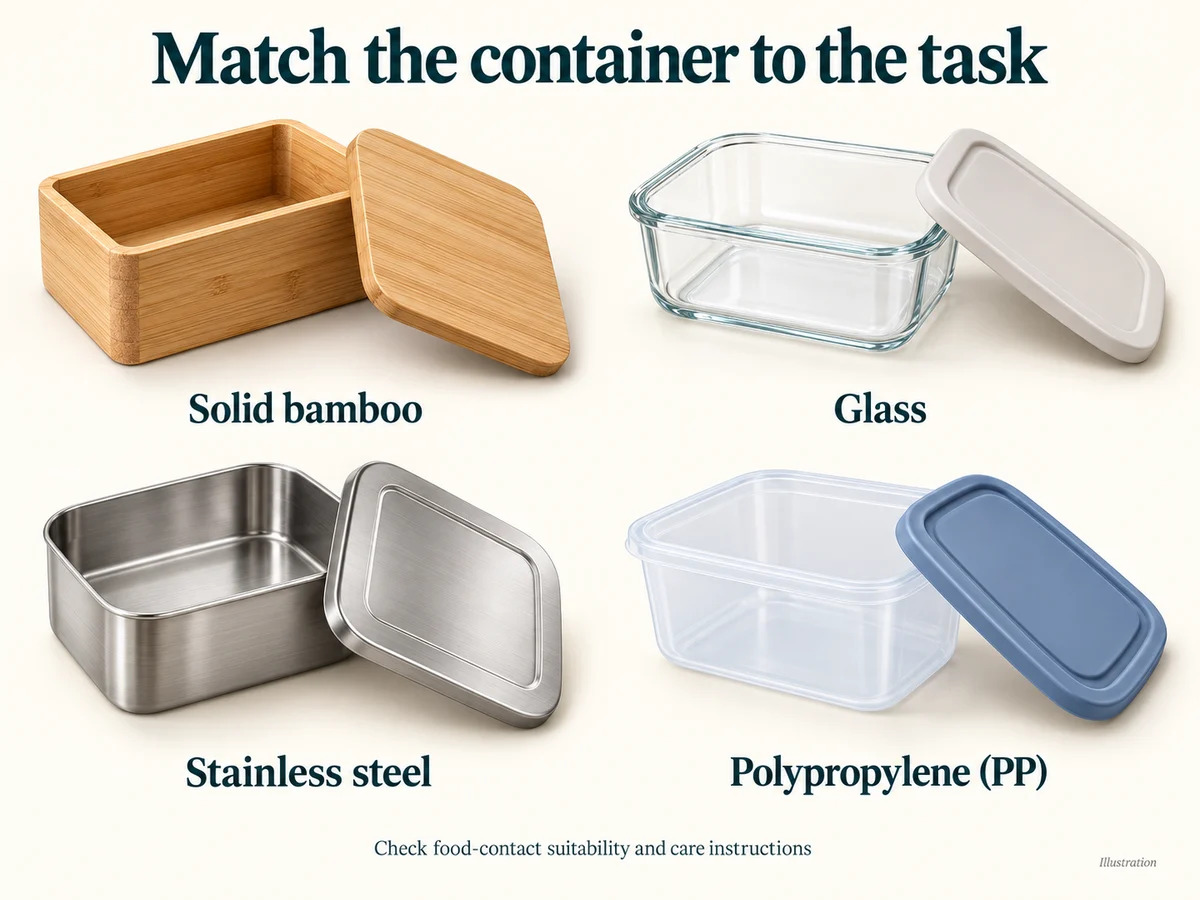
These use limits help you decide whether a bamboo container fits the job or whether glass, stainless steel or PP would suit it better. Reheating leftovers, carrying lunch and displaying wrapped dry goods do not require the same container. No single material earns a universal “healthiest” rating.
| Material or construction | Reasons to consider it | Limits to check |
|---|---|---|
| Solid bamboo box | Dry storage, countertop presentation and customized packaging, within the product’s stated use. | Direct versus wrapped food, finish and adhesive, moisture care, actual seal. |
| Glass | Visibility of contents; some models also support reheating. | Weight, breakage, thermal-shock limits and separate lid instructions. Not every glass jar is oven-safe. |
| Stainless steel | Reusable containers where impact resistance matters. | Steel grade, intended foods and lid seal. Do not assume microwave compatibility. |
| Polypropylene (PP) | Lightweight food storage and transport in suitable reusable models. | Heat, freezer and dishwasher limits are product-specific. A resin code alone does not authorize every use. |
| Bamboo-plastic composite | Recognizable by its molded construction; identify it before making a purchase decision. | EU authorization issues and UK advice against food use. Appearance and BPA-free labels do not settle suitability. |
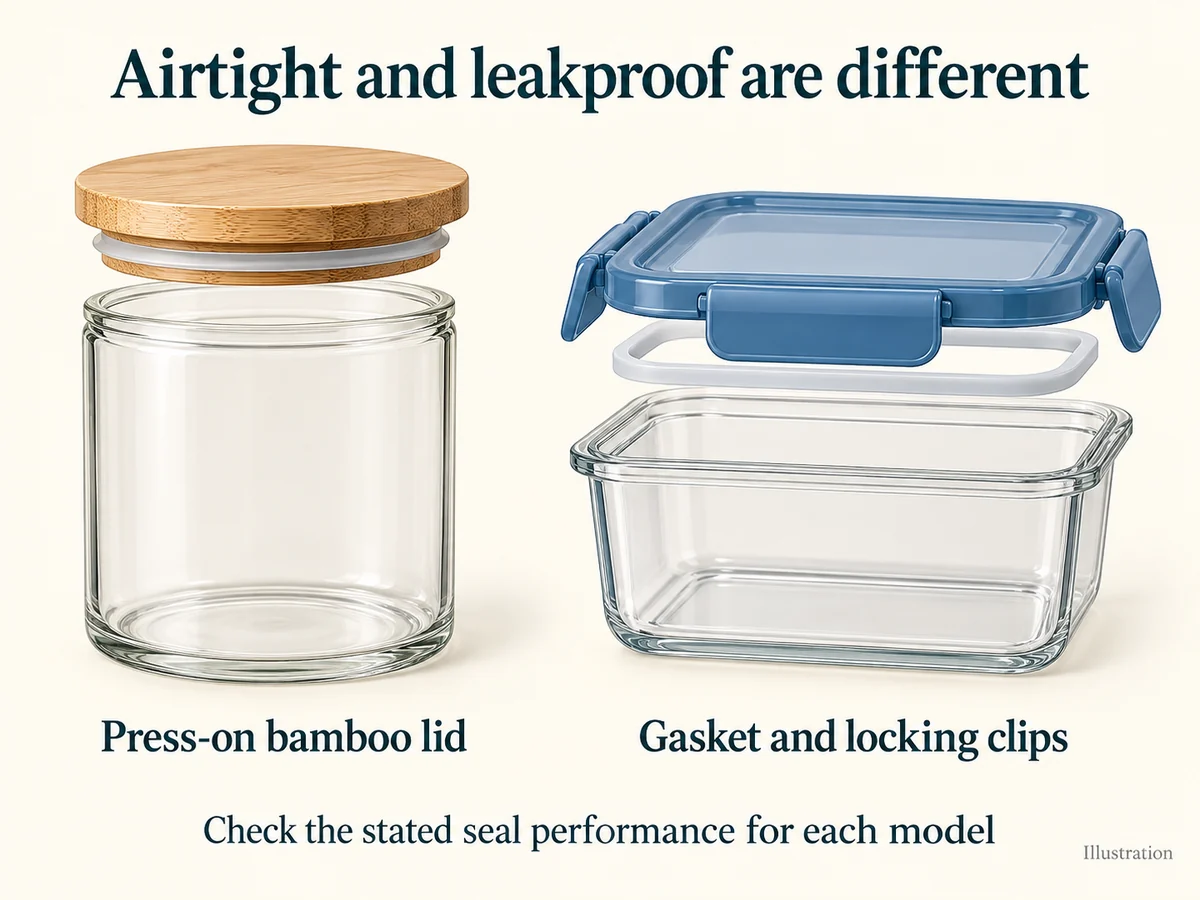
Airtight and leakproof are different claims
A lid may help limit air exchange while still leaking if the container tips over. For dry pantry storage, lid fit and moisture protection matter. For a bag containing lunch, the locking mechanism and leak performance matter too. Do not assume that a silicone ring proves either claim.
IKEA explicitly describes one glass jar with a bamboo lid as airtight but not leakproof. This is a useful distinction to ask about when comparing samples.
What should you check before buying or ordering?
Once you have a construction in mind, describe the actual storage task to the supplier. For a bulk order, include the food and destination market before choosing a finish or approving artwork. For example, will a bamboo tea box hold loose leaves against the interior or individually wrapped tea bags?
| Check | Request | Why it matters |
|---|---|---|
| Material and model | Box construction, board or resin type, lid, gasket, adhesive and interior finish. | Connects documents to the article you are actually ordering. |
| Food and contact | Loose or wrapped food, dry or moist, oily or acidic, storage time and temperature. | Defines the use the evidence must support. |
| Reports and declarations | Sample identity, tested material, test methods, contact conditions, date and results. | A coating-mixture screening report is not the same as migration testing of a finished box. |
| Destination market | Applicable requirements and the supplier’s basis for any compliance statement. | One market’s documentation is not a worldwide approval. |
| Physical sample | Interior and corner finish, lid fit, seams, dimensions, print or engraving and care label. | Shows whether the proposed design works in use. Appearance alone cannot establish chemical safety. |
| Packaging and order | Quantity by model, artwork, individual packaging, carton dimensions and agreed production specification. | Makes quotations comparable and reduces ambiguity before production. |
Keep the useful space-saving features
Nesting sets can reduce the space occupied by empty containers. Check whether the lids nest too, and whether the printed surfaces rub together. Importers should compare the actual packed carton dimensions and sets per carton rather than assuming a particular freight saving from a nesting photograph.
Capacity also needs a clear definition. Ask whether the quoted volume is brimful or usable with the lid fitted. For tea, coffee or biscuits, test the actual contents or inner pouch in a sample; a milliliter figure does not automatically translate into a fixed weight of every dry food.
Confirm customization on the chosen construction
Prints, engraving and packaging need to suit the material and finished design. For a set, specify the artwork for each size and check the color on a physical sample. Keep decoration away from food-contact areas unless it is part of the assessed specification. Confirm quantities, sample costs and production details for the selected container rather than borrowing terms from a dinnerware order.
We can discuss a side-pressed bamboo box for your dry-goods project. Tell us what you plan to store, whether the food is wrapped, your destination country, and the dimensions and quantity you need. With those details, we can review the proposed construction and available documents with you before finalizing a quotation.
Discuss your dry-goods storage box
Frequently asked questions
Is a bamboo lid on a glass jar the same as a bamboo-fiber container?
No. The glass forms the body; the bamboo lid, its coating and any gasket are separate components. Identify which parts may touch the food or condensation, and follow their individual care instructions.
Can I store coffee or tea directly in a solid bamboo box?
Only when that box and its interior finish are suitable for the intended direct contact. Confirm the food type and storage period. A box specified to hold sealed coffee pouches or wrapped tea bags should not automatically be used for loose contents.
Does a RoHS test report prove a food container is safe?
No. A RoHS report addresses specified restricted substances in the tested sample. It does not by itself show how a finished coating or box performs in contact with food. Read the sample description and test scope, not just the word “Pass”.
Are bamboo-fiber containers biodegradable or plastic-free?
A bamboo-filled plastic container contains a polymer binder, so it is not plastic-free. Plant content alone does not establish biodegradability or compostability of the finished product. Ask for evidence covering the whole article before making either claim.
Choosing the right container
A solid bamboo dry-goods box, a bamboo-plastic lunch box and a glass jar with a bamboo lid need different assessments. Choose the material and finish for the actual food, then check the use instructions and relevant documentation. For a custom order, make those conditions part of the agreed specification before production.
