
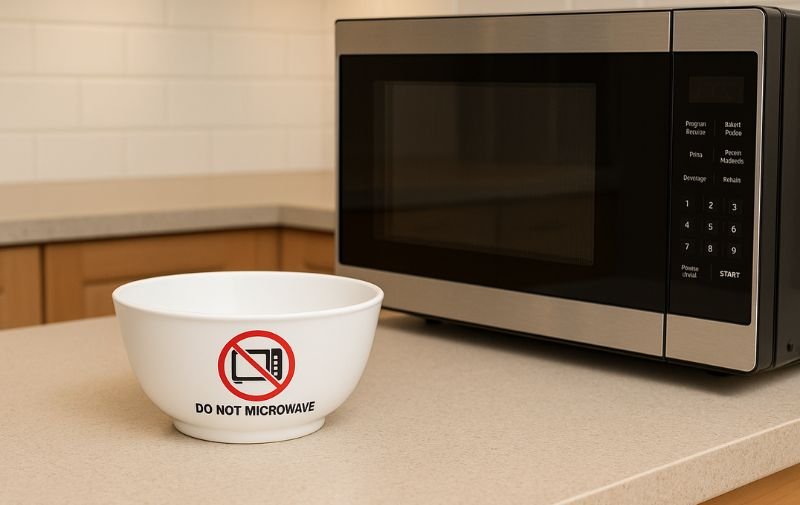
A melamine bowl can look like an everyday reheating bowl, especially when it feels sturdy and is labelled dishwasher-safe. That makes it easy to reach for when yesterday’s leftovers need warming. But washing and microwave heating are different uses, and one label does not establish suitability for the other.
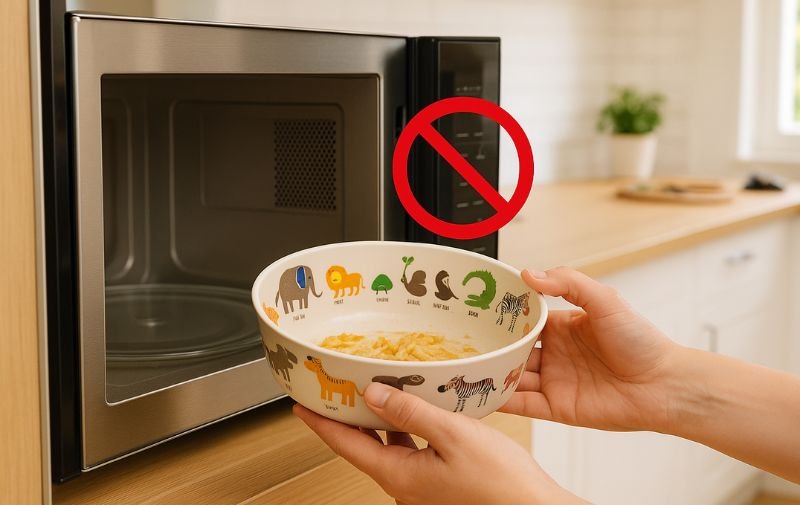
No, melamine bowls should not be used in the microwave. The FDA advises against heating food or drinks on melamine-based dinnerware. Transfer food to a container specifically labelled microwave-safe. A short heating time, an A5 material description or a heat-resistance rating does not make a melamine bowl suitable for microwave use.
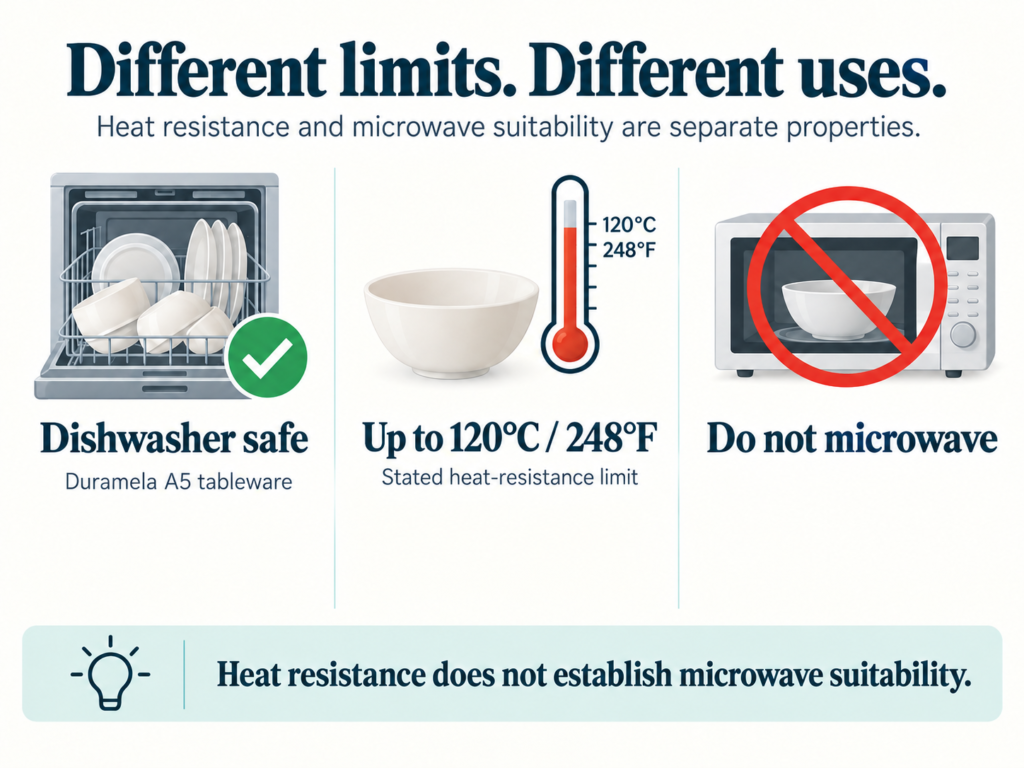
At Duramela, we supply A5 melamine tableware that is dishwasher-safe, with a stated maximum heat resistance of 120°C (248°F). Those specifications do not make it microwave cookware. For home users and restaurant buyers, the useful distinction is between a bowl for serving and a container for reheating. Here is how to make that choice and what to do if a bowl has already gone into the microwave.
Reviewed: 13 October 2026
Are Melamine Bowls Microwave Safe?
Keep melamine bowls out of the microwave, including for reheating, defrosting and short bursts at low power. There is no general 10-second or 30-second exception. The same advice applies to plain white bowls and printed designs; appearance does not tell you how a material will behave during heating.
The FDA’s guidance on melamine tableware is clear about microwave use. Check the instructions for the actual reheating container, including its lid, rather than relying on its weight, price or resemblance to ceramic.
| Situation | Suitable use? | What to do |
|---|---|---|
| Reheating or defrosting in a microwave | No, including brief or low-power cycles | Transfer food to a microwave-safe container first. |
| Cleaning Duramela A5 tableware in a dishwasher | Yes, under the product’s care instructions | Use the specified washing conditions; do not infer microwave suitability. |
| Serving cold or lukewarm food | Intended serving use, subject to the product instructions | Use an intact bowl and follow its food-contact conditions. |
| Very hot soup or prolonged hot-food holding | Do not decide from a heat-resistance number alone | Check hot-food guidance and choose a vessel intended for that use. |
| Oven, air fryer or direct hob heating | Not a cooking use for melamine serving bowls | Use cookware suitable for the appliance. |
Why Shouldn’t You Microwave Melamine Bowls?
Melamine dinnerware is normally made from melamine-formaldehyde resin. Its hard finish and resistance to everyday handling do not establish suitability for microwave heating. The concerns include chemical migration during unsuitable hot-food contact and damage from use outside the product’s limits.
Heat, contact time and the food all matter
Chemical migration is the transfer of substances from a food-contact material into food. The FDA notes that elevated temperatures can increase melamine migration into highly acidic foods. A bowl of tomato sauce is therefore not a useful way to test whether a melamine bowl can tolerate reheating. Looking for visible damage afterwards does not measure what transferred into the food.
Food-contact reports also have a defined scope: the sample, food simulants, contact time and temperature. A report covering a serving application does not automatically cover microwave cooking. Nor does a BPA-free claim address all of the substances or conditions relevant to melamine resin.
Damage and hot surfaces need attention
Stop using a bowl with cracks, blistering, rough patches or other surface deterioration. These are reasons to inspect and replace tableware, but they are not a home test for chemical migration. A bowl can look unchanged after misuse; that does not establish microwave suitability.
Handle any freshly heated container carefully. Even microwave-safe glass or ceramic can become hot from the food inside. It would be misleading to treat those alternatives as having no burn risk.
What If You Accidentally Microwaved a Melamine Bowl?
Stop the cycle and let the bowl cool before handling it. Do not repeat the experiment to see whether the same thing happens again.
- Remove it from the reheating routine. Use a labelled microwave-safe container for subsequent meals.
- Check the cooled bowl. Look for cracks, blisters, discoloration, roughness or an unusual smell. If it is damaged, take it out of food service.
- Do not use appearance or smell to clear the food. These observations cannot tell you the amount of chemical migration. Do not taste food to test it. If the bowl deteriorated or left particles or an unusual odour in the food, discard that food.
- Keep the product information if you need advice. The manufacturer can review the model and misuse conditions. If someone feels unwell after eating, seek medical or poison-information advice rather than relying on an online article to assess the exposure.
One accidental use does not, by itself, establish that poisoning occurred. Equally, an article cannot guarantee that a particular meal or bowl is unaffected without knowing the product and exposure conditions.
Does Dishwasher-Safe or 120°C Heat Resistance Mean Microwave-Safe?
No. Duramela’s A5 melamine tableware is dishwasher-safe and has a stated maximum heat resistance of 120°C (248°F). That maximum is not a recommended food-holding temperature, a continuous-use duration or permission to cook in the bowl. The washing instructions and the food-contact conditions still apply.
A dishwasher cycle and a microwave cycle expose tableware to different conditions. Do not turn a material temperature specification into a microwave time limit. For commercial dishwashers, check the model’s care instructions against your wash, rinse and drying cycle, including the detergent used.
| Label or description | What it tells you | What it does not establish |
|---|---|---|
| Dishwasher-safe | The product is intended for dishwasher cleaning under its care instructions. | Permission to microwave, bake or cook in it. |
| Heat resistance up to 120°C / 248°F | Duramela’s stated maximum heat-resistance specification. | A safe holding time for every food, or a microwave setting. |
| A5 melamine | A material description used for our melamine tableware. | A microwave-safe designation or proof of every finished product’s compliance. |
| BPA-free | A claim about BPA. | That the item has been evaluated for microwave use. |
| Food-contact test report | Results for the identified sample under stated test conditions. | Approval for uses outside that scope. |
| Microwave-safe | The intended reheating use of a specifically identified container. | Unlimited heating, an oven-safe rating or suitability of a different lid. |
For everyday cleaning, avoid abrasive pads that damage the surface, and inspect bowls as they come out of the wash. For other brands, follow their own instructions rather than assuming Duramela’s specifications apply to every melamine item.
Can Melamine Bowls Hold Hot Food?
Serving and microwave heating are different questions, but a blanket claim that every hot food is suitable would also be too broad. Temperature, contact duration, food type and the finished product all matter.
The FDA describes serving food on melamine tableware after heating it in suitable cookware. Germany’s Federal Institute for Risk Assessment (BfR) gives more conservative advice: avoid hot-food contact with melamine-formaldehyde resin tableware, including serving, and do not microwave it. Its guidance distinguishes this from cold or lukewarm use.
For very hot soup or prolonged hot holding, choose a vessel specifically intended for that task. Do not use the 120°C specification as a substitute for food-contact information. Our melamine food-contact safety guide explains how to read the product and report details.
Which Bowls Should You Use in the Microwave Instead?
Choose the actual container by its microwave instructions, not just by its material name. Check the lid separately: a bowl and its cover can have different temperature and ventilation requirements.
| Container type | What to check | Practical caution |
|---|---|---|
| Glass bowl or food container | Explicit microwave-use instructions for that product. | Follow thermal-shock precautions. A hot bowl can burn you. |
| Ceramic bowl | A microwave-safe designation; no prohibited metallic decoration. | Check for damage and follow the manufacturer’s heating limits. |
| Plastic container, including PP | Explicit microwave suitability and any food, time or temperature limits. | A number 5 recycling mark or BPA-free claim alone is insufficient. |
| Paper container | Instructions allowing the intended microwave use. | Not a general substitute for a soup bowl; coatings, printing and food type matter. |
| Unmarked, decorative or unidentified bowl | Identify the product and obtain its instructions. | Use a known microwave-safe container while the suitability is uncertain. |
Transfer the food before heating, vent the cover as instructed, and follow the appliance’s directions for stirring and standing time. Use suitable hand protection when removing hot dishes. Microwave suitability does not mean the outside of a container will stay cool.
Can Melamine Bowls Go in an Oven or Air Fryer?
No. Use cookware rated for the appliance instead of a melamine serving bowl. This includes conventional ovens, air fryers, hobs and direct contact with heating elements. Do not treat a low oven setting as permission to use a bowl intended for serving.
The same care is needed with warming equipment. A stated maximum heat resistance does not establish suitability for prolonged holding or exposure to a heat source. Tell the supplier which equipment you use before selecting tableware for a heated buffet or service line.
Choosing Bowls for Restaurant Reheating and Service
For a restaurant that reheats individual portions, define the reheating container before choosing the table presentation. Staff need to know which items can go into the microwave, especially when similar-looking bowls share a shelf.
Keep designated microwave-safe containers easy to identify and store them separately from melamine serving bowls. Include the washing instructions in staff handovers. When selecting a serving bowl, check its capacity with your actual portion, the rim’s handling comfort and how it fits your dishwasher racks.
We can discuss the bowl model, quantity, artwork and intended use before an order. Tell us whether your routine includes reheating, hot holding or commercial dishwashing so the product discussion starts with how the bowl will be used. Relevant food-contact documents should identify the sample and test conditions; they should not be presented as a microwave approval.
Browse our melamine bowl range, or send the model or reference photo, portion size, destination market and cleaning routine with your enquiry.
Discuss Your Bowl Requirements
Common Questions About Microwaving Melamine
My bowl has no microwave warning. Does that mean I can use it?
No. A missing warning is not evidence of suitability. If you know it is melamine, do not microwave it. If the material is unknown, identify the model and obtain the manufacturer’s instructions before using it for heating.
No. A5 describes the melamine material; it does not turn a serving bowl into microwave cookware. A higher price, thicker wall or heavier bowl is not a substitute for use instructions.
Can I use melamine as a lid over another bowl in the microwave?
Use a cover intended for microwave use instead. A melamine bowl or plate used as a cover is still being placed in the microwave.
What if the bowl is advertised as bamboo or wheat straw?
Those names do not identify the complete material. Some products combine plant material with a plastic binder. If that binder is melamine resin, do not microwave it; other composites still need their own explicit instructions. See our bamboo-melamine material guide for the distinction.
Can I test an empty melamine bowl in the microwave?
Do not run an empty-bowl experiment to establish suitability. It cannot measure migration or certify future use with food. Choose a container whose manufacturer already specifies microwave use.
For reheating, move food into a labelled microwave-safe container. For serving and washing, follow the melamine product’s instructions. Keeping those jobs separate is a practical way to avoid treating dishwasher suitability or heat resistance as a cooking claim.
