

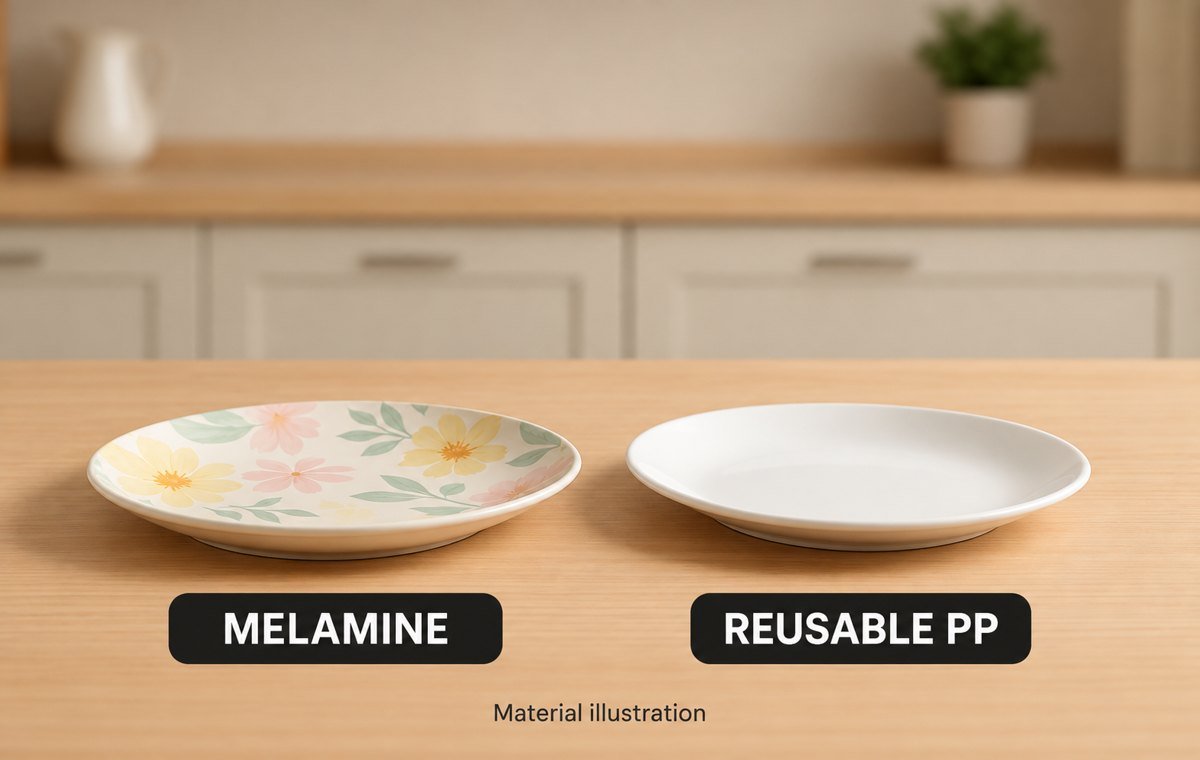
Melamine and plastic plates can look similar in a product photo, but they can behave differently in daily use. A plate chosen for a restaurant patio may need to hold its shape and presentation through repeated service. A plate used to reheat lunch has a different job.
Melamine plates can be a better fit when you want rigid, reusable dinnerware with a ceramic-like appearance. They are not always better or safer than other plastic plates. Melamine is itself a plastic, and it should not go in the microwave. For reheating, choose a plate specifically labeled microwave-safe, which may include some polypropylene products.
Compare the actual plate as well as the material name. Its size, weight, finish, care instructions, and food-contact documentation will tell you more than an A5 or BPA-free label alone. The comparisons below cover those differences and the checks worth making before buying a set or placing a bulk order.
Updated October 11, 2026 · By Lance, Duramela
Is melamine a type of plastic?
Yes. Melamine tableware is made with melamine-formaldehyde resin, a thermosetting plastic. Once cured into shape, it does not soften and remelt like a thermoplastic. That difference helps explain its rigid feel, but does not make it suitable for reheating food.
When a shop sells “plastic plates,” it may mean reusable polypropylene (PP), disposable polystyrene (PS), or another material. Comparing melamine with all of them as one group hides useful differences. A sturdy reusable PP plate is a different product from a thin disposable party plate.
What does A5 mean when you buy melamine plates?
A5 is a supplier grade description, not a food-safety certificate. Ask the supplier what it means in their material specification and which reports cover the finished plate. Labels such as A1, A3, and A5 should not replace that conversation.
A molded melamine article also contains filler; cellulose is commonly used. “100% melamine” in a sales description should therefore not be read as a finished plate made of resin alone. The BfR explanation of melamine-formaldehyde materials describes the role of these fillers.
Melamine vs other plastic plates at a glance
This table compares common product types. Thickness, formulation, decoration, and manufacturing quality still vary within each column. Use it to narrow your options before checking the actual model.
| What matters | Melamine plates | Reusable PP plates | Disposable PS plates |
|---|---|---|---|
| Typical purpose | Repeated table service | Repeated use; some models allow reheating | Single-use events or food service |
| Feel and rigidity | Hard, rigid body | Often lighter and more flexible; check thickness | Often light; rigidity varies with design |
| Appearance | Glossy or matte finishes, patterns and logos | Plain colors or decorated options | Plain or decorative finishes, including formal styles |
| Wear and drops | Can scratch, chip or crack | Can scratch or deform; impact performance varies | Thin models may bend or crack under load |
| Microwave use | No | Only if the particular plate is labeled for it | Do not assume suitability; follow the product label |
| Washing | Follow the model’s care instructions | Follow the model’s care instructions | Do not plan repeated washing of a single-use plate |
| Cost comparison | Include washing and replacement | Include washing and replacement | Include a new plate for each use and waste handling |
Polycarbonate (PC), SAN and other plastics also appear in tableware. If a listing only says “plastic,” request the resin name before comparing safety claims, cleaning instructions or price.
Which plates resist scratches, drops, and everyday wear?
Melamine’s hard surface and rigid body can suit repeated table service. A flexible PP plate may respond differently to a fall. Neither observation proves that every melamine plate will outlast every PP plate: surface wear, impact damage and bending are different tests.
Separate surface wear from break resistance
A plate may resist light utensil marks yet chip when it lands on its edge. Another may survive a drop but show scratches sooner. Avoid treating “scratch-resistant,” “shatter-resistant” and “unbreakable” as interchangeable descriptions.
For a useful sample comparison, choose plates of similar diameter and intended use. Check the rim for rough edges, the base for rocking, and the eating surface under angled light. Stack several plates to see whether they sit securely and separate easily. A sample review can reveal handling problems, but it is not a laboratory durability test.
Replace by condition, not a promised number of years
A home plate used twice a week and a restaurant plate washed several times a day do not have the same workload. Handling, detergent, storage and loss all affect replacement costs. A fixed lifespan such as “three years” is not a reliable comparison unless it comes from a defined test or your own service records.
Set aside plates with cracks, chips, rough damaged surfaces or distortion. In a restaurant, record why plates leave service. That gives you a better purchasing benchmark than a supplier’s claim that one material “lasts longer.”
Is melamine safer than other plastic plates?
There is no universal safety winner based on these material names. The useful questions are whether the finished article is suitable for food contact, what conditions it was evaluated for, and whether you will use it within those conditions.
What’s the truth about BPA in melamine versus other plastics?
Melamine-formaldehyde resin is made from melamine and formaldehyde, rather than bisphenol A (BPA). BPA is associated with materials such as polycarbonate and epoxy resins. A BPA-free claim therefore answers a different question from whether a melamine plate releases melamine or formaldehyde during use. See the BfR overview of BPA and its uses.
PP is also a different polymer from BPA-based polycarbonate. Choosing between melamine and PP solely by a BPA-free label misses the more practical differences, including reheating and cleaning. For a specific decorated plate, ask for the manufacturer’s material declaration and relevant finished-product documentation instead of assuming that a resin name verifies every component.
What should food-contact documentation cover?
Check the report’s product description, sample photo or model reference, test date, substances assessed and contact conditions. A report for another product, or for raw material alone, may not answer questions about the plate you are ordering. Your importer or testing laboratory can confirm whether additional documentation is needed for the destination market.
For melamine, temperature and food-contact conditions matter. The FDA’s tableware guidance discusses migration and warns against microwave heating. “BPA-free,” “A5” and “food-grade” do not override that advice.
Bamboo-filled melamine needs separate attention. It is not the same material as conventional melamine tableware with cellulose filler. The European Commission’s bamboo-plastic guidance explains that bamboo is not an authorised additive in plastic food-contact materials in the EU. Our bamboo melamine safety article covers that distinction.
Can you use them for hot food, microwaving, and dishwashing?
A plate keeping its shape does not prove that it is suitable for every temperature or food. Heat resistance, chemical migration and the manufacturer’s care instructions describe different things.
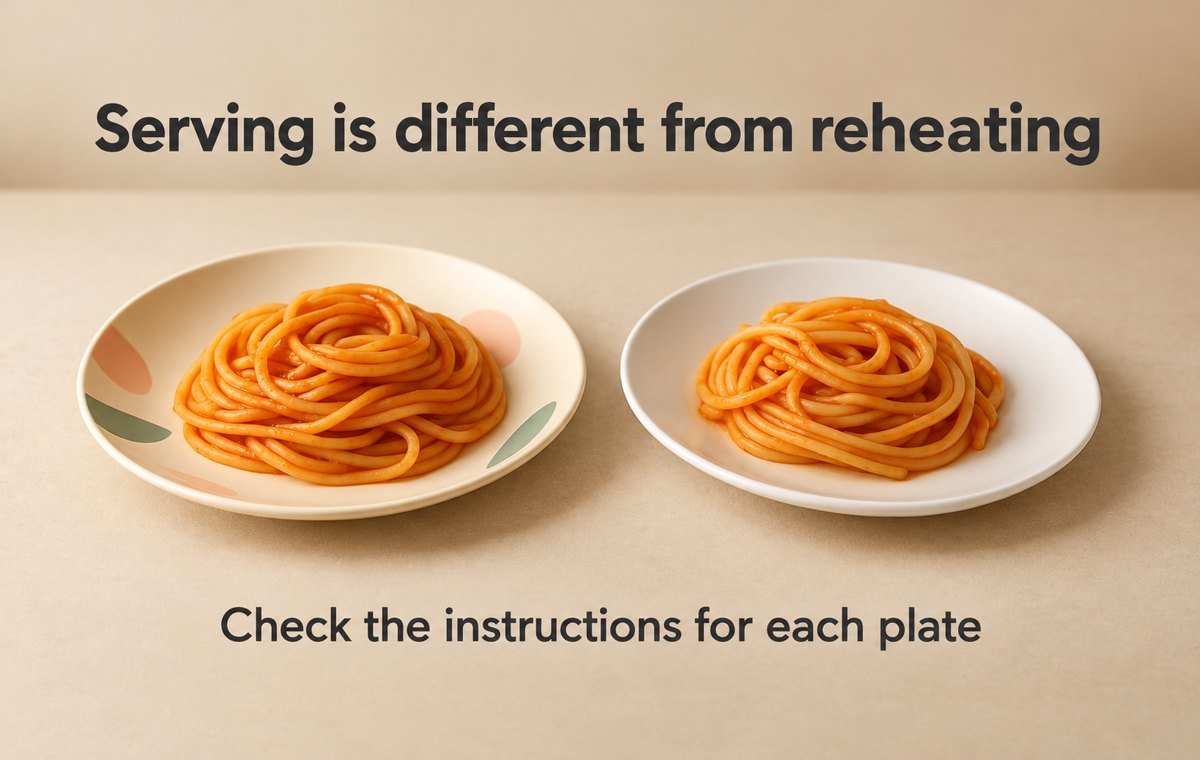
Microwaving and serving are different uses
Do not microwave melamine plates. For another plastic plate, check for an explicit microwave-safe instruction and follow any limits on time or food type. A PP marking by itself is not a reheating instruction. The USDA packaging glossary describes PP applications in microwave heating, while also distinguishing them from conventional oven use.
What about serving hot food?
The FDA permits serving food on melamine tableware after heating it in suitable cookware, while noting increased migration under very hot, acidic conditions. Germany’s BfR takes a more cautious position and recommends against contact with hot food. These are different recommendations; neither supports a blanket temperature promise for every plate.
If your operation holds hot, acidic dishes for extended periods, identify that use before choosing the material. For reheating or hot holding, select tableware specifically intended for the equipment and conditions involved.
| Use | Melamine | Other plastic plates |
|---|---|---|
| Microwave | Do not use | Use only a specifically labeled suitable product |
| Oven, grill or direct heat | Not suitable | Do not infer suitability from a microwave-safe label |
| Hot or acidic foods | Review the guidance above and the applicable use limits | Check food type, temperature and contact duration for that product |
| Dishwasher | Confirm the selected model’s washing instructions | Confirm the selected model’s washing instructions |
| Commercial wash cycle | Check detergent and wash/rinse conditions with the supplier | A domestic dishwasher claim may not cover your commercial cycle |
Cleaning, staining and surface care
Staining depends on the food, contact time and condition of the surface, as well as the material. Test your usual sauces on a sample within its permitted use conditions, then clean it as instructed. Compare the result under the same lighting.
Use the recommended detergent and a non-abrasive cleaning method. Do not try to restore a damaged surface by aggressive scouring. Let plates dry before storage, and keep stacks manageable so edges are not repeatedly knocked together. For a bulk purchase, include your normal wash routine in the sample evaluation.
How do they compare in appearance, weight, and printing?
Melamine is often chosen when a buyer wants a rigid plate with the look of glazed ceramic. It can carry a logo, decorative border or full-surface print. Reusable PP also comes in different colors and finishes; calling every PP plate “cheap-looking” is not a useful specification.
Hold the samples rather than judging only from photos. Compare the weight of plates with similar dimensions, the feel of the rim, the finish under your lighting and the space left for food. A wide decorative border may look attractive but leave less usable space for the same outer diameter.
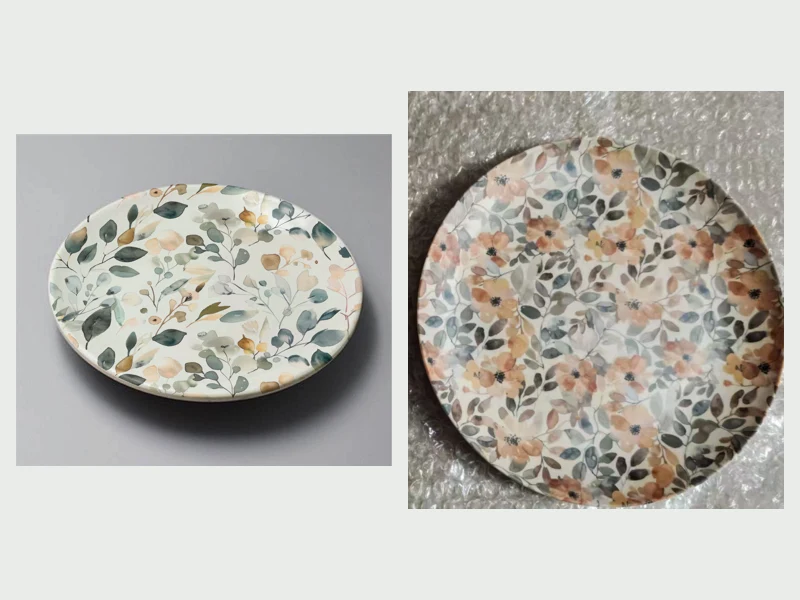
For a restaurant logo, check its position with food on the plate. For a retail range, compare a few prints on the same model before expanding the assortment. Keep an approved physical sample and artwork reference so later orders have something specific to match.
Which costs less over repeated use?
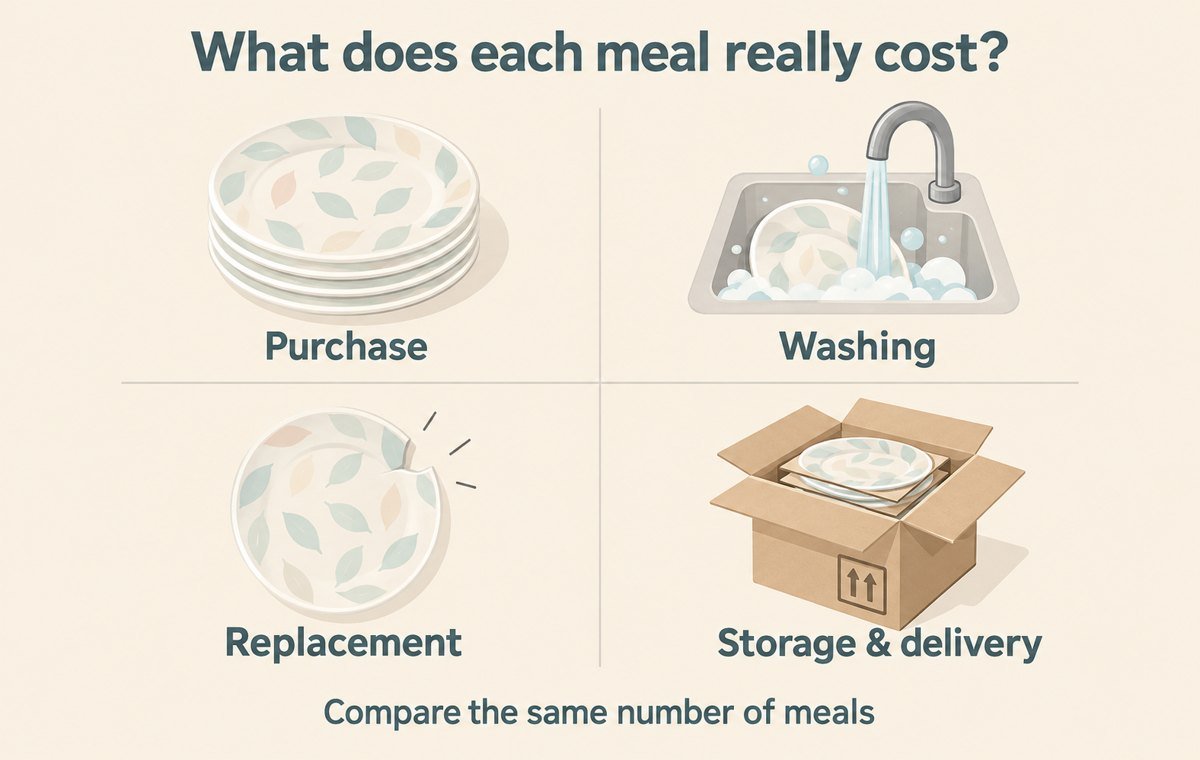
Compare the cost of serving the same number of meals. The cheapest plate to buy is not necessarily the cheapest to operate, and a reusable plate does not become economical unless it is actually reused.
For reusable melamine or PP, include the purchase, washing, replacement and handling costs over your chosen period. For single-use plates, include every plate consumed and waste handling. Use quotes and service records where you have them; do not assume PP needs monthly replacement or that melamine lasts a fixed number of years.
| Cost input | What to include | Where to get the figure |
|---|---|---|
| Purchase and setup | Plate price, printing, samples and any new mold | Itemized supplier quote |
| Washing | Labor, water, energy and detergent | Your wash cycle and operating costs |
| Replacement | Damaged, worn or missing plates | Trial or existing service records |
| Storage and delivery | Carton space, freight and handling | Packing details and delivery quote |
| Single-use consumption | All plates used, including double plating and waste collection | Actual event or service consumption |
A useful working calculation is total dinnerware-related cost divided by meals served. Use the same period and cost categories for both options. If you have no replacement data, calculate several scenarios and label them as estimates. That exposes which assumption changes your decision.
Are reusable plates the more sustainable choice?
Reuse can reduce the number of plates discarded after each meal, but it does not establish a universal environmental winner. Production, washing, transport, loss and the number of completed uses all affect the comparison. Reusable PP belongs in that discussion alongside melamine.

Do not assume that “plastic” means locally recyclable. Ask your waste collector whether it accepts the actual item, including its resin, form and condition. A recycling symbol does not guarantee collection. Likewise, a plant-fiber ingredient does not establish that a finished resin plate is biodegradable or compostable.
For an event, the practical question may be whether plates will be collected, washed and returned. For a restaurant, track loss and damage alongside wash efficiency. Those details are more useful than an unsupported “eco-friendly” badge.
Which plate suits your setting?
Start with the job the plate must do. A microwave requirement can settle the choice before you compare patterns. A large event without washing facilities raises different questions from a restaurant with a commercial dishwasher.
| Setting | A sensible starting point | Check before buying |
|---|---|---|
| Home meals with reheating | A specifically microwave-safe plate | Material and heating instructions; melamine is unsuitable for this task |
| Restaurant table service | Compare reusable melamine and PP samples for the planned menu | Food-contact conditions, appearance, stacking and washing |
| Outdoor dining or camping | Reusable plates suited to the food and packing routine | Weight, secure stacking and separation from cooking heat |
| Children’s meals | Age-appropriate tableware with clear instructions | Condition, grip and serving temperature; avoid an “unbreakable” assumption |
| Parties and catered events | Reusable service where collection and washing work; otherwise assess suitable single-use options | Food weight, permitted use, local rules and waste arrangements |
If you want ceramic-like presentation and a rigid reusable plate, melamine is worth comparing. If you need to reheat on the plate, choose an expressly suitable product instead. If cost is the deciding factor, calculate it for your actual service rather than comparing one reusable plate with one disposable plate.
What should you check before a bulk order?
Send suppliers the same specification. Otherwise, a lower quote may describe a smaller, lighter plate, a different decoration method or different packaging. The checklist below makes sample reviews and quotes easier to compare.
| Check | Ask for or review | Why it helps |
|---|---|---|
| Material and use | Resin specification, destination market and intended foods | Identifies the product being quoted |
| Dimensions and handling | Diameter, usable center, depth, weight and stack height | Checks portion size, storage and carrying |
| Food-contact documents | Applicable report and supporting compliance documents, with product identification and test conditions | Connects the evidence to the planned order |
| Print and finish | Artwork, logo position and an approved sample | Sets a reference for appearance |
| Care | Written washing and use limits | Checks compatibility with your operation |
| Order and delivery | Quantity per model and print, sample charges, production timing and packing | Makes the total quote and schedule clearer |
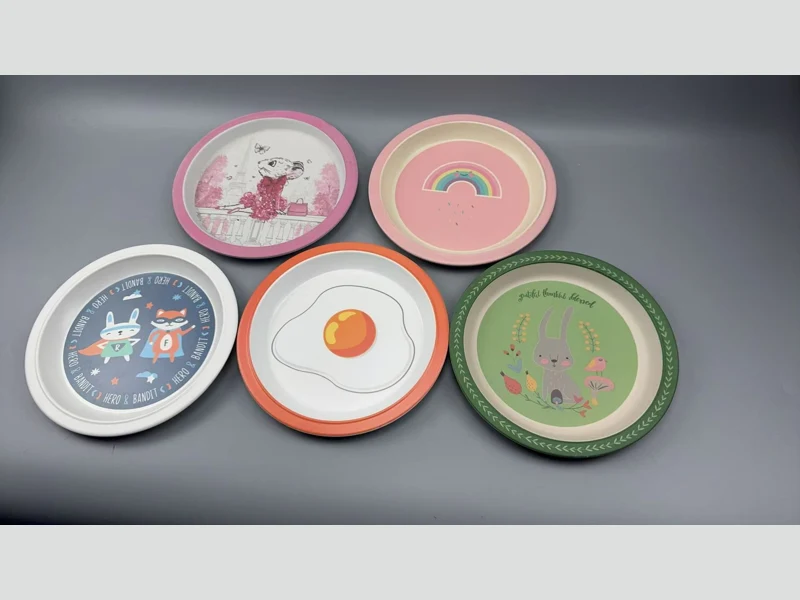
Duramela supplies custom melamine plates with restaurant logos and printed designs. Our restaurant plate page shows a 20 cm custom-logo project for a Belgian customer, including the plates in use. You can also browse our melamine plate range to choose a model for sampling.
For a sample enquiry, send the model or reference photo, quantity per design, destination country and intended use. Include your washing conditions if the plates are for commercial service. We can then discuss the sample, printing and applicable product documents for that order.
Frequently asked questions
Is melamine better than plastic for everyday use?
Melamine can suit everyday serving when you want a rigid plate with a ceramic-like finish, subject to its use instructions. It is itself a plastic. A reusable PP plate may suit a different routine, particularly if that specific product permits reheating. Compare the finished products rather than assuming one material is always better.
Does BPA-free mean melamine is safe to microwave?
No. BPA-free does not mean microwave-safe. Melamine tableware should not be used to heat food in a microwave, regardless of a BPA-free claim.
Can the number on the bottom identify the plate?
A resin marking can help identify material, but it does not establish the complete formulation, food-contact compliance or permitted heating conditions. A broad “other plastics” category cannot identify melamine on its own. Read the care label and ask the manufacturer if the material is unclear.
Does melamine release fewer microplastics than PP?
This comparison does not establish that. A claim about particle release needs product-specific evidence under comparable wear, temperature and washing conditions. Do not treat a smooth-looking surface, BPA-free label or migration report for particular chemicals as proof of zero particle release.
Are bamboo melamine plates a safer natural alternative?
No such conclusion follows from the bamboo ingredient. Bamboo-filled resin plates are plastic composites and have their own food-contact concerns. They should not inherit a safety claim from conventional melamine. See the material and market distinctions for bamboo melamine.
Why can two melamine plates have very different prices?
Compare their size, weight, finish, print, packing and order quantities. A new shape can also require tooling. Ask for an itemized quote and matching samples before attributing the entire difference to an A-grade label.
Choose the use conditions first, then compare samples and documents. That will tell you more about the right plate for your home or business than the broad label “melamine versus plastic.”
