

A melamine plate can look much like ceramic while feeling lighter in your hand. That makes it appealing for a busy dining room or an outdoor table, but it leaves a practical question: can you use it for the meals you normally serve, including hot food and children’s portions?
Melamine plates can be suitable for food service when the finished product meets the applicable requirements and is used within its stated limits. They are not microwave cookware. Hot-food advice differs between authorities, and neither an A5 label nor a BPA-free claim establishes safety for every use. Check the product’s instructions, condition and supporting test information.
We supply melamine plates at Duramela, so this distinction matters when discussing an order. A plate’s appearance tells you little about its tested use conditions. The guidance below separates everyday handling decisions from the documents a restaurant or importer should check before buying.
Reviewed: 13 October 2026
Are melamine plates safe to eat from?
Melamine plates can be suitable for serving food within the finished product’s documented limits. Serving a meal, reheating it and storing leftovers are different uses. For everyday decisions, start with the food’s temperature, how long it will stay on the plate and the plate’s condition. The sections below explain where extra care is needed.
The Hong Kong Centre for Food Safety’s study of melamine ware advises food businesses to buy from reliable suppliers and follow product specifications. That is a useful starting point for both a household purchase and a restaurant order.
| What you want to do | What to check | Practical next step |
|---|---|---|
| Serve a meal | Food type, serving conditions and the plate’s instructions | Choose a model documented for the intended use. |
| Reheat food | A separate dish’s heating instructions | Use cookware explicitly suitable for the appliance. |
| Use the plates in a restaurant | Menu, holding time, washing process and destination market | Give the supplier these details before selecting a model. |
| Keep using an older set | Its identity, care history and surface condition | Inspect each piece; replace damaged items. |

What are melamine plates made of?
Melamine dinnerware is a hard plastic based on melamine-formaldehyde resin. The material name describes a resin system, not a plate made from the raw chemical melamine alone. Fillers and decorative components also matter when identifying the finished article.
Its weight, resistance to breakage and range of printed designs explain its appeal for repeated service. Those practical qualities should be assessed separately from food-contact suitability. A plate can feel substantial and have a neat finish without that telling you how it performs in migration testing.
What does A5 tell you?
We use A5 melamine material for our plates. When specifying an order, record the material description alongside the model, dimensions and print. Do not use the grade name as a substitute for a report covering the product and the intended conditions. Likewise, a claim of “100% melamine” should not be read as a complete formulation or a promise of zero migration.
Does BPA-free mean the plate is safe for any food?
No. BPA-free addresses one substance. It does not establish how a plate performs when heated or worn, or what amounts of melamine and formaldehyde may migrate into food.
What do FDA and BfR say about melamine dinnerware?
The FDA’s tableware guidance permits serving food on melamine-based tableware but says not to microwave food or drinks in it. It also explains that heat and acidity can increase migration. This guidance is not an FDA certificate for a particular Duramela model.
Germany’s Federal Institute for Risk Assessment (BfR) gives more conservative advice: avoid contact between melamine-formaldehyde resin tableware and hot food. Its FAQ distinguishes this from cold or lukewarm use. These are attributed recommendations; they should not be presented as identical worldwide rules.
For a purchase, use the guidance applicable to your market together with the product’s documented limits. A report and a general advice page answer different questions. The report identifies what was tested; the advice helps you decide whether the planned use is appropriate.
Can melamine plates hold hot or acidic food?
Do not assume that hot soup, coffee and a cool salad are interchangeable uses. The FDA and BfR recommendations above differ, so a blanket “all hot food is fine” answer would hide a meaningful qualification. For hot meals, choosing a dish specifically intended for that task is the straightforward option.
The Centre for Food Safety’s handling advice also cautions against using melamine ware for hot oil, freshly deep-fried foods or storage of highly acidic foods. Serving and storing are different tasks: a short meal does not establish suitability for keeping leftovers overnight.
A temperature printed on a specification sheet needs context. Ask whether it describes food contact, washing or another test, and for how long. Do not take 70°C as a universal dividing line that makes every melamine product safe below it. If your service includes hot holding, describe the actual process rather than asking only whether the plate is “heat resistant.”
Can melamine plates go in the microwave or oven?
Do not microwave melamine plates. Use a separate dish explicitly labelled for microwave heating, as the FDA recommends. A brief reheating cycle is still heating; a plate that looks unchanged afterwards has not thereby passed a safety test.
Do not use serving plates as ovenware or put them on a hob. Keep the cooking dish and serving dish distinct in your kitchen routine. For restaurants, include this in staff instructions so plates are not accidentally sent through a reheating step. A “dishwasher-safe” statement does not grant permission to use an oven or microwave.
Are melamine plates suitable for babies and children?
A small, light plate may be easier to handle, but age-appropriate size and resistance to breakage do not settle food-contact safety. The Centre for Food Safety’s advice on children’s tableware asks parents to consider the conditions of use, including food type and heating.
Check the intended age group and care instructions. Prepare and heat food in appropriate cookware, supervise use, and inspect the plate during washing. For a product used with hot infant food or formula, follow the more cautious hot-contact guidance discussed above rather than relying on a children’s design or BPA-free wording.
For a nursery or school order, include the children’s age group, meal temperatures and washing routine in the purchasing specification.
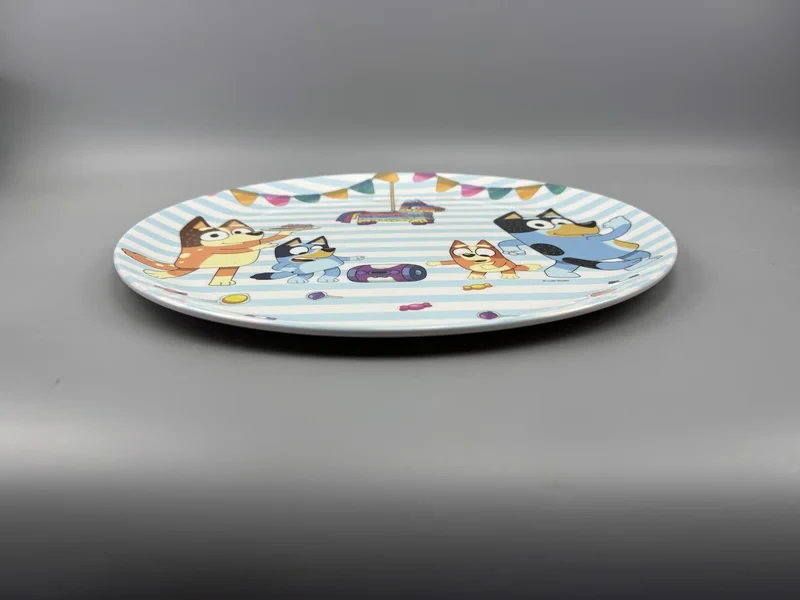
How should you clean melamine plates, and when should you replace them?
Follow the instructions for the model you own. Dishwasher settings vary, so a general label needs to be matched to your actual machine and cycle. For handwashing, use the recommended detergent and a soft cleaning tool; do not try to restore a worn surface with abrasive scouring.
BfR advises replacing tableware with damaged surfaces. Inspection is particularly useful in a mixed restaurant stack, where one heavily worn plate can be missed among newer pieces. Do not assign a universal replacement interval in months or years: condition and usage differ.
| What you notice | What to do |
|---|---|
| Food residue on an otherwise intact surface | Clean using the manufacturer’s instructions, then inspect again. |
| A stain that does not wash away | Ask about an approved cleaning method; do not use an abrasive treatment to force it off. |
| Cracks, chips or a damaged food-contact surface | Remove the item from food service and replace it. |
| Peeling decoration or substantial surface wear | Stop using it for food and contact the supplier about the defect. |
| Uncertain compatibility with a commercial wash cycle | Confirm the cycle conditions before putting a new range into routine use. |
How can you check whether a melamine plate is suitable for food contact?
Keep the product description, sample and documents connected. A report for a different item is not enough just because both products are white melamine plates. Ask the supplier to explain any mismatch in model number, material or decoration rather than making that assumption yourself.
| Label or claim | What it addresses | What to request or check |
|---|---|---|
| A5 / 100% melamine | The supplier’s material description | Finished-product identity and applicable supporting documents |
| BPA-free | A claim about BPA | Separate evidence for the product’s intended food-contact use |
| Dishwasher-safe | A cleaning claim | Cycle, detergent and other stated limitations |
| Tested to a food-contact requirement | Results for identified samples and test conditions | The complete report, including sample details and results |
| Smooth, heavy or glossy | Appearance and handling | Do not use these characteristics as substitutes for testing |
What should a buyer look for in a report?
| Check | Question to resolve before ordering |
|---|---|
| Sample identity | Does the model, photograph or description correspond to the item being purchased? |
| Material and decoration | Does the tested specification represent the proposed product? Ask about changes. |
| Methods and results | Which substances or properties were tested, and what were the reported findings? |
| Contact conditions | What temperature, duration and food simulants were used? How do these relate to the intended use? |
| Destination market | Which requirements does the report address, and is additional documentation needed? |
| Traceability | Can the supplier connect the report and agreed specification to the order? |
I would check that connection before comparing two suppliers’ claims. A one-page certificate image can look convincing while leaving out the sample description or test conditions you need to read.
When should you choose another material?
Choose around the task. If you want to heat and eat from the same dish, look for glass or ceramic cookware explicitly marked for that appliance. Do not assume every glass or ceramic plate is microwave-safe; decorative finishes and product instructions still matter.
If breakage and frequent handling are the main concerns, consider suitable stainless steel tableware alongside melamine. Check the particular product’s use instructions and whether its weight, shape and appearance suit your service. The best comparison uses the actual dishes and workflow, not a universal ranking of materials.
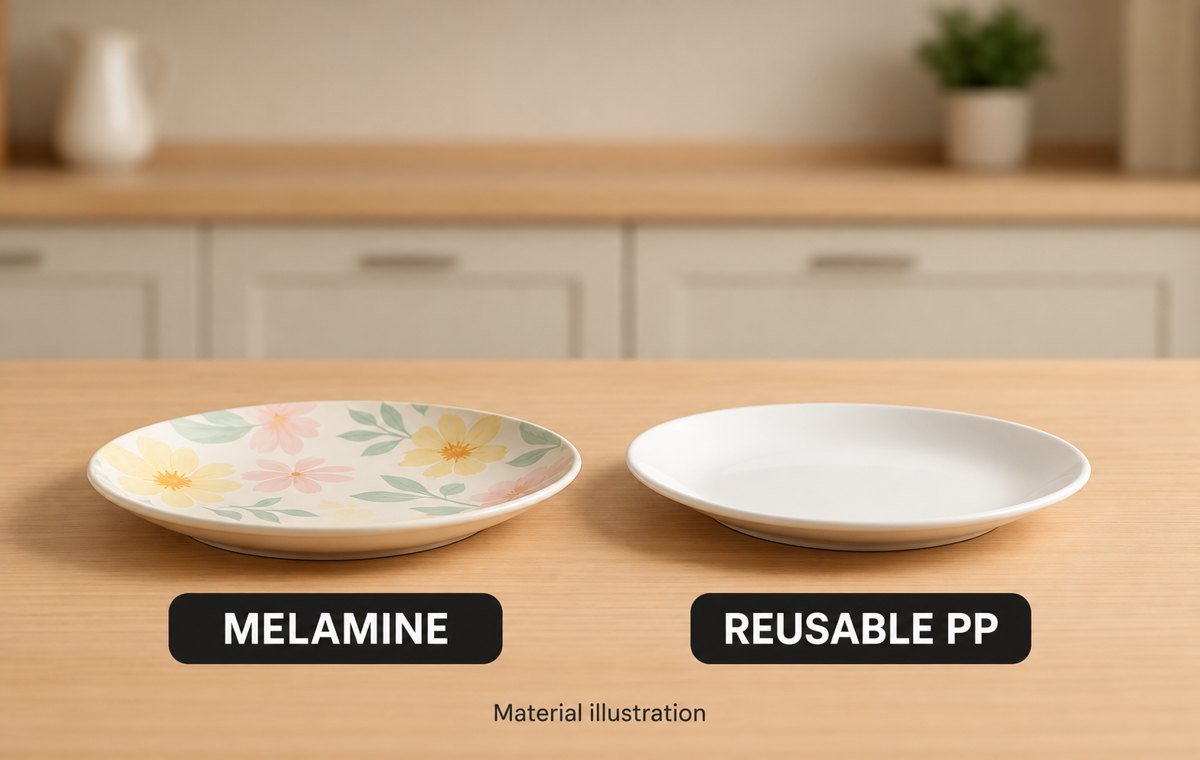
Reusable polypropylene (PP) is another plastic option. Check the individual product label rather than applying melamine instructions to PP, or assuming that every PP plate has the same heating limits.
Bamboo-filled plastic is a separate case. It should not be presented as an automatically safer or wholly natural version of melamine. The European Commission’s bamboo-plastic action addresses plastic food-contact products containing unauthorised bamboo additives. Solid bamboo articles are a different material category.
For a broader material comparison, see melamine plates versus other plastics and our explanation of bamboo-melamine plates.
Common questions about melamine plate safety
Does a more expensive plate mean better safety?
Price includes design, weight, packaging and order size as well as manufacturing costs. It cannot replace the product information and evidence above. Compare like-for-like specifications before treating a higher price as reassurance.
Can I identify a suitable plate from a photograph?
A photograph helps assess shape, decoration and visible defects. It cannot establish the composition or migration performance. Ask for the model details and instructions, especially when buying from a marketplace listing with little technical information.
Are plain plates automatically safer than printed ones?
The absence of a pattern does not prove suitability, and a pattern alone does not establish a problem. Include the decoration in the specification and ask whether the supporting evidence covers the finished item you plan to buy.
Can I use a report from a previous order for a new design?
Ask the supplier whether the existing evidence covers the change. Keep the old report for reference, but do not silently apply it to another material, model or print. Record the answer with the new order specification.
Choosing melamine plates for your restaurant or business
Send us the plate model or reference photo, destination country, intended dishes and washing routine. We can then discuss the relevant product information alongside dimensions, print and order quantity. This avoids choosing a design first and discovering later that the planned service needs a different material.
Duramela has food-contact testing documentation for its melamine products. When you enquire, specify the model so we can discuss the applicable documents and tested conditions.
Our restaurant plate page shows an actual custom-logo project, with sample and ordering details to help you plan your own order.
