
Broken plates look like a small problem at first. Then the real cost appears: staff cleanup time, safety risk, replacement orders, inconsistent table settings, food waste, and a poor guest experience.
Melamine plates are often better for high-frequency restaurant, hotel, buffet, cafeteria, patio, poolside, and outdoor dining use. Ceramic plates are often better for microwave reheating, heavier hand-feel, and classic fine dining. I usually choose by service scene, not by material name.
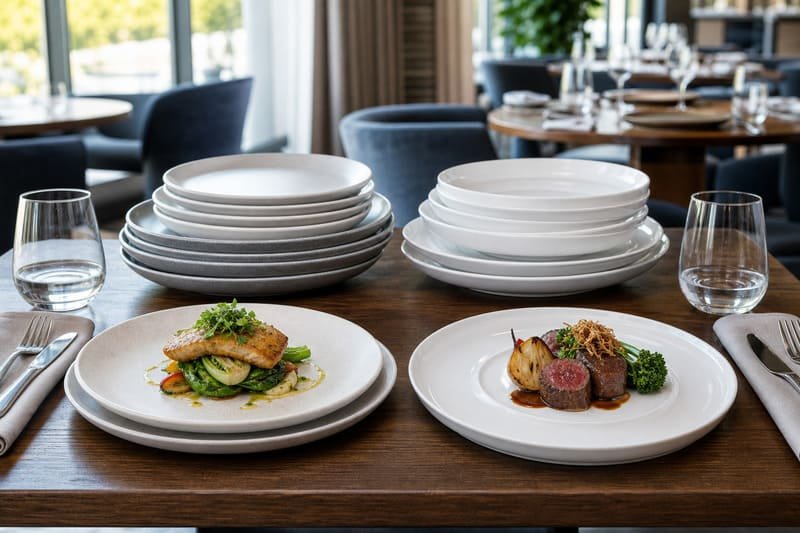
I do not think this question has one simple answer. I have seen buyers replace ceramic plates with melamine for patios, poolside service, buffet counters, school dining, catering, and chain restaurants. I have also seen buyers keep ceramic plates for upscale indoor service because the weight, sound, and traditional table image fit the dining concept better.
When a buyer asks me whether melamine can replace ceramic, I first ask where the plate will be dropped, carried, washed, stacked, and reheated. If the plate is used near a pool, on a patio, or in a buffet line, the decision is very different from a quiet indoor dining room.
The better question is not “Which material is better?”
The better question is:
Which plate reduces risk and supports the guest experience in this exact dining environment?
Best Plate Material by Dining Scenario
| Use Scene | Better Choice | Why |
|---|---|---|
| Fine dining indoor service | Ceramic | Heavier feel, classic sound, traditional premium image |
| Hotel breakfast buffet | Melamine | Lower breakage risk and easier handling |
| Poolside service | Melamine | Reduces risk from sharp broken ceramic pieces |
| Patio or outdoor dining | Melamine | Lighter, more break-resistant, safer for movement |
| Microwave reheating | Ceramic | Melamine should not be microwaved |
| Children’s dining / school canteen | Melamine | Lighter and more break-resistant |
| Custom logo or full-surface artwork | Melamine | Stronger design flexibility and repeatability |
| Premium tasting menu | Ceramic | Better for traditional porcelain-style presentation |
Last Updated: May 25, 2026 | Estimated Reading Time: 8 minutes
By Lance, Marketing Director at Duramela
What Should I Compare Before Choosing Melamine or Ceramic Plates?
The wrong plate creates daily friction. I see it in cracked edges, heavy trays, slow service, mixed replacements, staff complaints, and guests who notice poor presentation.
The best comparison is not only unit price. Buyers should compare breakage risk, plate weight, microwave needs, dishwasher use, design options, storage, transport, replacement frequency, and brand presentation before choosing melamine or ceramic plates.
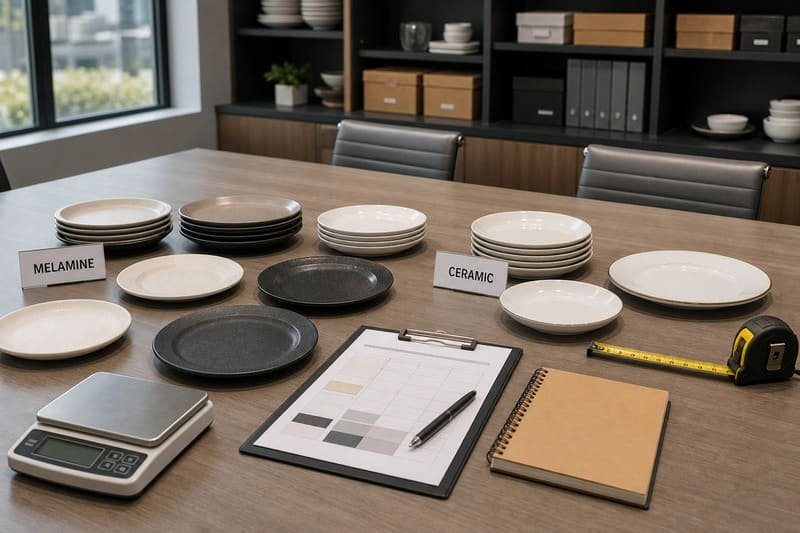
I usually start with the actual dining task. A hotel breakfast buffet does not use plates in the same way as a fine dining restaurant. A poolside bar does not have the same safety risk as a small indoor café. A chain restaurant may care more about stable repeat orders and logo consistency than the feeling of one plate in the hand.
Here is the basic way I compare both materials with buyers:
| Decision Point | Ceramic Plates | Melamine Plates |
|---|---|---|
| Breakage risk | Higher | Lower in normal service |
| Weight | Heavier | Lighter |
| Microwave use | Usually suitable if body, glaze, and decoration allow | Not suitable |
| Dishwasher use | Usually suitable | Often suitable when used according to supplier guidance |
| Design range | Classic, often limited by glaze and firing | Strong for full-surface artwork, logos, and colors |
| Outdoor safety | Risk from broken sharp pieces | Often safer for patio, poolside, and camping |
| Premium hand-feel | Strong | Depends on thickness, shape, and finish |
| Replacement control | Can be harder if color or glaze changes | Easier when mold and artwork are controlled |
I often tell buyers to map the plate to the movement:
- Does staff carry many plates at once?
- Do children use them?
- Does the venue have tile, concrete, or poolside flooring?
- Does the kitchen reheat food directly on the plate?
- Does the brand need custom colors, logos, or printed artwork?
- Does the operator need stable repeat orders over several years?
These questions matter more than broad claims like “melamine is better” or “ceramic is better.”
My Zone-Based Plate Selection Method
For many foodservice projects, the most practical answer is not full replacement. It is zone-based selection.
| Dining Zone | Main Risk or Priority | Better Plate Choice |
|---|---|---|
| Indoor fine dining room | Premium feel and traditional table image | Ceramic |
| Hotel breakfast buffet | High handling, high stacking, frequent washing | Melamine |
| Poolside service | Broken shard safety and wet floors | Melamine |
| Patio dining | Outdoor movement and drop risk | Melamine |
| Room service | Transport weight and possible reheating needs | Mixed decision |
| School dining / canteen | Drop risk and child handling | Melamine |
| Catering / events | Transport, setup speed, breakage control | Melamine |
| Chef tasting menu | Sensory expectation and controlled service | Ceramic |
This is why I often recommend a mixed approach. A hotel may use ceramic in the premium dining room and melamine at the breakfast buffet. A restaurant may keep ceramic indoors but use melamine on the terrace. This protects the brand experience while reducing risk where the risk is highest.
The Real Cost Is Not Only the Plate Price
The lowest unit price is not always the lowest total cost. Ceramic may be cheaper or more premium in some cases, but breakage and handling costs can change the final decision.
| Cost Item | Ceramic Risk | Melamine Risk |
|---|---|---|
| Breakage replacement | Higher in high-movement areas | Lower, but not zero |
| Staff cleanup time | Higher when plates break | Lower under normal use |
| Safety risk from shards | Higher | Lower |
| Freight weight | Higher | Lower |
| Staff carrying fatigue | Higher due to weight | Lower due to lighter handling |
| Microwave flexibility | Advantage if microwave-safe | Limitation |
| Custom artwork repeatability | Can be more difficult | Easier with controlled molds and printing |
| Mismatched replacements | Possible if glaze changes | Easier to control with repeat production |
For many buyers, the real savings from melamine do not come from the first quotation. They come from fewer breakages, easier handling, more stable replacement supply, and lower risk in high-frequency dining zones.
When Are Ceramic Plates Still the Better Choice?
It is easy to criticize ceramic because it breaks. I do not think that is fair. Ceramic still has real value in many restaurants.
Ceramic plates are often better when microwave use, heavier hand-feel, and a traditional upscale table image are important. Many fine dining and indoor restaurant settings still prefer ceramic for these reasons.
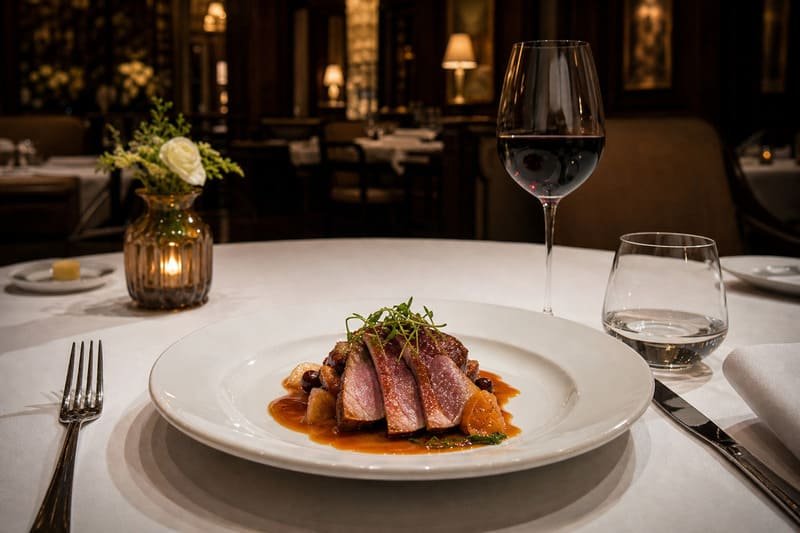
Ceramic has a certain feeling that many guests understand immediately. It feels solid. It sounds familiar on the table. It fits many classic restaurant styles. If a chef wants a traditional porcelain-style setting or needs to reheat food on the plate, ceramic is often the more natural choice.
However, microwave suitability should still be checked. Many ceramic plates are microwave-safe, but not all decorations, glazes, or metallic rims are suitable for microwave use. Buyers should confirm the supplier’s use instructions instead of assuming every ceramic plate is safe for reheating.
I also see ceramic used where the service pace is slower. A quiet indoor restaurant can manage ceramic better than a poolside bar, buffet line, or school canteen. Staff may carry fewer plates at a time. The floor may be safer. Replacement may not be a major problem. In this case, the heavier weight can even feel like a benefit.
The main limits are still clear. Ceramic can chip. It can crack. It can break into sharp pieces. It is heavier for staff, cartons, and transport. Some buyers also find it harder to create bold full-surface artwork or repeat a special design later.
| Ceramic Works Well When | Ceramic Becomes Harder When |
|---|---|
| The venue needs microwave reheating | The venue has high breakage risk |
| The dining room wants a classic premium look | Staff carry many plates per shift |
| The service is slower and controlled | The floor is hard, wet, or outdoor |
| The menu needs heated plates | The buyer needs many custom printed designs |
| The brand prefers porcelain tradition | Replacement consistency is important |
| Guest perception depends on weight and sound | Freight weight and storage handling matter |
I do not advise a buyer to remove ceramic only because melamine exists. I advise the buyer to check where ceramic creates real cost or risk. If ceramic performs well in a quiet indoor dining room, I would keep it there. If ceramic breaks often in outdoor service, buffet service, or children’s dining, I would test melamine in that area first.
When Are Melamine Plates More Practical for Commercial Dining?
Busy service does not forgive fragile products. In high-frequency dining, buyers usually care less about theory and more about what survives daily work.
Melamine plates are often more practical for restaurants, hotels, buffets, cafeterias, patios, poolside service, catering, and outdoor dining because they are lighter, more break-resistant, and easier to customize.
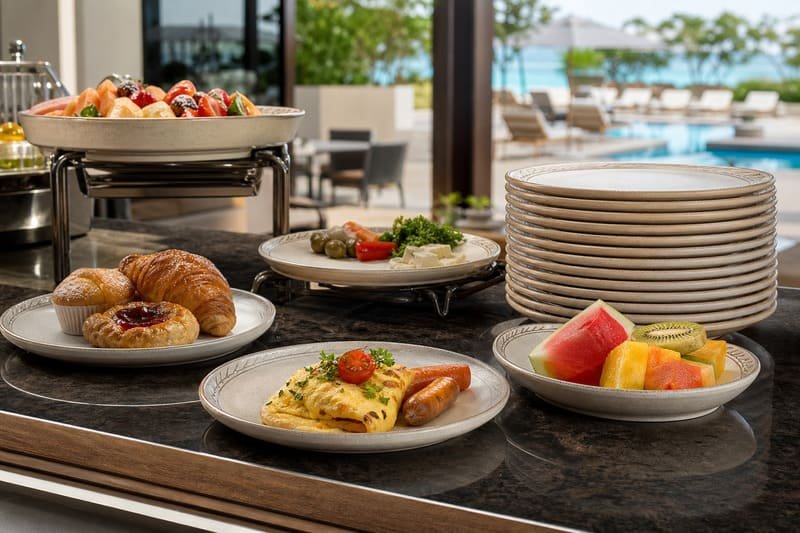
Melamine’s strongest value is not that it looks exactly like ceramic. Its strongest value is that it helps reduce breakage and improve handling in busy places.
A server can carry lighter plates with less pressure. A buffet team can move stacks more easily. A poolside venue can reduce the risk of sharp broken pieces near guests. A chain restaurant can repeat the same logo, color, or artwork more consistently across locations.
At Duramela, I often discuss A5 food-grade melamine with international buyers. It is a common choice for commercial foodservice and retail projects because it gives a practical balance of durability, surface finish, and cost. But I always remind buyers that the label “A5” alone is not enough. I still ask for the exact material declaration, production control, and food-contact test reports for the target market.
Some buyers also ask about A8-type materials when they want a more porcelain-like or slightly translucent visual effect. I treat this as a project-specific discussion because naming and formulation can vary by supplier. The best choice depends on target market, budget, visual effect, and testing needs.
Melamine also gives more freedom for visual design. A buyer can use full-surface patterns, restaurant logos, seasonal artwork, kids’ designs, stone effects, wood-grain effects, and color systems that match a brand. This is why custom melamine plates are often used by restaurants, hotels, catering brands, and private-label tableware programs.
| Melamine Advantage | Why It Matters in B2B Buying |
|---|---|
| Better break resistance | Helps reduce replacement pressure |
| Lighter weight | Helps staff handle plates faster |
| Custom printing | Supports brand identity and retail series |
| Many existing molds | Helps reduce development time |
| Stackable shapes | Supports storage and service flow |
| Outdoor suitability | Helps reduce risk in patio and poolside areas |
| Repeatable artwork | Helps chain restaurants maintain consistency |
| Lower freight pressure | Helps reduce shipping weight compared with many ceramic items |
I often see melamine used as a smart replacement for only part of a ceramic range. A restaurant may keep ceramic dinner plates indoors and use melamine plates for terrace service. A hotel may use ceramic in a premium dining room and melamine at the breakfast buffet. This mixed approach is practical. It protects the guest experience while lowering risk where the risk is highest.
How Do Safety, Microwave Use, and Dishwasher Use Affect the Decision?
A plate choice is not safe only because it looks good. I always ask how the kitchen will use it every day.
Melamine plates should not be used in microwaves or ovens. Food-grade melamine can be suitable for normal foodservice and dishwasher use when the material, production, test reports, and use conditions match the target market and application.
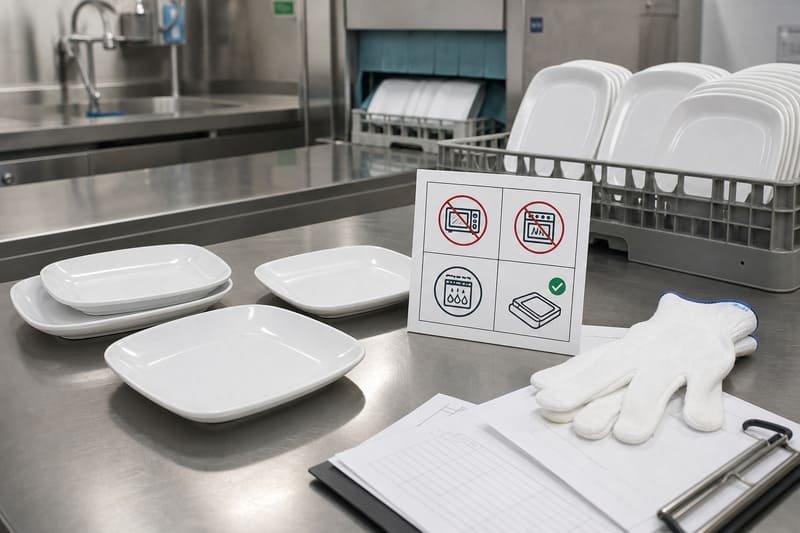
I want to be very clear about one point: melamine plates should not go into the microwave. This is not a small note. It is a real use rule. If a restaurant needs to reheat food directly on the plate, ceramic is usually the better material choice for that task, provided the ceramic plate is labeled microwave-safe.
The U.S. FDA states that foods and drinks should not be heated on melamine-based dinnerware in microwave ovens. The FDA also discusses migration concerns under certain high-temperature and acidic conditions (FDA). The Centre for Food Safety in Hong Kong gives similar practical guidance, advising that melamine-ware should not be used for cooking, microwave heating, conventional oven heating, hot oil, deep-fried foods, or storage of highly acidic foods (CFS).
Dishwasher use is different. Many commercial melamine plates are designed for dishwasher cleaning when used according to supplier instructions. Buyers should still confirm temperature, detergent, drying method, surface finish, and product grade. Very harsh use can shorten the surface life of any tableware, including both ceramic and melamine.
For food-contact compliance, I do not like vague claims. A buyer should ask for material grade and target-market documents. FDA guidance on food-contact substances emphasizes that food-contact safety depends on chemistry, intended use, and migration evaluation (FDA Guidance). For EU buyers, food-contact material requirements should also be checked against the destination market’s rules, such as the European Commission’s food contact materials framework (European Commission).
Documents should match the destination market. FDA-related food-contact documentation, LFGB testing, BPA-Free declarations, or California Proposition 65 evaluations are not interchangeable. If selling into California, Proposition 65 review may also be relevant depending on the product and substances involved (OEHHA).
| Safety Question | My Practical Answer |
|---|---|
| Can melamine go in the microwave? | No. I do not recommend it under any condition. |
| Can ceramic go in the microwave? | Usually yes, but body, glaze, and decoration must be checked. |
| Can melamine go in the dishwasher? | Often yes, when product and use conditions are correct. |
| Is all melamine the same? | No. Material grade, curing, molding, and surface finish matter. |
| Are certificates always included? | No. They depend on market, order, testing scope, and destination. |
| Is melamine for children’s use possible? | Yes, but material, design, labeling, and compliance must be checked carefully. |
| Can melamine hold hot food? | It can serve many hot foods, but it should not be used for cooking or reheating. |
The FDA Food Code also emphasizes that foodservice equipment and utensils should be cleanable, maintained, and kept in good repair for safe operation (FDA Food Code). In practical terms, this means damaged plates—whether ceramic or melamine—should be removed from service.
I also suggest buyers avoid low-grade unknown materials. A very cheap plate can become expensive if it causes quality complaints, color changes, odor issues, surface wear, or failed market testing. In commercial sourcing, the lowest unit price is rarely the best decision by itself.
How Should I Test Melamine Plates Before Replacing Ceramic Plates?
A full replacement can feel risky. I usually prefer a controlled trial because daily use shows problems that a catalog cannot show.
Before replacing ceramic plates, test melamine samples in the real service area. Check weight, size, stacking, washing, scratch resistance, food presentation, staff feedback, guest response, packing, and replacement planning before placing a bulk order.
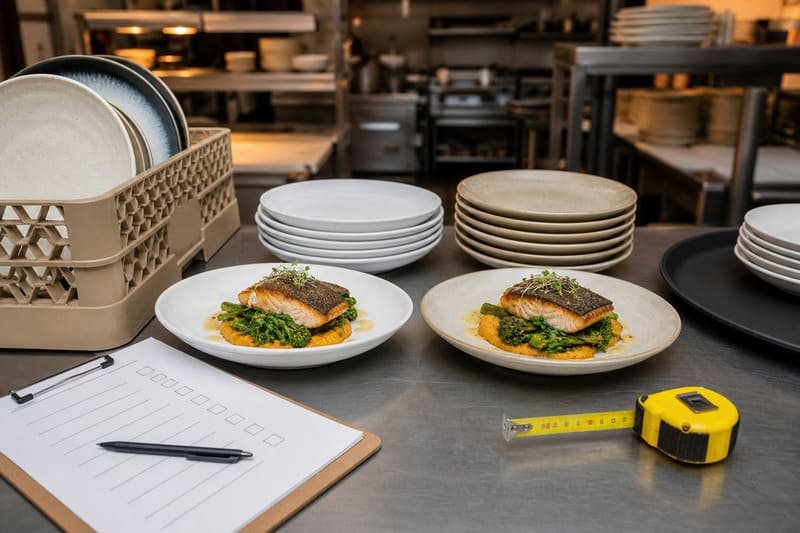
The buyer should not judge only by photos. A plate may look perfect online but feel too light, too thick, too shallow, or too different from the existing table style. Samples solve many of these doubts.
For restaurants and hotels, I suggest testing the plate in real movement. Staff should carry it with food. Dishwashing staff should wash it several times. The kitchen should check whether the size fits the pass, tray, cart, rack, and shelf. The buyer should compare the plate with existing ceramic pieces under actual lighting.
This small amount of work can prevent a large wrong order.
My 7-Day Trial Test Before Replacing Ceramic
| Test Area | What I Check |
|---|---|
| Service carrying | Can staff carry enough pieces comfortably? |
| Plate weight | Does it reduce fatigue compared with ceramic? |
| Plate thickness | Does it feel stable and not too thin? |
| Stack height | Does it fit storage space, carts, and shelves? |
| Food presentation | Does the color make food look good? |
| Dishwasher result | Does the surface stay clean and smooth? |
| Scratch resistance | Does normal use leave visible marks too quickly? |
| Logo or artwork | Is the printing position correct after plating? |
| Edge finish | Does the rim feel smooth in hand? |
| Guest response | Does the plate feel acceptable for the dining concept? |
| Carton packing | Can it handle export shipping and warehouse handling? |
If a buyer wants custom melamine plates, I also suggest confirming artwork carefully before production. A printed design on a flat screen can look different on a curved plate. Logo size, color tone, rim area, and surface finish should be checked. For large chain projects, I prefer a pre-production sample when time allows.
MOQ is another practical point. A standard custom order may start around 3,000 pieces per design or SKU, but some projects can begin with smaller trial orders when the mold, color, and production schedule allow it. I think a trial order is helpful for restaurants, hotels, and new brands that want proof before building a full range.
FAQ: What Do Buyers Usually Ask Before Switching to Melamine Plates?
Many buyers ask the same questions before they change materials. I understand why. The wrong answer can create trouble after delivery.
Buyers usually ask about microwave limits, dishwasher use, food safety documents, custom logos, MOQ, samples, scratch resistance, A5 versus A8 materials, and whether melamine should replace ceramic fully or only partly.
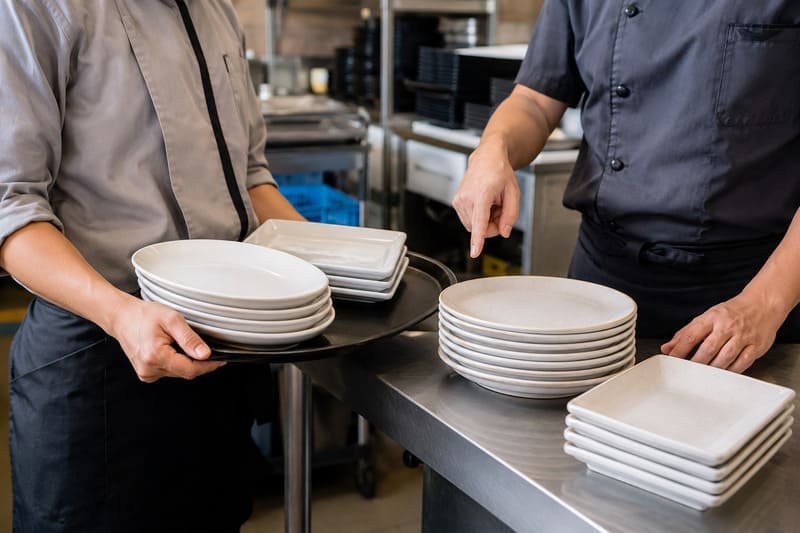
Can melamine plates fully replace ceramic plates?
I do not always recommend a full replacement. Melamine can replace ceramic in many high-frequency and high-risk areas, such as buffets, patios, poolside service, cafeterias, catering, school dining, and outdoor dining.
Ceramic may still be better for microwave reheating and formal dining rooms that need a traditional heavy feel. I usually suggest a zone-based decision.
Should I replace all ceramic plates at once?
Usually no. I recommend testing melamine in the highest-risk zone first, such as patio service, poolside dining, buffet lines, or children’s dining. If staff feedback, guest response, washing results, and breakage reduction are positive, then expand the replacement step by step.
Do melamine plates look cheap?
They can look cheap if the shape, thickness, color, and surface finish are poor. Good melamine can look clean, modern, and close to porcelain in some designs. It can also carry bold artwork that ceramic cannot easily support.
The sample matters more than the material name. Thickness, edge design, surface finish, and pattern quality decide whether melamine looks premium or cheap.
Are melamine plates safe for food contact?
Food-grade melamine plates can be suitable for normal foodservice when used correctly and supported by relevant test reports for the target market. They should not be used for microwave heating, oven heating, direct flame, hot oil, or cooking.
For B2B orders, buyers should confirm the exact material, color, production batch, intended use, and destination market before relying on any safety claim.
Can I print my restaurant logo on melamine plates?
Yes. Logo printing is one of melamine’s strong points. A buyer can print a small logo, a rim pattern, a full-surface design, or a private-label artwork series. The final result depends on artwork quality, mold shape, print method, and production control.
This is one reason many restaurants and hotel groups choose restaurant melamine tableware for branded service areas, buffet programs, outdoor dining, and retail-style collections.
Will melamine plates scratch?
Melamine is durable, but it is not impossible to scratch. Sharp knives, rough cleaning pads, abrasive powders, metal scrapers, and heavy abuse can mark the surface over time.
If a restaurant serves many steak or knife-heavy entrées and surface appearance is critical, I suggest testing samples carefully before replacing ceramic plates in that area.
What MOQ should I expect?
For custom designs, the standard MOQ is often around 3,000 pieces per design or SKU. Some smaller trial orders may be possible, especially when using existing molds and available colors. MOQ depends on design, mold, material, printing, packaging, and production schedule.
Should I choose A5 or A8 melamine?
For many export foodservice projects, I usually discuss A5 food-grade melamine first because it is a common practical option. A8-type materials may be discussed for special visual effects, but naming and formulation can vary by supplier.
The best choice depends on the target market, budget, design effect, product thickness, and testing requirements. Buyers should confirm exact composition and test reports instead of relying only on the A5 or A8 label.
What is my final buying rule?
Choose ceramic when microwave reheating, traditional weight, and formal table image matter most. Choose melamine when breakage control, lighter handling, outdoor safety, repeatable artwork, and custom branding matter more.
Conclusion
I choose by service scene, not material name. Ceramic has its place. Melamine often wins where daily use, safety risk, handling weight, replacement control, and customization matter more.
For indoor fine dining, ceramic can still be the right choice because it gives a traditional heavy feel and supports microwave reheating when the ceramic body and decoration allow it. For hotel buffets, patios, poolside service, cafeterias, catering, and outdoor dining, melamine often makes more operational sense because it reduces breakage risk and improves handling.
My practical advice is simple:
Do not replace ceramic everywhere just because melamine is durable. Start with the highest-risk zone, test real samples, check safety documents, and choose the material that reduces risk without hurting the guest experience.
