
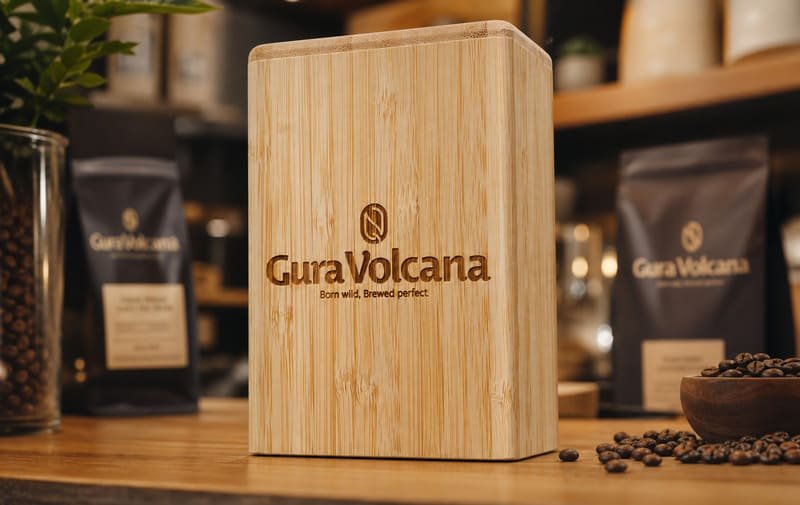
If you want a custom bamboo storage box but have no idea where to start, you are not alone. Most buyers send a photo and ask for a price — and then wonder why the quote takes too long or comes back completely different from what they expected.
Customizing a bamboo storage box is a specification process, not a price-first question. Before a supplier can quote accurately, you need to define your use case, dimensions, structure, surface finish, logo method, quantity, packaging, and delivery terms. A reference photo helps, but it is not enough.
I work with customers on custom bamboo products every day — from the first inquiry to factory confirmation, sampling, packaging, and shipping. What I have seen is simple: buyers who get accurate quotes fast are the ones who come prepared. Buyers who struggle are usually the ones who skip the specification step.
When I review a bamboo storage box project, I do not start with the box shape only. I first ask what goes inside, how much it weighs, whether it needs a seal, whether it touches food directly, and how the buyer wants the customer to open the package.
This guide walks you through what you need to prepare, what bamboo can and cannot do, how a real coffee container project was specified, and how to avoid the most common custom sourcing mistakes.
Last Updated: June 23, 2026 | Estimated Reading Time: 8 minutes
By Lance, Marketing Director at Duramela
Custom Bamboo Box Specification Map
A bamboo storage box can be a coffee container, tea box, soybean container, hotel amenity box, retail gift box, or dry goods storage item. Each use case changes the specification.
Before asking for a quote, prepare the use case, capacity, size, structure, lid type, seal requirement, surface finish, logo method, packaging, quantity, and delivery terms. These details help the supplier quote the real product instead of guessing from a photo.
| Specification | What to Prepare | Why It Matters |
|---|---|---|
| Use case | Coffee, tea, soybeans, gifts, hotel amenities, retail | Determines structure, finish, and packaging |
| Capacity | Coffee beans, dry goods volume, item size | Determines box size and lid design |
| Dimensions | Height, width, diameter, inner size | Prevents wrong sampling |
| Wall thickness | Example: around 2 cm for a solid premium feel | Affects weight, cost, and structure |
| Lid type | Lift-off, fitted, hinged, magnetic, sealed | Affects function and sample complexity |
| Seal requirement | Silicone ring, inner bag, or no seal | Affects freshness and food-contact checks |
| Surface finish | Plant oil, wax, lacquer, paint | Affects look, touch, and food-contact positioning |
| Logo method | Laser engraving, branding, packaging print | Affects artwork and sample approval |
| Packaging | Bulk, individual box, gift box, inner tray | Affects cost, MOQ, and shipping volume |
| Delivery terms | EXW, FOB, DDP, door delivery | Affects real landed cost |
A good reference photo is useful, but it cannot replace exact measurements. A supplier still needs to know the capacity, lid fit, wall thickness, finish, packaging, and target market.
What Can a Bamboo Storage Box or Bamboo Container Hold?
A bamboo storage box works best for dry goods, gift products, and premium presentation items. It is not suitable for every storage need.
Bamboo storage boxes and bamboo containers are best for dry products such as coffee beans, tea, soybeans, nuts, wrapped snacks, hotel amenities, and retail gift items. They are not designed for liquids, wet food storage, microwave use, dishwasher cleaning, or high-humidity storage without additional protection.
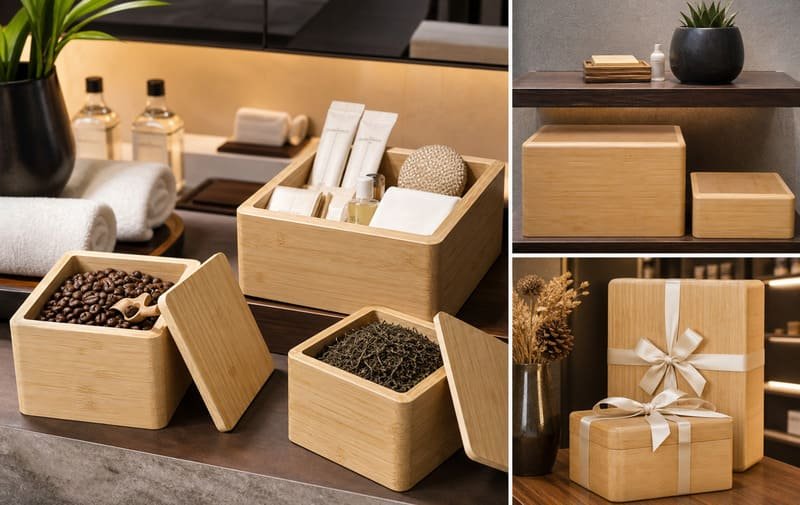
Most custom bamboo container inquiries I receive are for products where presentation matters as much as storage. Buyers want the product to feel natural, premium, and giftable. Common applications include:
- coffee beans;
- tea leaves;
- soybeans or grains;
- nuts and dry snacks;
- wrapped candies;
- hotel amenity kits;
- spa products;
- corporate gifts;
- premium retail packaging;
- decorative home storage.
If the box will hold coffee beans, tea, or dry food, the buyer should think carefully about food contact, aroma protection, moisture, and closure. Coffee storage especially needs protection from air, moisture, heat, and light, as the National Coffee Association explains in its guidance on how to store coffee.
A bamboo container can be made with a fitted lid and food-contact silicone seal ring to improve closure, but bamboo alone should not be treated like a fully engineered airtight metal or glass canister. If strong freshness protection is required, buyers may still need an inner bag, foil pouch, or secondary packaging.
| Product Stored | Bamboo Container Fit | What to Confirm |
|---|---|---|
| Coffee beans | Strong fit | Capacity, seal ring, inner bag, food-contact finish |
| Tea leaves | Strong fit | Aroma protection and dry storage |
| Soybeans / grains | Good fit | Capacity and moisture protection |
| Nuts / dry snacks | Good fit | Food-contact surface and packaging |
| Hotel amenities | Strong fit | Presentation and easy opening |
| Corporate gifts | Strong fit | Logo, gift box, insert, delivery date |
| Liquids | Not suitable | Use another container material |
| Wet food | Not suitable | Bamboo can absorb moisture and stain |
This is why I always ask what goes inside the box before I discuss price. A bamboo box for coffee beans is not the same as a bamboo gift box for wrapped items.
Case Study: A Custom Bamboo Container for 250g Gura Volcana Coffee Beans
A real case is the easiest way to show how custom bamboo storage box specifications work.
For a Kenya coffee customer, Gura Volcana, I suggested a custom bamboo container designed to hold around 250g of coffee beans, with a fitted lid, food-contact silicone seal ring, plant oil finish, laser engraved logo, and premium gift packaging. The project was not only a bamboo box; it was a coffee storage and brand presentation package.
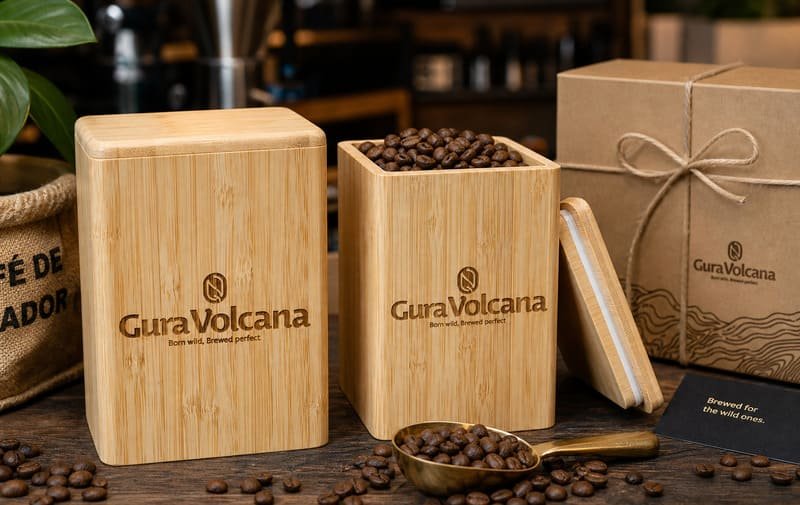
The customer wanted something that could hold 250 grams of coffee beans, protect the product, and look premium enough for retail or gifting. They also wanted the Gura Volcana brand name engraved on the bamboo surface.
For this project, I did not quote only a basic box. I reviewed the full set:
- bamboo container;
- fitted lid;
- food-contact silicone seal ring;
- laser engraved logo;
- plant oil surface finish;
- premium gift box;
- inner tray;
- outer printed packaging.
Here is the specification I suggested:
| Specification Item | Suggested Detail |
|---|---|
| Use case | 250g coffee bean storage and gift packaging |
| Brand | Gura Volcana |
| Approximate dimensions | 12 cm H × 8 cm diameter |
| Wall thickness | Around 2 cm |
| Lid type | Fitted lid |
| Seal | Food-contact silicone seal ring |
| Surface finish | Plant oil finish, natural matte look |
| Logo method | Laser engraving, Gura Volcana centered on the container |
| Gift box material | 2 mm greyboard / rigid board |
| Inner lining | 128g coated paper |
| Outer paper | 180g coated paper with gloss or matte lamination |
| Printed content | Customer brand story, coffee origin, or product information |
| Inner tray | 350g white card insert tray |
| Reference price | Approx. USD 4.75 per set, FOB, based on this project discussion |
This case shows why a “bamboo container price” is not useful without details. The price includes structure, lid, seal, surface treatment, logo, and packaging. A plain bamboo box would be a different product.
One important note: the exact 250g capacity should be tested with the buyer’s real coffee beans. Bean size, roast level, and packing density can change volume. A sample is necessary before mass production.
The 2 cm wall thickness gave the container a strong, premium hand feel. But it also increased material use, weight, and cost. For some projects, a thinner wall may be more practical. The right thickness depends on the buyer’s target price, brand position, and expected hand feel.
If your project needs a similar bamboo storage box for coffee, tea, gifts, or retail packaging, this type of specification is the level of detail I recommend preparing before asking for a final quote.
What Information Does a Supplier Actually Need to Quote You?
Most buyers think sending a picture is enough. It is not. A photo tells the supplier what the box looks like, but it does not explain capacity, thickness, lid structure, surface treatment, logo placement, packaging, or order quantity.
To get a useful quote, you need to provide intended use, target dimensions, capacity, material thickness preference, lid type, surface finish, logo file or artwork idea, order quantity, packaging requirements, and destination country. Without these, any quote you receive is only a rough guess.
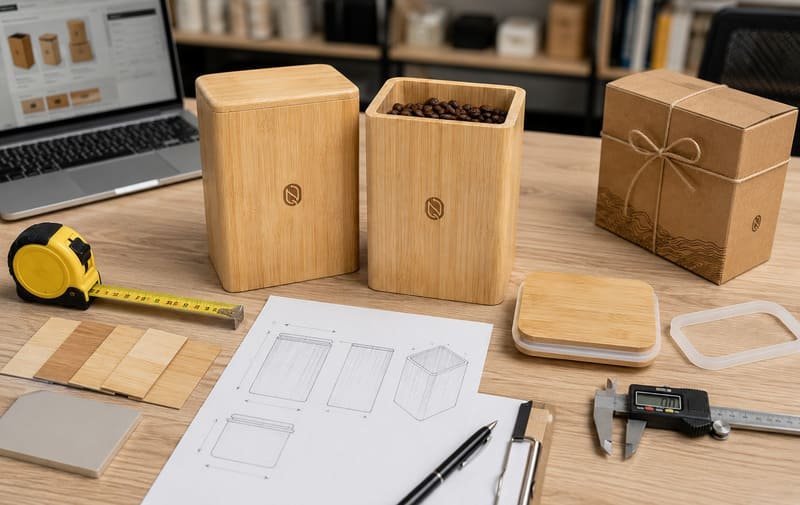
When I receive a bamboo container inquiry, I usually ask for these details:
| Quote Detail | What to Provide |
|---|---|
| Use case | Coffee, tea, soybeans, gift, hotel amenity, retail, dry storage |
| Capacity | Example: 250g coffee beans or inner item size |
| Dimensions | Height, width, diameter, inner size if needed |
| Wall thickness | Target feel and cost range |
| Lid type | Fitted, sliding, hinged, magnetic, or open-top |
| Seal requirement | Silicone seal ring, inner bag, or no seal |
| Surface finish | Plant oil, wax, lacquer, water-based coating, paint |
| Logo method | Laser engraving, branding, printed packaging |
| Packaging | Bulk, individual box, premium gift box |
| Quantity | Trial order, wholesale order, retail launch |
| Destination | Country and preferred shipping terms |
For food-related storage, the buyer also needs to clarify whether the bamboo surface will directly touch food. If the coffee beans are inside an inner bag, the bamboo may function more as a gift container. If the beans directly touch the bamboo, food-contact finish and testing become more important.
Food-contact safety depends on the full material system, including coating, oil, wax, adhesive, and any seal ring. FDA guidance on food-contact substance evaluation is useful for understanding why intended use matters.
What Can Bamboo Actually Do — and What Are Its Limits?
Bamboo looks premium. It has natural grain, warm hand feel, and a clean minimalist appearance that works well for coffee packaging, hotel amenities, gifts, and retail products. But bamboo is not plastic, metal, or paper. It has real production limits.
Bamboo works best with simple structures, laser engraving, natural finishes, and dry storage applications. It does not support unlimited colors, full-color surface printing, complex shapes, dishwasher cleaning, or strong airtight performance without additional components and testing.
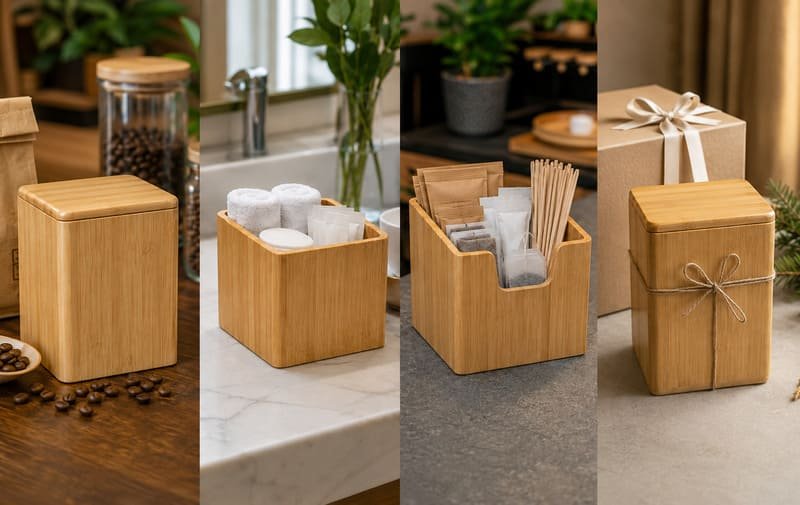
Bamboo can be processed into boxes, containers, trays, and packaging components. Laminated bamboo material can offer useful strength and stability, but it still has material behavior that must be respected. Research on laminated bamboo material helps explain why structure and bonding matter for bamboo products.
Logo Methods: Which One Fits Your Project?
For most bamboo storage boxes, laser engraving is the most practical logo method.
| Method | Effect | Suitable For | Limitation |
|---|---|---|---|
| Laser engraving | Natural burned look, permanent | Most bamboo projects | No full color |
| Branding iron | Deep, rustic impression | Premium gift products | Simple shapes only |
| Silk screen printing | Single or limited color | Flat coated surfaces only | Needs testing and may not suit all finishes |
| Full-color printing | Multi-color visuals | Better on packaging than raw bamboo | Less natural, more production risk |
| Painted finish | Solid color surface | Decorative boxes | Covers natural bamboo grain |
For the Gura Volcana coffee container, laser engraving was the best choice. It matched the natural material and made the brand feel more premium.
Surface Finish Options
Surface finish affects appearance, touch, maintenance, and food-contact positioning.
| Finish Type | Look | Feel | Notes |
|---|---|---|---|
| Plant oil finish | Warm, matte | Slightly oily and natural | Good for natural positioning, confirm food-contact documents |
| Clear lacquer | Glossy or semi-glossy | Hard surface | Lower cost, but do not assume food-contact suitability |
| Water-based coating | Clean, smooth | More coated feel | Can support a cleaner surface, test if food contact |
| Wax finish | Soft sheen | Slightly textured | Good for dry storage products |
| Painted finish | Solid color | Painted surface | Covers bamboo grain |
Guidance on wood and bamboo food contact materials is useful because oils, coatings, waxes, glues, and similar materials should also be considered when bamboo is used with food.
One honest note: bamboo is a natural material. Color and grain can vary between pieces and batches. If color consistency is critical for your brand, discuss tolerance with the supplier before sampling. Samples are not optional for custom bamboo storage boxes; they are necessary.
How Does Use Case Change the Design?
A storage box is not just a box. A bamboo container for coffee beans, a hotel amenity display, a restaurant condiment holder, and an e-commerce gift product all have different requirements.
Different use cases lead to different capacity needs, lid structures, surface finishes, logo methods, and packaging choices. Defining your use case early helps prevent expensive sample revisions and production delays.
Here is a practical use case breakdown:
| Use Case | Key Design Priority | Lid Type Suggestion | Packaging Need |
|---|---|---|---|
| Coffee / tea retail gift | Aroma protection, premium look | Fitted lid + silicone seal | Premium gift box |
| Soybeans / dry goods | Capacity and moisture awareness | Fitted or lift-off lid | Retail or bulk packing |
| Hotel room amenity display | Clean aesthetic, open access | Slide or lift-off lid | Minimal or branded sleeve |
| Restaurant condiment holder | Durability and easy access | Open top or shallow lid | Bulk packing |
| E-commerce product packaging | Unboxing experience | Hinged or magnetic lid | Strong branded outer box |
| Corporate gift | Brand impression | Lid with engraved message | Ribbon, inner tray, branded box |
If you do not have a technical drawing yet, an AI-generated image or mood board can be useful as a style reference. But it is not a production file. You still need exact dimensions, capacity, lid details, and packaging requirements.
A good supplier will use the visual reference as a starting point and then ask for measurements before sampling.
Sampling, MOQ, and What to Expect on Cost
One of the most common questions I get is: how much does it cost, and what is the minimum order? The honest answer is: it depends.
Sample confirmation before bulk production is not optional for custom bamboo products. Bamboo color, lid fit, logo effect, hand feel, seal ring, packaging, and structural detail all need physical review before mass production.
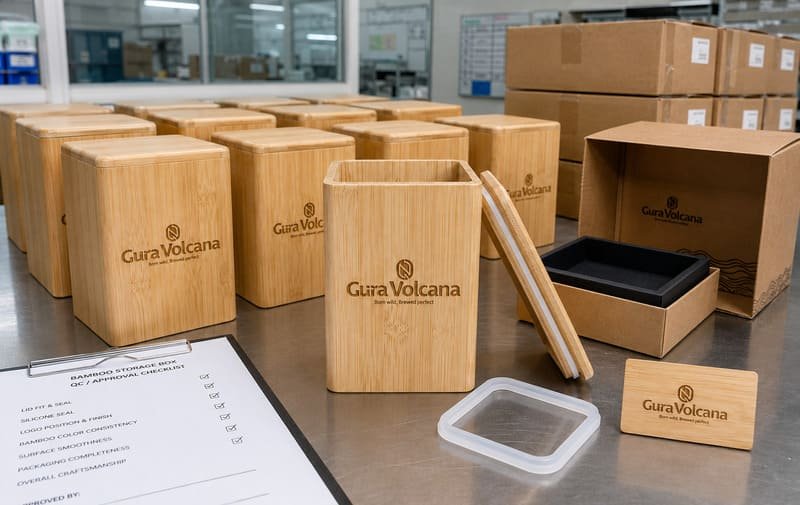
Size, structure, thickness, finish, logo complexity, packaging, and shipping terms all affect the price. There is no universal number.
Cost Factors at a Glance
| Factor | Impact on Cost |
|---|---|
| Dimensions | Larger boxes use more material |
| Wall thickness | Thicker walls increase material and weight |
| Lid structure | Hinged, sealed, or magnetic lids cost more than simple lids |
| Seal ring | Adds component sourcing and fit testing |
| Logo method | Laser engraving is usually practical; complex artwork adds work |
| Surface finish | Oil, lacquer, paint, or coating affect cost |
| Outer packaging | Plain box vs premium gift box changes cost significantly |
| Order quantity | Larger quantity lowers unit cost |
| Shipping terms | EXW, FOB, DDP, or door delivery affect landed cost |
For many custom bamboo storage box projects, sample cost may fall in a broad range such as USD 80–150 depending on complexity. The actual cost depends on size, structure, finish, logo, packaging, components, and destination. Some suppliers may credit sample cost back after bulk order, but this should be confirmed case by case.
For buyers who have never imported before — especially restaurant owners, hotel buyers, coffee brands, or small retail brands — I suggest asking whether the supplier can arrange door-to-door delivery. Some suppliers can quote with freight, customs clearance, and local delivery included. This is not always available for every country or order size, but it is worth asking.
The International Chamber of Commerce explains Incoterms and delivery terms, which helps buyers understand why EXW, FOB and DDP are not the same.
When Is Bamboo Not the Right Storage Box Material?
Bamboo is beautiful and practical for many dry storage and gift packaging projects, but it is not suitable for every use case.
Bamboo is not the right storage box material for liquids, wet foods, dishwasher cleaning, microwave use, high-humidity storage, strong airtight performance without extra packaging, or projects that require perfect color uniformity across all pieces.
| Requirement | Better Alternative | Why |
|---|---|---|
| Liquid storage | Glass, stainless steel, plastic | Bamboo is not liquid-proof |
| Wet food storage | Food-grade plastic, glass, stainless steel | Moisture can damage bamboo |
| Dishwasher cleaning | Dishwasher-rated material | Bamboo should not be machine washed |
| Microwave use | Microwave-safe material | Bamboo should not be microwaved |
| Strong airtight packaging | Metal canister, glass jar, engineered container | Bamboo alone is not a high-barrier package |
| Perfect color consistency | Plastic, metal, printed packaging | Bamboo grain and tone vary naturally |
| Full-color product surface | Printed paper box, plastic, metal | Bamboo surface printing is limited |
This section is important because bamboo should be chosen for the right reason. It is strong for natural presentation, dry goods, gifting, and brand storytelling. It is not a universal storage material.
Practical Questions Before Ordering a Bamboo Container
Buyers often ask similar questions before committing to samples or bulk production. These are the practical answers I give most often.
Can a bamboo storage box be airtight?
It can be designed with a fitted lid and food-contact silicone seal ring to improve closure, but bamboo is a natural material. If the product needs strong freshness protection for coffee beans, buyers should test the seal and may still need inner bags, foil pouches, or secondary packaging.
What can a bamboo storage box hold?
It is best for dry goods such as coffee beans, tea, soybeans, nuts, wrapped snacks, hotel amenities, spa products, corporate gifts, and retail packaging.
It is not suitable for liquids or wet food storage.
Can I engrave a logo on the bamboo container?
Yes. Laser engraving is usually the most practical method for a bamboo container. It works well for logos, names, short text, and simple graphics.
For the Gura Volcana project, the brand name was planned as a centered laser engraving on the bamboo surface.
Can I get a bamboo storage box in a specific color?
Raw bamboo cannot be color-matched like plastic or ceramic. You can apply a painted finish for solid colors, but this covers the natural bamboo grain.
If color is important to your brand, discuss finish options and color tolerance with the supplier before sampling.
Can bamboo storage boxes go in the dishwasher?
No. Bamboo storage boxes should not go in the dishwasher.
They are best wiped clean and kept dry. Long exposure to water, heat, or strong detergent can cause warping, cracking, or finish damage. Wood-like food contact items should be washed and dried properly, and bamboo boxes need the same careful mindset.
What is a realistic MOQ for a custom bamboo storage box?
It varies by supplier and product complexity. Some suppliers can accept orders from around 500 pieces, but unit cost will usually be higher at low quantities.
For the Kenya Gura Volcana coffee box project, the unit economics became more favorable around 1,000–2,000 pieces. These are project examples, not fixed rules.
How long does sampling take?
Sampling usually takes around 10–20 days depending on complexity. If the structure involves a silicone seal ring, special lid fit, laser engraving, or custom outer packaging, allow extra time for component sourcing and sample adjustment.
Do I need a technical drawing?
Not always. A clear photo reference plus exact dimensions is usually enough to start. But if your design has specific structural requirements — such as a hinged lid, inner tray, silicone seal, magnetic closure, or exact capacity — a simple sketch or annotated photo helps a lot.
Can one bamboo container have one gift box?
Yes. A bamboo container can be packed one piece per premium gift box, but packaging cost and MOQ must be confirmed early.
Rigid gift boxes, coated paper, printed brand stories, inner trays, and lamination all affect cost and production time.
Conclusion
A custom bamboo storage box starts with a clear specification, not a price request. Define your use case, capacity, size, finish, logo, packaging, quantity, and delivery terms first — then the quote will actually mean something.
For coffee beans, tea, soybeans, hotel amenities, and premium gifts, bamboo can create a warm, natural, and high-value product experience. But the details matter: lid fit, seal ring, surface finish, food-contact positioning, packaging structure, and sample approval all affect the final result.
My practical advice is simple:
Do not ask only, “How much is this bamboo box?” Ask what it needs to hold, how it should close, how it should look, how it will be packed, and what documents or delivery terms are needed. That is how a custom bamboo container becomes a real product instead of just a nice reference photo.
If you are planning a custom bamboo container for coffee, tea, gifts, or retail packaging, prepare the specification first. It will save time, reduce sampling mistakes, and make supplier communication much more accurate.
