

Buyers ask this question every week. The answer feels obvious at first, but the more you look at it, the more complicated it gets.
Bamboo utensils are not automatically better than plastic utensils. The right choice depends on how frequently the utensils are used, how they are cleaned, what your brand positioning is, and whether your operation can support the maintenance that solid bamboo actually needs. In some cases, reusable plastic or certified recycled plastic can be the more practical option.
I have worked with buyers from restaurants, cafés, importers, and private-label brands who all ask some version of this question. Most of them come in thinking the answer is simple:
“Bamboo is natural, so it must be better than plastic.”
I understand why they think that way. Solid bamboo has a strong natural material story. It looks warm, feels organic, and fits brands that want a more eco-conscious image. But for B2B sourcing, the decision cannot stop there.
The real question is:
Which material fits your daily use, cleaning process, customer expectation, market claim, and replacement plan?
That is where bamboo and plastic need a more honest comparison.
Last Updated: June 15, 2026 | Estimated Reading Time: 8 minutes
By Lance, Marketing Director at Duramela
Bamboo or Plastic? Start with the Service Model
A material that works beautifully in one business can fail in another. I usually start by asking how the utensil will be used every day.
Solid bamboo is strongest when the buyer wants a natural look, handwashing is realistic, and brand story matters. Reusable plastic is stronger when the operation needs dishwasher use, high-volume handling, and lower maintenance. RPET can be useful for brands that want recycled-content positioning, but it still needs proper documentation.
| Service Model | Better Starting Point | Reason |
|---|---|---|
| Handwashed café | Solid bamboo | Natural look, manageable care routine |
| Eco-focused salad bar | Solid bamboo | Strong natural material story |
| High-volume school cafeteria | Reusable plastic | Dishwasher use and fast reset matter more |
| Budget restaurant chain | Reusable plastic | Lower maintenance and consistent replacement |
| Eco retail brand | Solid bamboo or RPET | Different sustainability stories |
| Hotel breakfast display | Solid bamboo | Natural presentation and guest-facing image |
| Takeaway event | Disposable bamboo | Single-use event fit |
| Microwave-required service | Microwave-safe plastic, if labeled | Solid bamboo should not be microwaved |
I do not treat all plastic as automatically “bad.” Traditional single-use plastic, reusable food-grade PP, ABS, and recycled plastics such as RPET belong to different sourcing discussions. A buyer who compares solid bamboo only with cheap disposable plastic is not making a fair comparison.
At the same time, I do not think recycled plastic has the same natural material appeal as solid bamboo. If a buyer wants the most natural story, solid bamboo is still the strongest option. It is real bamboo, with grain, color variation, and hand feel that synthetic materials cannot fully copy.
Are All Bamboo Utensils the Same Type of Product?
Most buyers assume bamboo is bamboo. That assumption causes a lot of confusion.
There are at least three different bamboo product types: solid bamboo, bamboo fiber composite, and disposable bamboo. Each one has different durability, cleaning requirements, market fit, production cost, and claim limitations. Mixing them up during sourcing leads to wrong expectations and customer complaints.

Solid Bamboo Utensils
Solid bamboo utensils are made from real bamboo culms or laminated bamboo material that is cut, shaped, sanded, and surface-treated. They look natural and warm. They are popular in cafés, salad shops, farm-to-table restaurants, hotel breakfast displays, gift programs, and eco-focused brand collections.
Solid bamboo is the closest option to a natural bamboo product. It is a good fit when buyers want the material itself to communicate a natural and renewable story.
But solid bamboo also needs care. It is best handwashed, dried properly, and kept away from microwaves, ovens, long soaking, and aggressive dishwashing.
Bamboo Fiber Composite
Bamboo fiber composite products are made from bamboo powder or bamboo fiber mixed with a binding resin, then molded under heat and pressure. These products may look similar to melamine or molded plastic tableware, and they should not be marketed as pure bamboo.
Research on bamboo fiber composite materials shows how bamboo fiber can be combined with polymer materials, but for food-contact tableware the binder system and target-market rules are critical.
For Europe, buyers need to be especially careful. The European Commission has taken action against plastic food contact materials containing bamboo additives, because these products can be misleadingly marketed and may create migration risks.
Disposable Bamboo
Disposable bamboo items, such as single-use forks, spoons, stirrers, skewers, or picks, are designed for one-time use. They are a separate category from reusable solid bamboo utensils and reusable plastic utensils.
Using disposable bamboo as a comparison point against reusable plastic or solid bamboo creates a false picture. The life cycle, use case, and customer expectation are different.
| Product Type | Material | Reusability | Cleaning | Best Fit |
|---|---|---|---|---|
| Solid bamboo | Real bamboo | High, with care | Handwash preferred | Cafés, eco brands, display-style dining |
| Bamboo fiber composite | Bamboo powder or fiber + resin | High | Depends on resin and supplier guidance | Some molded tableware projects, with compliance review |
| Disposable bamboo | Thin bamboo | Single use | Not applicable | Events, takeaway, catering |
| Reusable plastic | PP, ABS, or similar food-grade plastic | High | Often dishwasher suitable if specified | High-volume restaurants, schools, canteens |
| RPET plastic | Recycled PET | Depends on product design | Confirm temperature and washing limits | Eco-positioned retail or fast-casual programs |
Once a buyer knows which product type they are actually comparing, the sourcing conversation becomes much more useful.
If you are building a wider natural serving collection, it may also make sense to compare utensils with a matching bamboo Tray or a coordinated bamboo plate so the material story stays consistent across the table.
What Are the Real Limits of Solid Bamboo Utensils?
A lot of product listings make solid bamboo sound maintenance-free. That is not accurate, and it sets buyers up for problems.
Solid bamboo utensils work well in the right conditions, but they have specific limits. They should not be microwaved, they are best handwashed, and the surface treatment quality directly affects how long they last in real use.
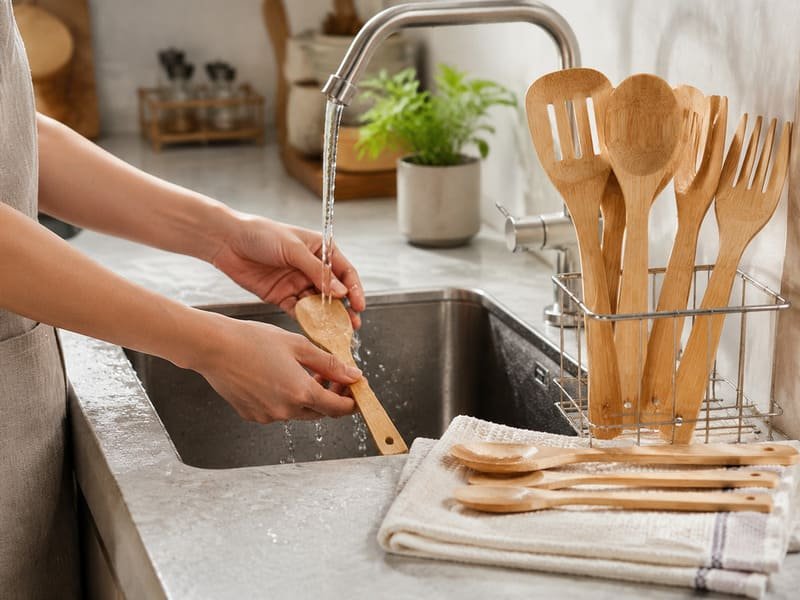
When restaurants or importers first ask about solid bamboo, they often focus on price and appearance. The questions they should be asking are about surface treatment, moisture management, and replacement rate.
Surface Treatment Matters
Surface treatment matters more than many buyers expect.
For low-cost projects, some suppliers use a basic clear coat. I do not automatically treat a clear coat as food-contact safe unless the supplier can provide matching test reports. It may look smooth and cost less, but that does not mean it is the best choice for utensils that touch food directly.
For solid bamboo utensils intended to touch food, I usually prefer:
- food-contact wood wax oil;
- water-based coatings;
- finishes supported by suitable test reports for the target market.
Wood wax oil gives a more natural, slightly oily hand feel. Water-based coatings can give a cleaner surface and better gloss. Both are usually better directions than choosing the cheapest clear-coat-only option without documentation.
Guidance on food-contact materials from the FDA emphasizes that food-contact safety depends on chemistry, intended use, and potential migration evaluation (FDA).
Warping and Cracking Are Real Risks
Warping and cracking are real risks for solid bamboo if utensils are soaked, left wet, washed aggressively, or stored in poorly ventilated areas. Research on bamboo-based materials also discusses dimensional stability as a material performance issue (BioResources).
This is not a defect unique to one supplier. It is part of working with a natural bamboo material.
Dishwasher Use Should Not Be Promoted as Standard
For solid bamboo utensils, repeated dishwasher use is not recommended. Occasional exposure may not destroy a well-made utensil immediately, but positioning solid bamboo as dishwasher-safe in marketing materials creates a service expectation that the material cannot reliably meet over time.
Handwashing and proper drying are the safer recommendation.
| Factor | Solid Bamboo | Reusable Plastic | RPET |
|---|---|---|---|
| Microwave safe | No | Only if specifically labeled microwave-safe | Generally not my first choice for microwave use |
| Dishwasher safe | Not recommended | Often yes, if specified | Depends on product design |
| Handwash preferred | Yes | Usually no | Depends on product |
| Warping risk | Moderate to high if misused | Low | Low to moderate depending on heat |
| Surface treatment needed | Yes | No | No |
| Natural visual appeal | High | Low to medium | Medium |
| Replacement frequency | Medium if not maintained | Low to medium | Depends on use and temperature limits |
Buyers who operate high-turnover environments with machine washing, fast table resets, and large utensil volumes will often find that solid bamboo creates workflow friction. That does not make it a bad product. It just means it is not the right product for that specific environment.
When Does Plastic Actually Make More Sense?
There is a tendency in eco-focused marketing to treat plastic as the obvious wrong choice. That framing is not helpful for buyers who need to make practical decisions.
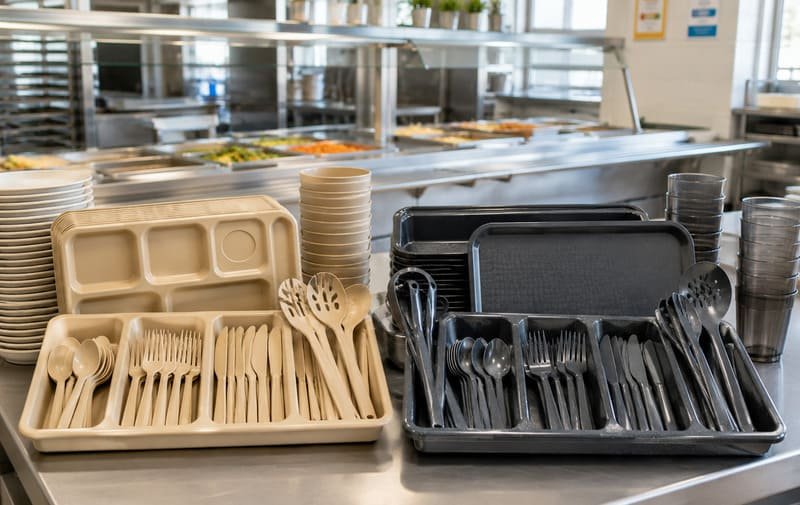
For high-frequency commercial operations, machine-washing environments, standardized large-scale service, or markets where product replacement happens often, reusable plastic or certified recycled plastic can be the more operationally sound choice. The key is choosing the right type of plastic and being honest about what each material actually offers.
Not All Plastic Is the Same
Traditional single-use plastic is a different discussion from reusable food-grade PP, ABS, or RPET. Reusable plastic utensils made from suitable food-contact materials can be designed for dishwashing, high-frequency use, stacking, and volume handling without the special care routine that solid bamboo needs.
Some reusable plastics can also be microwave-safe when they are specifically designed and labeled for that use. Solid bamboo should not be used in a microwave.
Where RPET Fits
RPET stands for recycled PET. It is made from recycled PET material, often from post-consumer sources such as bottles. In many European retail and foodservice projects, RPET can be easier to position than virgin plastic because it supports recycled-content and recyclability discussions when the supplier can provide the right documentation.
However, buyers should distinguish between:
- made with recycled content;
- recyclable;
- 100% recyclable;
- certified recycled content;
- suitable for food contact.
These are different claims. They need market-specific proof, not only supplier wording.
The European Commission provides information on recycled plastic food contact materials, and its wider plastics strategy supports the broader shift toward circular plastic use. For packaging and recyclability positioning, third-party systems such as RecyClass recyclability certification may also be relevant depending on the product and market.
The honest comparison between bamboo and plastic is not:
“Natural is always better.”
or:
“Durable is always better.”
It is a question of which material fits the buyer’s actual operation model, brand language, customer expectations, cleaning process, and documentation needs.
Practical Use Case Comparison
| Use Case | Solid Bamboo | Reusable Plastic | RPET |
|---|---|---|---|
| Eco-focused café or salad bar | Strong fit | Weak fit | Moderate fit |
| High-volume school or canteen | Poor fit | Strong fit | Moderate to strong fit if product is suitable |
| Private-label natural brand | Strong fit | Weak fit | Moderate fit |
| Budget restaurant chain | Poor fit | Strong fit | Moderate fit |
| Hotel breakfast buffet display | Moderate to strong fit | Weak fit | Weak to moderate fit |
| Kids’ tableware retail | Limited fit due to maintenance | Moderate fit | Moderate fit |
| Microwave-required operation | Not suitable | Only if product is microwave-safe | Usually not my first recommendation |
A café that handwashes utensils, serves a curated menu, and wants customers to feel the warmth of natural materials may choose solid bamboo. A school cafeteria that runs hundreds of meals per session and machine-washes everything may be better served by reusable food-grade plastic.
Where Solid Bamboo Still Wins
Plastic may be more practical in some operations, but that does not mean plastic has the stronger brand story.
If a buyer wants the most natural material experience, solid bamboo is still the strongest option. It is made from real bamboo rather than a molded resin or recycled plastic material, and its grain, color variation, and hand feel are part of its value.
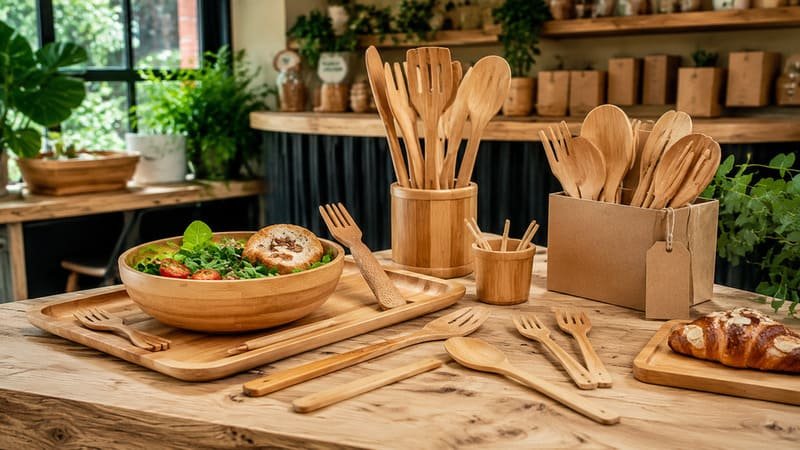
For cafés, boutique hotels, wellness brands, salad shops, gift sets, and curated retail programs, solid bamboo often communicates something that plastic cannot:
- natural warmth;
- visible grain;
- lighter environmental storytelling;
- handmade or craft-inspired positioning;
- a softer guest experience;
- compatibility with bamboo serving collections.
Solid bamboo also pairs well with broader natural tableware programs. If your brand already uses bamboo dinnerware, bamboo trays, or bamboo display pieces, solid bamboo utensils can make the table setting feel more complete.
But I still avoid broad claims like “bamboo is always more eco-friendly.” Solid bamboo usually carries the strongest natural and renewable-material positioning, but its real environmental performance still depends on:
- bamboo sourcing;
- surface finish;
- adhesive or coating;
- product lifespan;
- packaging;
- transport;
- end-of-life handling.
Studies comparing reusable and single-use kitchenware show that the full environmental picture depends heavily on use frequency, washing, material choice, and lifespan (University of Michigan). Other life-cycle research also shows that environmental impact depends on the whole system, not just the material name (PubMed).
So my advice is simple: use solid bamboo when the natural material story matters and the operation can support proper care. Use plastic or RPET when cleaning speed, durability, and operational consistency matter more.
Common Buyer Questions About Bamboo and Plastic Utensils
The buyers usually ask practical questions because the wrong material choice can create customer complaints, returns, or operational friction.
The most important questions involve food-contact safety, dishwasher use, microwave limits, surface treatment, RPET claims, MOQ, and whether bamboo fiber composites can be marketed as plastic-free.
Are bamboo utensils food-safe?
They can be food-safe when made with suitable food-contact materials and finishes.
For solid bamboo, buyers should check the coating, oil, wax, and any adhesive. For bamboo fiber composites, buyers should check the resin system, migration reports, and target-market rules. A report should match the exact item, color, finish, and target market.
Can bamboo utensils go in the dishwasher?
For solid bamboo, repeated dishwasher use is not recommended. Handwashing and proper drying extend product life significantly.
If a buyer needs machine washing, reusable food-grade plastic may be a more practical choice.
Are bamboo utensils more eco-friendly than plastic?
Solid bamboo usually has the strongest natural-material story. It is renewable, visible, and easy for customers to understand.
However, not all plastic is the same. RPET or certified recycled plastics may support recycled-content or recyclability claims in certain markets when documentation is available. Buyers should avoid broad environmental claims unless they can support them with product-specific evidence.
Is RPET more eco-friendly than bamboo?
Not automatically.
RPET can support recycled-content or recyclability positioning when properly documented, but it is still a plastic material. Solid bamboo has a stronger natural-material story, while RPET may be more practical where durability, washing, and recycling claims matter.
The right answer depends on use model, documentation, product lifespan, and end-of-life handling.
What is the minimum order quantity for custom bamboo utensils?
Standard MOQ at Duramela is often around 3,000 pieces per design. Smaller trial orders may be possible for restaurants, new brands, or test projects, depending on existing shape, logo method, finish, and packaging requirements.
What surface treatment is best for solid bamboo utensils?
For food-contact solid bamboo utensils, I usually prefer food-grade wood wax oil or water-based coatings.
A cheap clear coat may lower cost, but I do not assume it is food-contact safe unless the supplier can provide matching reports. The finish should match the use case and the target market.
Can bamboo utensils be microwaved?
No. Solid bamboo utensils should not be used in the microwave.
Some plastic utensils or tableware can be microwave-safe only if they are specifically designed and labeled for that use. Buyers should not assume all plastic is microwave-safe.
Can bamboo fiber composite be sold as plastic-free?
Usually no.
Bamboo fiber composite often contains resin. In some markets, bamboo-plastic food contact materials face restrictions. Buyers should not market them as pure bamboo or plastic-free unless the material and claims are legally supported.
Conclusion
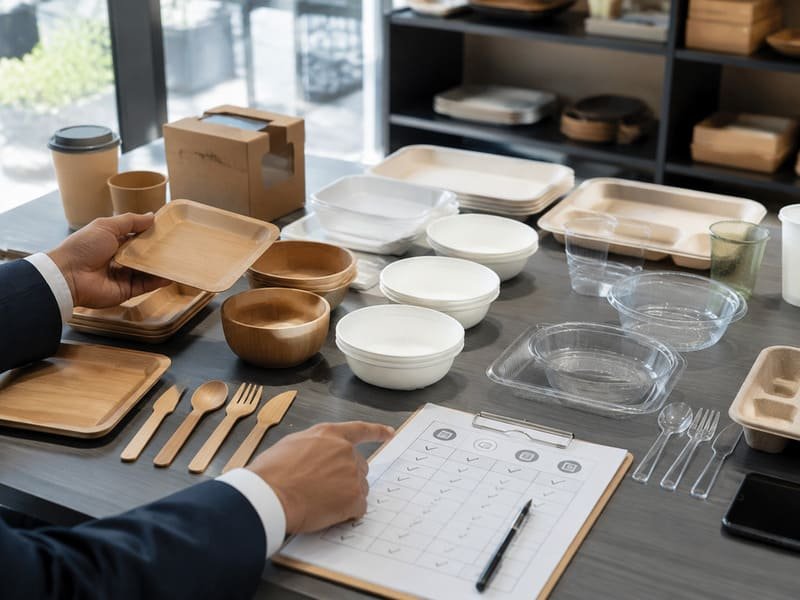
Bamboo utensils are a good fit for the right buyer. Plastic utensils, including RPET, are a better fit for others. The decision comes down to your operation, cleaning process, brand position, customer expectation, and market documentation.
Solid bamboo is the strongest option when you want a natural material story, warm hand feel, and visible bamboo character. But it needs proper surface treatment, handwashing, drying, and clear no-microwave instructions.
Reusable plastic is often better for high-volume operations that need dishwasher use, microwave-safe options, and low-maintenance handling. RPET can support recycled-content or recyclability positioning when the documentation is strong, especially in markets that value circular plastic use.
My practical advice is simple:
Do not compare “bamboo” and “plastic” as broad labels. Compare solid bamboo, bamboo fiber composite, disposable bamboo, reusable plastic, and RPET against your real service model. That is how you choose the material that actually works for your business.
