
Nobody wants to hear a plate shatter during a busy Friday night terrace service. But switching to the wrong material just to avoid breakage can create a different set of problems: poor food presentation, unclear use limits, staff misuse, and tableware that looks out of place.
Melamine plates work well for many outdoor restaurants because they help reduce everyday breakage, make staff handling easier, and support branded table presentation. The key is choosing the right food-contact material, understanding what melamine can and cannot do, and matching the plate to the specific outdoor setting.
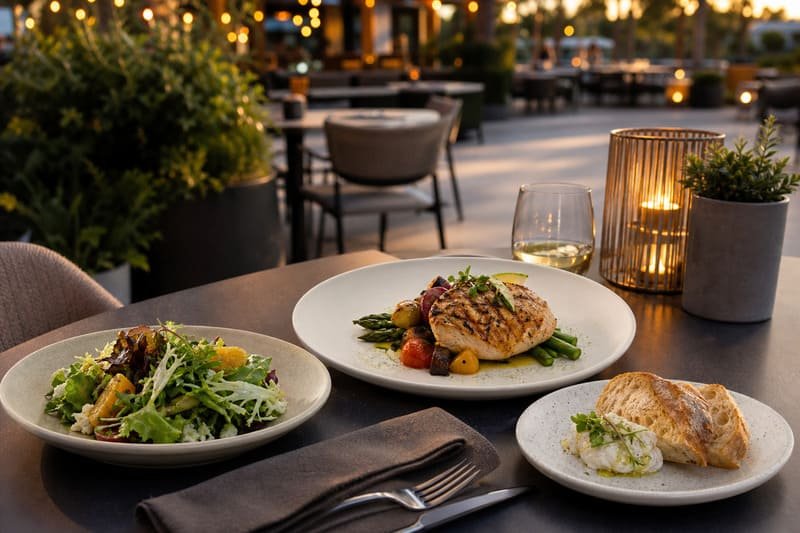
Over the years working with restaurant buyers, hotel procurement managers, and hospitality importers from different markets, I have heard the same questions come up repeatedly:
- Does melamine actually hold up outdoors?
- Does it look cheap on the table?
- Can it go in a commercial dishwasher?
- Can staff reheat food on it?
- Is it safe for poolside or terrace service?
- What should I check before ordering?
These are fair and practical questions. I do not think melamine is the right answer for every dining situation. But for outdoor restaurants, patios, poolside service, beach bars, garden cafés, resort terraces, and casual hotel dining areas, it often solves several real operating problems.
When I review outdoor tableware projects, I do not start with the plate pattern. I ask where the plate will be dropped, how far staff carry it, whether the service area is near water, whether the ground is tile or concrete, and whether the kitchen ever reheats food on the plate.
That is where the decision becomes clearer.
Outdoor Service Risk Map
Outdoor dining creates different risks from indoor dining. A plate may look fine in a showroom, but outdoor service adds movement, hard floors, weather exposure, longer carrying distance, and more guest handling.
For outdoor restaurants, the best plate choice should reduce breakage risk, support staff carrying, look good in natural light, handle repeated washing, and come with clear no-microwave use instructions. Melamine helps with many of these risks, but only when the product is specified and used correctly.
| Outdoor Service Risk | Why It Matters | How Melamine Helps |
|---|---|---|
| Hard terrace floor | Ceramic can shatter into sharp pieces | Lower breakage risk under normal handling |
| Poolside service | Broken shards create safety concerns near bare feet and wet floors | More practical than fragile ceramic |
| Long carrying distance | Staff carry plates across patios, stairs, gardens, or resort areas | Lighter handling than many ceramic plates |
| Busy table turnover | More drops, bumps, and fast clearing | Better daily durability |
| Limited outdoor storage | Plates are stacked and moved often | Lower chip risk during stacking |
| Natural sunlight | Colors and surface appearance are judged differently outdoors | Samples should be checked in real lighting |
| Staff reheating habits | Microwave misuse can damage melamine | Clear staff training is required |
| Brand presentation | Outdoor plates must match the restaurant concept | Custom printing and colors can support identity |
This is the difference between buying a plate and buying a service tool. Outdoor restaurants need tableware that survives daily movement without hurting the guest experience.
Last Updated: May 28, 2026 | Estimated Reading Time: 10 minutes
By Lance, Marketing Director at Duramela
Is Melamine Really Break-Resistant, or Is That Just Marketing?
Let me be direct: melamine is not unbreakable. Nothing is. If you drop a melamine plate from a height onto a hard tile floor, it can chip or crack. If staff use it roughly for years without proper care, it will show wear.
What melamine offers is meaningful break resistance for everyday outdoor restaurant use. Compared with ceramic, melamine plates are less likely to shatter from normal drops, bumps, and stacking impacts, although they can still chip or crack under hard abuse.
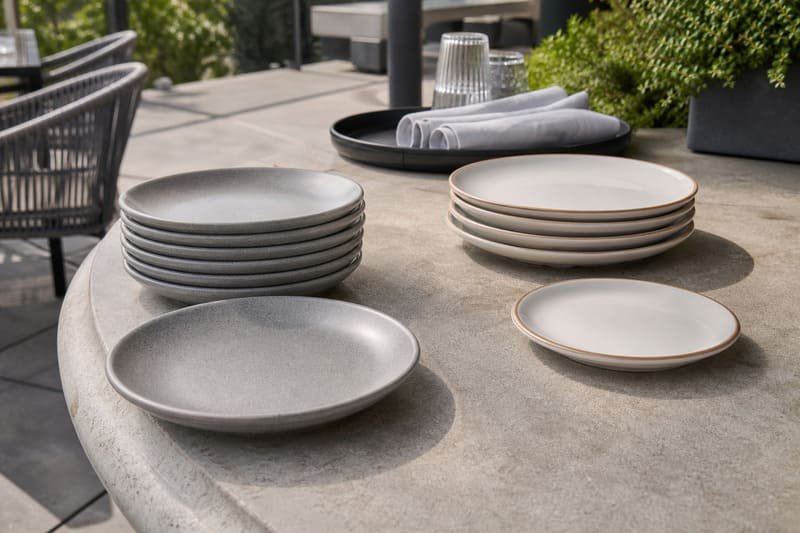
When I talk to restaurant buyers who are dealing with outdoor service — terraces, poolside dining, beach bars, garden cafés, resort patios — the breakage conversation always comes down to frequency and cost.
A fine-dining indoor restaurant might absorb the cost of replacing a few ceramic plates each month. An outdoor restaurant with high table turnover, staff carrying multiple plates across uneven surfaces, and guests moving tableware themselves faces a different situation.
Broken ceramic is not only a replacement cost. It can also mean:
- staff cleanup time;
- delayed service;
- food waste;
- guest safety concerns;
- inconsistent plate sets;
- higher emergency replacement orders.
Breaking Down the Risk Difference
| Situation | Ceramic Plate | A5 Melamine Plate |
|---|---|---|
| Drop from table height onto tile | Very likely to shatter | Often survives or chips slightly |
| Knocked off a tray by a guest | High breakage risk | Lower breakage risk |
| Stacked during storage and tipped over | Multiple plates can break | Less likely to break from stacking impact |
| Long-term daily commercial use | Gradual chipping at edges | Gradual surface wear over time |
| Thrown or hit hard against a surface | Will break | Can also crack or chip |
| Poolside accident | Sharp shards are a concern | Lower sharp-shard risk |
The point is not that melamine is indestructible. The point is that it helps reduce the type of breakage that happens most often in outdoor restaurant operations.
That reduction in daily breakage can translate into lower replacement pressure, fewer service interruptions, and less risk in high-traffic outdoor zones.
A Note About A5, A1, and A8 Melamine
In sourcing conversations, A5 melamine is commonly used to refer to food-contact melamine material for tableware, while A1 is generally not used for food-contact dinnerware. However, A5 is not a regulatory certificate by itself. Buyers should still confirm material declarations, food-contact test reports, and destination-market requirements for the exact product.
Some suppliers also discuss A8-type melamine for special visual effects, but I treat that as a project-specific material discussion rather than a universal upgrade. For most outdoor restaurant applications, well-made A5 melamine is the practical starting point.
If you are sourcing commercial melamine plates for outdoor use, ask for samples, material details, and food-contact documentation before confirming a bulk order.
Does a Lighter Plate Actually Make a Difference for Outdoor Service?
If you have never worked a busy outdoor service, this question might seem minor. If you have, you already know the answer.
Melamine plates are usually lighter than ceramic plates of similar size and thickness, although exact weight depends on product design. For outdoor restaurants, lighter plates can make carrying, clearing, stacking, and event setup easier for staff.
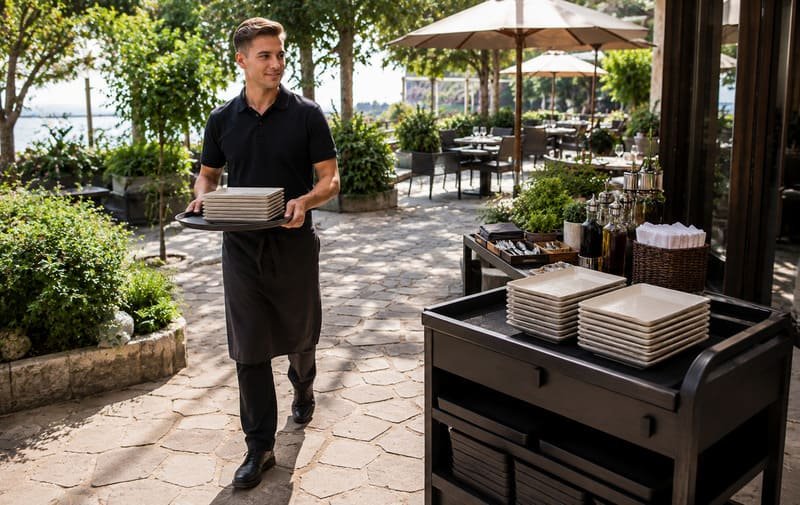
I have spoken with buyers from resort properties and beachside restaurants who specifically mentioned staff handling as one of their main reasons for testing melamine.
Outdoor service often means:
- longer walking distance;
- stairs or slopes;
- uneven patio floors;
- wet poolside areas;
- temporary event setups;
- staff carrying multiple plates at once;
- fast setup and breakdown.
The weight of one plate may not seem important. But multiply that by hundreds of plates per shift, and the difference becomes real. Lighter service equipment can help reduce manual handling strain in foodservice work; the Texas Department of Insurance has published foodservice ergonomics guidance that discusses reducing strain during repetitive tasks and handling (TDI).
Operational Benefits of Lightweight Melamine in Outdoor Settings
Beyond carrying weight, stackability is a practical advantage. Outdoor service areas often have limited storage space: small prep stations near the terrace, storage carts near the pool, or portable trolleys at events.
Plates that stack efficiently and are less likely to chip in the stack help with space management and protect the product between uses.
| Operational Factor | Heavy Ceramic | A5 Melamine |
|---|---|---|
| Carrying weight per plate | Higher | Lower |
| Tray load capacity per trip | Fewer plates per trip | More plates per trip |
| Risk of drop during carrying | Higher when staff are tired | Lower due to easier handling |
| Stacking during storage | Chips can appear at edges | Generally more forgiving |
| Storage space efficiency | Moderate | Good when shapes stack well |
| Setup and breakdown for events | Slower | Faster |
| Poolside movement | More risk if dropped | More practical for high movement |
One practical note: lighter does not always mean “cheap.” A well-made A5 melamine plate with the right thickness, weight distribution, and surface finish can feel solid in the hand.
When I help buyers choose melamine for a specific outdoor venue, I always ask whether the plate needs to feel substantial when a guest picks it up. That tactile experience affects the table impression.
Does Melamine Look Good Enough for an Outdoor Restaurant Table?
This is the question outdoor restaurant owners and hotel buyers hesitate to ask directly, but it is almost always in the back of their mind.
Melamine does not have to look cheap. With the right surface finish, color, thickness, edge design, and custom print or logo, melamine plates can support a professional outdoor table setting. The final appearance depends more on product selection than on the material name alone.
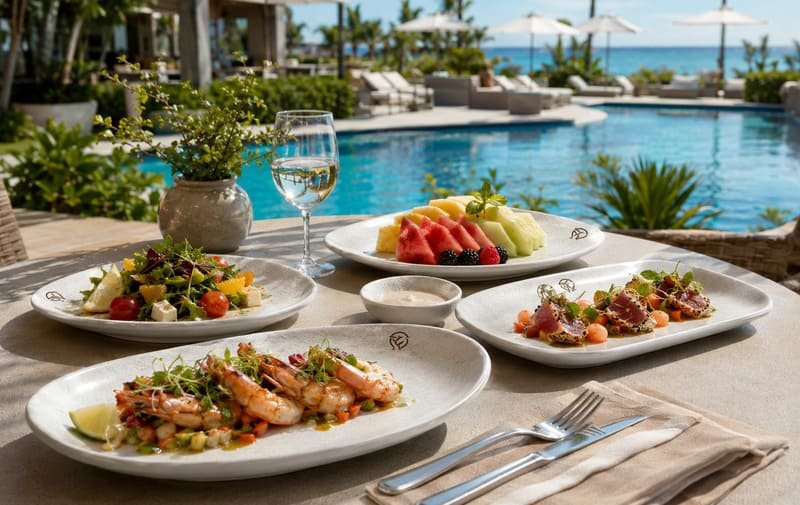
I understand where the concern comes from. There is a lot of low-quality melamine on the market: thin plates, uneven colors, rough edges, and surfaces that look obviously plastic.
That is not what I recommend for commercial outdoor restaurants.
For outdoor dining, appearance should be judged under real conditions:
- natural sunlight;
- terrace shade;
- evening lighting;
- table linen or bare tabletop;
- food color;
- brand atmosphere;
- guest expectations.
A plate that looks too bright indoors may look perfect on a beach terrace. A matte white plate may look premium in a hotel patio setting. A wood-grain or stone-effect melamine plate may work well for casual resort dining. A strong color may fit a poolside bar or fast-casual outdoor concept.
Appearance Factors That Matter for Outdoor Settings
| Appearance Factor | What to Look For |
|---|---|
| Surface finish | Smooth, consistent, no bubbles or rough spots |
| Color consistency | Even tone across all plates in the batch |
| Thickness and weight | Substantial enough to avoid a flimsy feel |
| Edge design | Clean rim, no rough or sharp-feeling edges |
| Print or branding | Clear logo or pattern, properly centered |
| Gloss level | Consistent across the set |
| Outdoor lighting | Color should be approved in real daylight |
| Food contrast | Plate color should make food look appetizing |
Custom printing is available for many A5 melamine products, including full-surface designs, simple logo placement, seasonal patterns, and color-matched sets.
For outdoor restaurants that want a consistent brand identity across their tableware, custom melamine plates are worth considering. But I always recommend approving physical samples. A design on a computer screen can look different on a curved plate, and outdoor sunlight can change the color impression.
What Can Melamine Plates Not Do? The Honest Use Limits
This section matters as much as anything else in this article. Melamine works well for outdoor service, but it should not be treated like ceramic cookware.
Melamine plates should not be used in microwaves, conventional ovens, direct flame, or high-temperature cooking applications. Many commercial A5 melamine plates are designed for dishwasher cleaning, but buyers should follow supplier guidance for temperature, detergent, drying, and stacking.
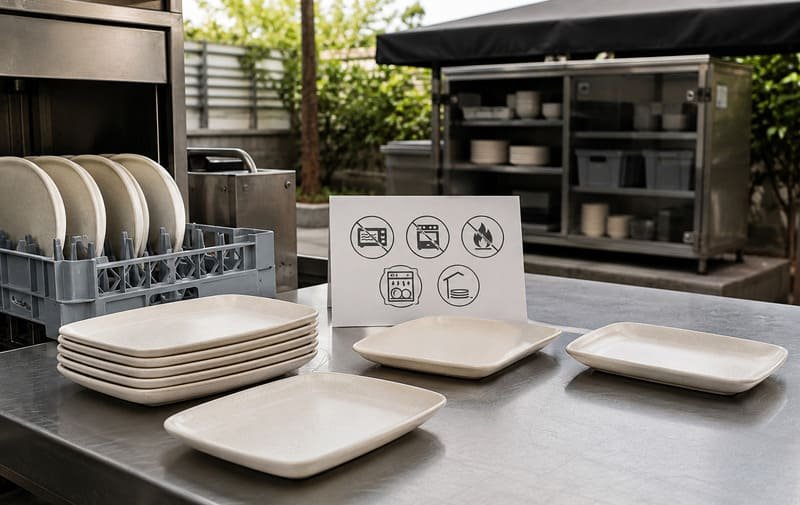
Here is a situation I hear about sometimes: a restaurant switches to melamine for outdoor use, then staff start putting plates in the microwave to reheat food before carrying them outside. This is product misuse.
The U.S. FDA states that foods and drinks should not be heated on melamine-based dinnerware in microwave ovens and discusses melamine migration concerns under certain high-temperature and acidic conditions (FDA). The Centre for Food Safety in Hong Kong also advises that melamine-ware should not be used for cooking, microwave heating, conventional oven heating, hot oil, deep-fried foods, or storage of highly acidic foods (CFS).
For outdoor restaurants, I suggest a simple staff rule:
Heat food in proper cookware first. Plate it on melamine only for service.
Clear Use Guidelines for Outdoor Restaurants
| Use Scenario | Suitable for A5 Melamine? | Practical Note |
|---|---|---|
| Cold food and beverages | Yes | Suitable for normal service |
| Room-temperature food service | Yes | Common use case |
| Pre-plated hot food carried to table | Yes, if supplier-approved | Use for serving, not heating |
| Commercial dishwasher cleaning | Often yes | Follow supplier instructions |
| Microwave reheating | No | Use microwave-safe cookware instead |
| Conventional oven use | No | Melamine is not cookware |
| Open flame or direct heat | No | Avoid direct heat |
| Hot oil or fryer-direct foods | No | Use proper cookware or heat-rated servingware |
| Long-term outdoor sun storage | Not recommended | Store in shaded, dry areas when not in use |
| Use after cracking or deep scratching | No | Remove damaged items from service |
FDA guidance on food-contact substances emphasizes that food-contact safety depends on chemistry, intended use, and potential migration evaluation (FDA Guidance). This is why I do not rely only on words like “food grade.” I ask for the exact material, product specification, and target-market test documents.
The FDA Food Code also emphasizes that foodservice equipment and utensils should be maintained in good repair and be cleanable for safe operation (FDA Food Code). In practical terms, if a melamine plate becomes cracked, heavily scratched, chipped, or badly worn, it should be removed from service.
What Should Buyers Confirm Before Ordering Outdoor Melamine Plates?
A plate that looks good in a catalog may still fail in outdoor service. I prefer to confirm the real use case before discussing large production.
Before ordering outdoor melamine plates, buyers should confirm material grade, food-contact documents, plate weight, surface finish, stacking, dishwasher guidance, outdoor storage plan, custom artwork, packing method, and sample approval under real service conditions.
When I work with restaurant and hotel buyers, I usually ask them to test samples in the actual outdoor setting instead of only in an office or showroom. This helps avoid surprises.
My Outdoor Plate Sourcing Checklist
| Checkpoint | What to Confirm | Why It Matters |
|---|---|---|
| Material | A5 food-contact melamine and test reports | Supports foodservice use |
| Weight | Not too light, not too heavy | Affects guest feel and staff handling |
| Thickness | Suitable wall thickness and rim strength | Helps avoid flimsy feel |
| Surface finish | Matte, semi-gloss, stone, wood-grain, or custom | Affects table presentation |
| Outdoor lighting | Approve color in real sunlight | Prevents color mismatch |
| Dishwasher use | Supplier guidance for temperature and detergent | Prevents misuse |
| Microwave rule | Clear no-microwave staff instruction | Avoids product damage and safety concerns |
| Stacking | Stack height and shelf/cart fit | Supports storage and service speed |
| Artwork | Logo size, color, placement, and curve fit | Prevents design errors |
| Packing | Carton strength and inner protection | Reduces export shipping damage |
If you are building a full outdoor dining program, it is often better to plan the plate range together with bowls, trays, and service accessories. This creates a more consistent table setting. Many buyers start by reviewing restaurant melamine tableware as a full collection rather than choosing one plate shape alone.
FAQ: Melamine Plates for Outdoor Restaurants
Outdoor restaurant buyers usually ask practical questions before switching from ceramic, porcelain, or plastic. These answers are based on the questions I hear most often during sourcing projects.
Can I wash melamine plates in a commercial dishwasher?
Many A5 melamine plates are designed for commercial dishwasher use, but buyers should follow the supplier’s instructions for temperature, detergent, drying, and stacking.
Avoid abrasive pads, harsh chemicals, metal scrapers, and using plates with cracks or deep scratches. If your outdoor restaurant uses aggressive washing cycles, test samples before placing a large order.
How long do melamine plates last in a high-use outdoor restaurant?
Service life depends on use frequency, washing method, stacking, surface finish, staff handling, and whether the team avoids microwave or high-heat misuse.
In many restaurant projects, good A5 melamine can last for multiple seasons, but heavy knife use, rough stacking, harsh detergents, repeated high-impact drops, or outdoor sun storage can shorten its appearance life.
What is the difference between A1 and A5 melamine? Does it matter for a restaurant?
Yes, it matters, but buyers should understand the wording carefully. A1 and A5 are common sourcing terms, not official certificates.
In foodservice tableware sourcing, A5 is commonly discussed as the food-contact melamine choice, while A1 is generally not accepted for food-contact dinnerware. Buyers should confirm actual material declarations, food-contact test reports, and destination-market requirements before purchasing.
Can melamine plates be customized with a restaurant logo?
Yes. Many A5 melamine plates support custom printing, including logo placement, rim patterns, full-surface designs, solid colors, and seasonal artwork.
For outdoor restaurants, I recommend testing samples under actual outdoor lighting. Colors can look different in sunlight compared with indoor showroom lighting.
Is melamine a good fit for a fine-dining outdoor setting?
It depends on the venue. For casual outdoor dining, beach bars, resorts, poolside service, buffet areas, and hotel terraces, melamine is often a practical choice.
For fine-dining terrace service, product selection must be more careful. I would check wall thickness, weight, surface finish, rim shape, table setting, and food presentation before making a decision. A restrained matte or semi-gloss design often works better than a very bright plastic-looking finish.
Can melamine plates stay outside all day?
They can be used for outdoor service, but I do not recommend storing them outside under direct sun, rain, or extreme temperatures for long periods.
When not in use, store them indoors or in a shaded, dry area. This helps protect the surface appearance and keeps the plates cleaner for the next service.
Are melamine plates safe near a pool?
They are often a practical choice for poolside service because they reduce the risk of sharp broken ceramic pieces. However, staff should still avoid leaving plates on wet walking paths, and any damaged plates should be removed from service.
Poolside service also needs clear storage, clearing, and washing routines because wet floors and guest movement increase handling risk.
Can melamine fully replace ceramic for outdoor restaurants?
Sometimes, but not always. For casual patios, beach bars, poolside dining, and resort terraces, melamine may replace ceramic very well. For high-end outdoor tasting menus or venues where traditional ceramic feel is central to the concept, melamine should be tested carefully before full replacement.
My usual recommendation is to start with the highest-risk outdoor area first, test samples, and expand only after staff and guest feedback are positive.
Conclusion
Melamine plates work for outdoor restaurants because they help reduce breakage, make staff handling easier, and support clean table presentation. But they are only the right choice when buyers understand the real use limits.
For outdoor service, melamine should be used for serving, not cooking or reheating. It should not go in microwaves, ovens, open flame, hot oil, or direct high-heat applications. It should also be stored properly when not in use and removed from service if damaged.
My practical advice is simple:
Choose melamine plates for outdoor restaurants when you need lower breakage risk, lighter handling, and flexible design. But confirm food-contact documents, test real samples outdoors, train staff on no-microwave use, and match the plate to the actual service environment.
