
Room-service trays look simple, but I often see small tray choices create slipping, breakage, cleaning delays, storage problems, and replacement pressure. A tray is not just a flat surface. In a hotel, it is a moving service tool.
Melamine trays can work well for hotel room service when they are specified correctly: non-skid surface options, A5 food-grade melamine, practical cleaning structure, stable stacking, suitable size, export packing, and custom hotel branding. The best tray is not always the cheapest tray; it is the tray that fits the hotel’s real service workflow.
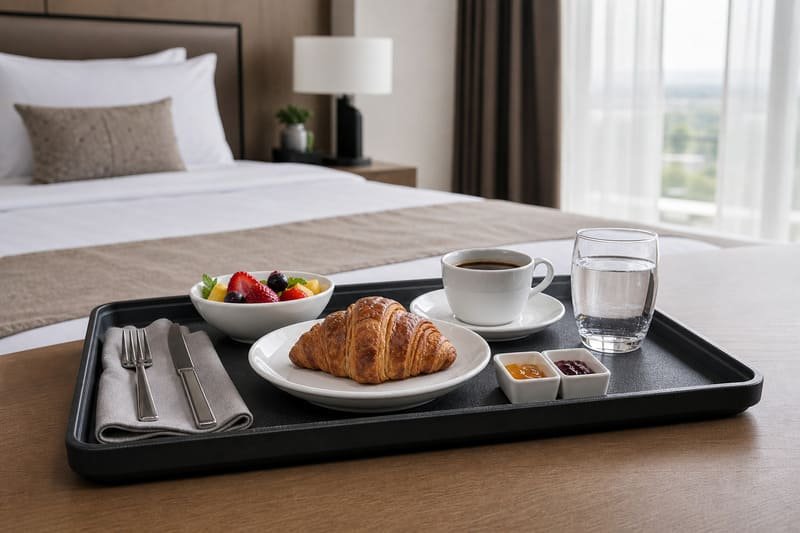
I have handled many hotel and hotel-supply tray discussions from the manufacturing side. I learned that buyers rarely fail because they choose the wrong color. They usually fail because the tray does not fit daily service.
A good room-service tray must support:
- carrying;
- washing;
- stacking;
- drying;
- storage;
- guestroom presentation;
- hotel branding;
- export packing;
- repeated staff handling.
A breakfast tray with coffee cups has different needs from a wine-service tray with glasses. A buffet support tray has different needs from an in-room dining tray. This is why I always start with workflow before price.
When I review a room-service tray sample, I usually do not start with the pattern. I check the surface grip, edge height, stack gap, tray weight, corner shape, and carton packing first.
Room-Service Tray Decision Snapshot
Hotel buyers do not need to start with every technical detail. First, they need to identify where the tray will be used and what risk it must control.
The most important room-service tray decisions are surface grip, tray size, edge structure, cleaning flow, stackability, branding position, and packing strength. These points affect daily hotel operation more than color alone.
| Hotel Need | Tray Feature to Check | Why It Matters |
|---|---|---|
| Coffee delivery | Non-skid surface | Helps reduce cup movement during carrying |
| Breakfast room service | Tray size and rim height | Holds plate, cup, cutlery, napkin, and condiments |
| Wine or bar service | Surface grip and premium finish | Helps stabilize glasses while supporting brand image |
| Fast cleaning | Smooth surface and simple corners | Reduces cleaning delay and residue buildup |
| Drying and storage | Stack gap and stack height | Helps airflow and back-of-house efficiency |
| Hotel branding | Logo position and finish | Avoids conflict with grip, cleaning, and presentation |
| Export order | Packing method and inspection standard | Reduces shipment damage and quality disputes |
For hotel trays, I do not evaluate the product as decoration first. I evaluate it as part of a moving service workflow.
Last Updated: May 27, 2026 | Estimated Reading Time: 9 minutes
By Lance, Marketing Director at Duramela
What Does Non-Skid Design Really Mean for Hotel Room Service?
A tray can look premium, but risk appears when cups slide during delivery. One small slip can damage service confidence and create extra cleanup for staff.
Non-skid melamine trays can help cups, glasses, and plates stay more stable during normal carrying, but performance depends on the tray surface, item base, moisture, weight, and carrying angle. A 30-degree tilt check can be useful in sample review, but it should never be treated as a universal safety promise.
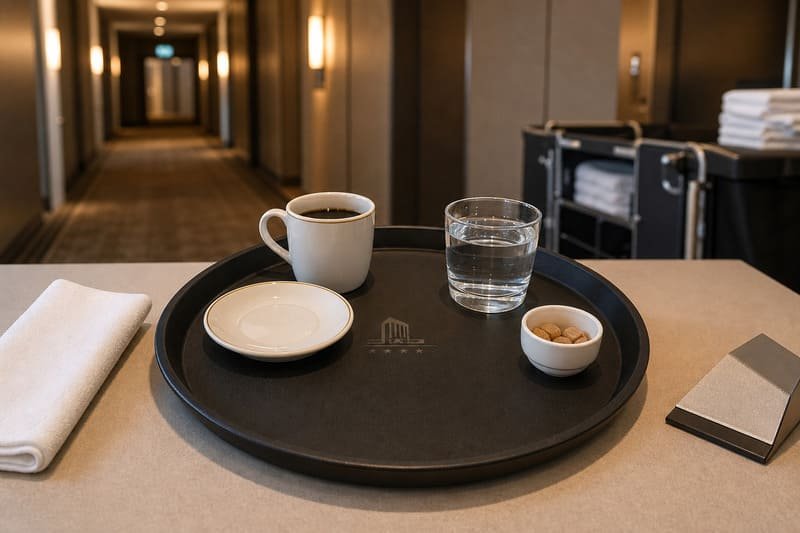
I treat “non-skid” as a service-risk question, not only as a product label. I first ask what needs to stay stable:
- coffee cup;
- wine glass;
- breakfast plate;
- condiment bowl;
- teapot;
- water glass;
- full meal set.
A non-skid surface is usually closer to a matte or lightly textured finish. It is not the same as a high-gloss decorative tray. I do not suggest that buyers expect both strong grip and a very shiny surface at the same time.
In many hotel tray projects, a non-skid surface helps common cups, glasses, and plates stay more stable during normal service. In factory sample discussions, a 30-degree tilt check is often used as a practical reference. But I still treat it as a sample-check method, not a safety guarantee. The tray condition, item base, water, grease, condensation, weight, and handling angle all matter.
| Buyer Question | Practical Meaning | My Manufacturer View |
|---|---|---|
| What will sit on the tray? | Cups, plates, glasses, or full meal sets create different risks | I suggest testing with the hotel’s actual tableware |
| Is the tray often tilted? | Room-service paths, elevators, and doorways affect carrying | I avoid absolute non-slip claims |
| Is the surface wet? | Condensation and spills may reduce grip | I suggest sample testing after water contact |
| Is a glossy look required? | High gloss may conflict with non-skid needs | I explain the trade-off before production |
| Does the hotel use plate covers? | Covers change height, balance, and weight | I test the full room-service setup, not only one cup |
I have seen buyers request a very elegant glossy tray and later ask for stronger grip. I usually explain this early. If non-skid performance is a main requirement, the finish should be planned from the start. It should not be treated as a small afterthought.
For hotel projects where grip is a key requirement, a dedicated Non slip tray design is usually a better starting point than trying to modify a purely decorative tray later.
Why Does Break Resistance Matter More Than Unit Price?
A cheap tray can look attractive at purchase time, but the real cost appears when trays crack, chip, deform, or need frequent replacement.
A5 melamine trays are not unbreakable, but they are often selected for hotel room service because they are lighter and more break-resistant than many ceramic or glass alternatives under normal handling. For hotels, the real buying decision should include service life, staff handling, replacement pressure, and guest safety.
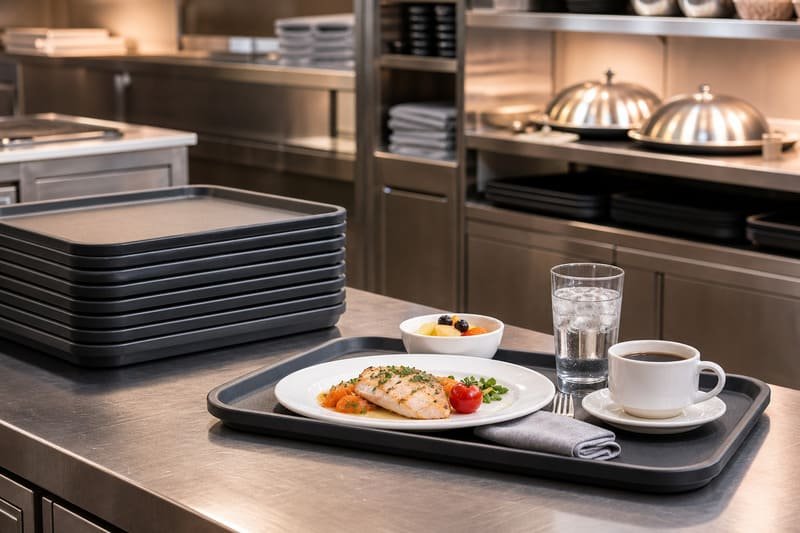
Hotel trays are not display items. Staff carry them, stack them, wash them, dry them, and move them many times each day.
I do not like to promise exact breakage rates, because every hotel works in a different way. Still, durable A5 food-grade melamine is often selected because it gives a practical balance of strength, weight, food-contact use, and long-term value for commercial service.
When I discuss tray procurement, I also look at the edge structure. A tray with a weak edge may look fine in photos, but it may not handle repeated stacking well. A tray with poor thickness balance may feel cheap in the hand. A tray with unstable shape control may create packing and stacking issues.
| Tray Material | Common Strength | Common Concern | Room-Service Fit |
|---|---|---|---|
| A5 melamine | Strong, lighter than many rigid alternatives, suitable for repeated use | Needs correct material and production control | Often suitable for hotel room service |
| Ceramic | Premium surface and hard feel | Heavy and fragile | Less practical for carried trays |
| Wood | Natural look and warm style | Needs more care and may absorb moisture | Good for selected hotel concepts |
| Low-grade plastic | Low price | May look cheap, deform, or scratch more easily | Risky for premium hotel image |
| Metal | Strong and thin | May feel cold, noisy, or slippery depending on finish | Useful for some bar or service settings |
I usually suggest A5 melamine for international hotel and foodservice buyers. It gives a more stable direction than lower-grade alternatives. But I do not treat “melamine” as one single quality level. Material grade, mold quality, pressing control, polishing, curing, and inspection all affect the final tray.
For many hotel buyers, a standard melamine tray is a good starting point when the project needs durability, repeatable design, and commercial practicality.
How Does Cleaning Efficiency Depend on Tray Structure?
A tray can be washable, but I see slow service when edges trap dirt, trays dry poorly, or stacking blocks airflow.
Cleaning efficiency depends on smooth surfaces, simple tray structure, suitable size, stackability, drying space, and the hotel’s actual washing process. It does not depend only on the word “melamine.”
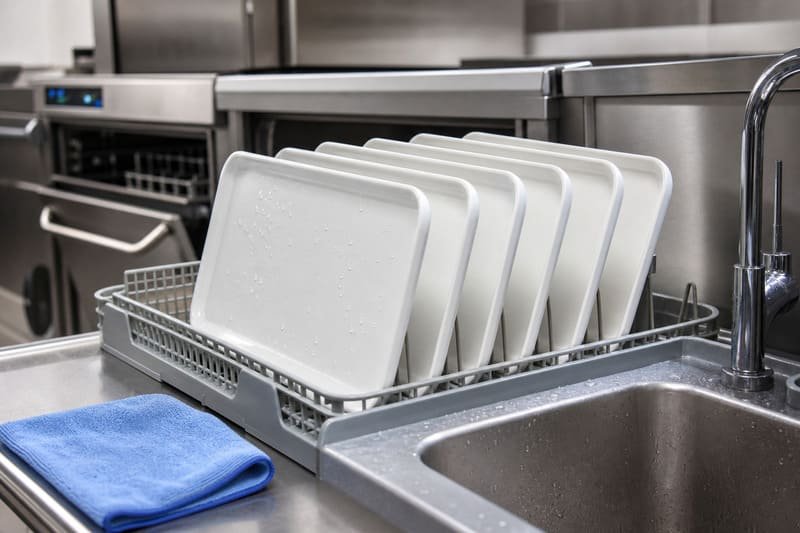
I often explain that cleaning efficiency is about the full structure.
A smooth tray surface helps staff wipe and wash it. A simple corner shape helps reduce dirt-trapping areas. A tray that is too large may not fit well in washing stations. A tray that stacks too tightly may slow drying. A tray that is too heavy may tire staff during repeated handling.
I also ask buyers whether the tray will be cleaned by hand, by a commercial dishwasher, or by a mixed process. Some melamine items can be suitable for dishwasher cleaning, but I always connect this point to the exact product confirmation. I do not suggest assuming that every tray has the same washing performance.
The U.S. FDA explains that foods and drinks should not be heated on melamine-based dinnerware in microwave ovens and discusses melamine tableware use conditions in its melamine tableware Q&A. For trays, this reinforces an important sourcing principle: confirm intended use and do not treat melamine as cookware.
My Cleaning-Flow Check
| Cleaning Factor | Why It Matters | What I Usually Check |
|---|---|---|
| Surface smoothness | Food and drink marks clean more easily | Polishing and finish sample |
| Corner radius | Deep corners can hold residue | Mold shape and rim structure |
| Tray size | Oversized trays may not fit cleaning flow | Washing area, sink, dishwasher, and trolley size |
| Stack gap | Tight stacking can slow drying | Stack height and air space |
| Printing position | Heavy artwork may affect inspection needs | Decal position and surface requirements |
| Non-skid finish | Grip surface may require different cleaning expectations | Sample cleaning after real use |
| Rim height | Helps contain items but may trap residue if poorly designed | Edge shape and wipeability |
I once discussed a tray with a buyer who focused only on the top pattern. The project changed after the hotel checked the washing area. The final tray size became slightly smaller, and the stack became easier to handle. That small change made the product more practical.
I learned from that case that cleaning should be discussed before artwork, not after it.
How Should Size, Weight, and Stackability Be Chosen?
A tray may pass a product test, but I see problems when it feels awkward in the hand, does not fit the trolley, or stacks too high in storage.
The right melamine tray size should match meal type, room-service trolley, staff carrying comfort, washing equipment, storage space, and the number of trays used during peak service. A tray should be tested with the hotel’s real service setup before bulk production.
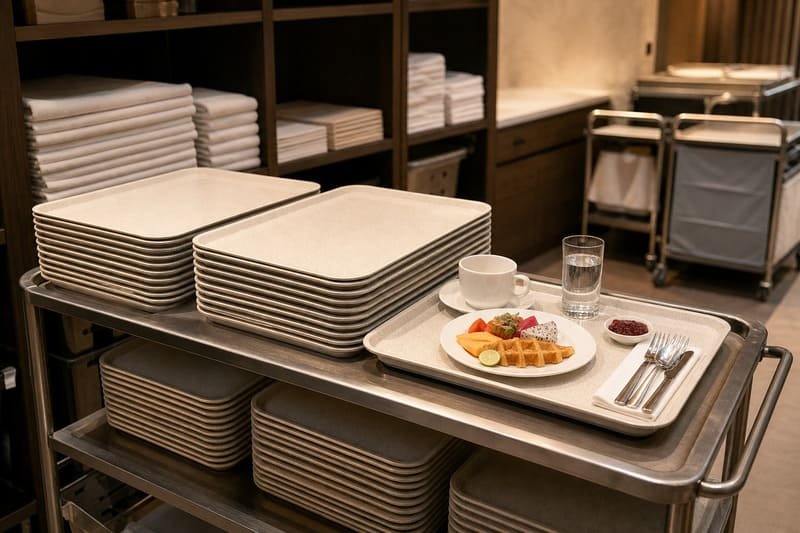
I like to ask hotel buyers what the tray carries during a normal order. A simple coffee service needs less space than a full breakfast. A luxury hotel may need extra space for plate covers, cutlery packs, napkins, glasses, and small condiment dishes. A business hotel may prefer a compact tray that moves quickly and stores easily.
Tray weight is also important. A heavier tray can feel stable, but it may create strain during repeated service. A very light tray may feel less premium and may bend expectations in the wrong way. The best choice is usually a balanced tray with enough thickness, a comfortable edge, and good stack behavior.
For room-service trays, I usually ask buyers to test the tray with a real order:
- one plate;
- one cup;
- one glass;
- cutlery;
- napkin;
- condiment dish;
- plate cover if used;
- menu card or amenity item if required.
| Use Case | Suggested Focus | Possible Risk If Ignored |
|---|---|---|
| Breakfast room service | Space for plate, cup, bowl, cutlery | Items feel crowded and unstable |
| Coffee or tea service | Cup stability and easy carrying | Cups slide during delivery |
| Wine or bar service | Glass stability and premium look | Glass movement creates risk |
| Guestroom amenity tray | Appearance and logo placement | Tray looks generic or off-brand |
| Banquet support tray | Stackability and cleaning speed | Storage and wash flow become slow |
| Poolside service | Grip, break resistance, and easy cleaning | Slips or breakage create safety problems |
I recommend that buyers request samples when the order volume is important. A drawing can show size, but it cannot fully show hand feel. A photo can show color, but it cannot show stack height. A product sample helps the hotel test carrying, washing, drying, and storage.
I see sample testing as one of the simplest ways to reduce procurement risk.
My Room-Service Tray Workflow Check
A room-service tray does not work alone. It moves through a full hotel workflow, from storage to service to washing and back again.
Before approving a tray, I check how it performs in the full hotel workflow: carrying, washing, drying, storing, branding, and shipping. This is where many tray problems appear before they become expensive bulk-order mistakes.
| Workflow Step | What I Check | Why It Matters |
|---|---|---|
| Carry | Does the tray keep cups, glasses, and plates stable? | Helps prevent spills during room delivery |
| Wash | Does the surface clean easily? | Reduces staff time and residue problems |
| Dry | Does the stack allow airflow? | Prevents wet stacking and slow turnaround |
| Store | Does it fit shelves, trolleys, and service stations? | Saves back-of-house space |
| Brand | Does logo placement avoid grip and cleaning issues? | Keeps the tray practical and professional |
| Inspect | Are surface, color, edge, and logo easy to check? | Improves quality control before shipment |
| Ship | Does packing protect large flat trays? | Reduces export damage and complaints |
This workflow view is the reason I prefer discussing hotel trays earlier in the project, not after the buyer has already finalized the design. A tray that looks beautiful on a screen may still fail if it dries slowly, stacks poorly, or does not fit the service trolley.
When Should Hotels Choose Custom Branding or a Standard Tray?
A beautiful logo can help the hotel image, but I see trouble when branding decisions block daily operation.
Hotels should choose custom branding when tray size, weight, surface finish, cleaning method, and non-skid needs are already clear. Operation should come before decoration, because branding cannot fix a tray that does not work in daily service.
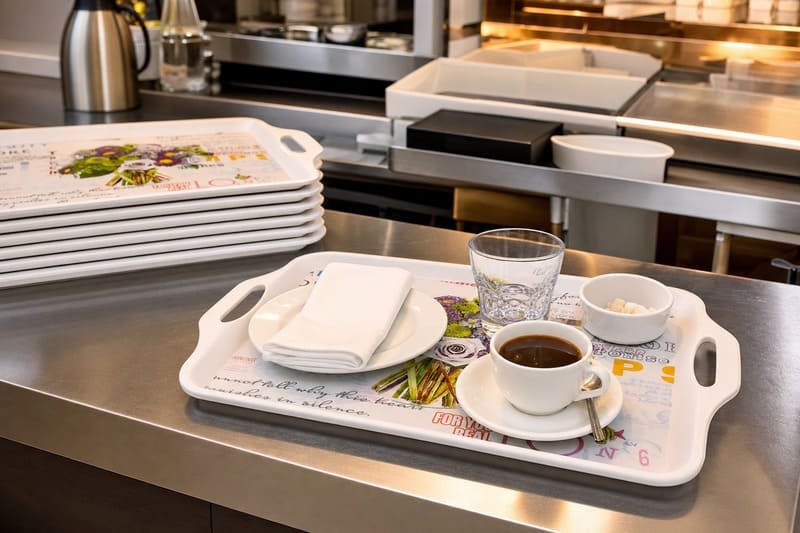
Custom melamine trays can support hotel logos, full-surface artwork, solid colors, wood-grain effects, marble patterns, and special packaging. I like custom work because it helps a hotel create a more complete guest experience.
Still, I do not recommend starting with logo size. I prefer to start with how the tray will be used.
If a hotel already has a standard tray size, custom printing can be simple. If the hotel needs a new shape, new mold development may be needed. This can increase time and cost. For many hotel projects, an existing mold with a custom color or logo can be a better first step. It can reduce development pressure and still create a branded result.
Custom Option Comparison
| Option | Best For | Development Need | My Practical Comment |
|---|---|---|---|
| Existing mold + logo | Fast hotel branding | Low | Often the easiest option |
| Existing mold + full pattern | Strong visual design | Medium | Artwork proofing becomes important |
| Custom color | Brand color matching | Medium | Color approval should use samples |
| New mold | Exclusive shape | Higher | Best for larger or long-term projects |
| Non-skid finish | Service stability | Product-specific | Must be planned early |
| Special packaging | Hotel procurement or retail-style programs | Medium | Useful when presentation matters |
I also remind buyers that non-skid finish may change the visual effect. A hotel that wants a glossy black tray may need to accept a different finish if grip is important.
I prefer clear trade-off communication before sampling. It saves time for both sides and helps the buyer explain the choice inside the hotel team.
What Quality and Compliance Points Should a Buyer Confirm?
A tray may look correct in a photo, but risk appears when material, testing, packing, or inspection details stay unclear.
Hotel buyers should confirm material grade, food-contact requirements, correct-use instructions, dishwasher suitability, non-skid sample performance, inspection standard, packing strength, and final artwork before bulk production. These details should be agreed before the order, not after problems appear.
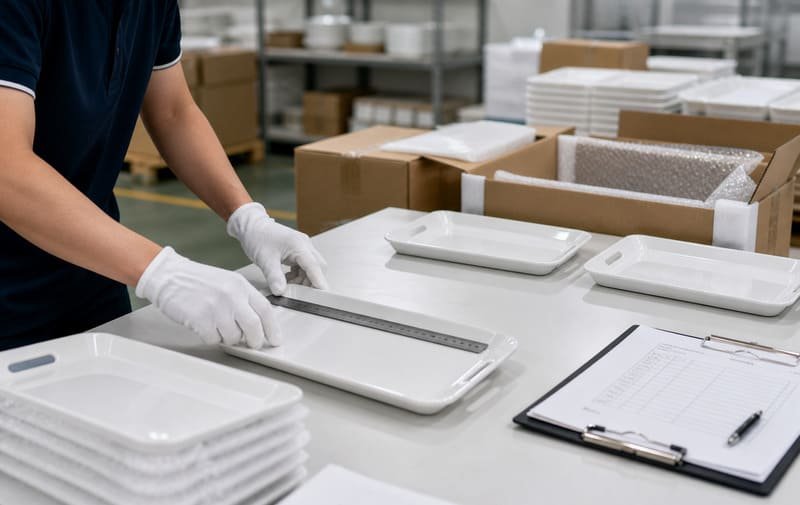
I write this from a manufacturer and exporter point of view. I am not a testing lab, and I am not a hotel safety regulator. My role is to help buyers define the product clearly, produce it in a stable way, and prepare the right documents or samples when needed.
For international hotel projects, I usually suggest confirming food-contact requirements early. Food-contact documents should match the destination market. FDA-related documentation, LFGB testing, BPA-Free declarations, and California Proposition 65 reviews are not interchangeable. The buyer should confirm which documents apply to the exact tray material, color, surface finish, and market.
For the U.S. market, the eCFR includes regulations related to melamine-formaldehyde resins in food-contact applications. FDA guidance on food-contact substances also emphasizes that food-contact safety depends on chemistry, intended use, and potential migration evaluation (FDA Guidance). For EU buyers, food-contact material requirements should be checked against the destination market’s framework, such as the European Commission’s information on food contact materials.
The Centre for Food Safety in Hong Kong also gives practical correct-use advice for melamine-ware, including avoiding use for cooking, microwave heating, conventional oven heating, hot oil, deep-fried foods, or storage of highly acidic foods (CFS). Even though a room-service tray is not usually used like a bowl or plate, the same correct-use mindset is important.
If selling into California, Proposition 65 review may also be relevant depending on the product and substances involved. Buyers should check official information from OEHHA and confirm whether any warning or evaluation is required.
For inspection, AQL should be treated as an inspection sampling method, not as a product safety certification. ISO 2859-1 is commonly referenced for sampling procedures by attributes (ISO). In practical tray production, buyers should define acceptable inspection levels for appearance, color, edge finish, logo position, warpage, packing, and function.
I also like to confirm packaging. A good tray can still arrive with damage if carton strength is poor. Room-service trays are often large and flat, so carton protection, inner separation, corner protection, and packing method matter.
| Confirmation Item | Why I Ask | Best Timing |
|---|---|---|
| Material grade | A5 food-grade melamine is often preferred for hotel projects | Before quotation |
| Non-skid sample | Real items must be tested on the surface | Before bulk order |
| Dishwasher suitability | Washing conditions differ by hotel | Before production |
| Food-contact tests | Markets have different needs | Before shipment plan |
| Correct-use instructions | Prevents wrong use in hotel operation | Before packaging approval |
| Artwork proof | Logo and color errors are costly | Before mass production |
| AQL inspection level | Quality standard must be clear | Before final inspection |
| Carton packing | Export transport can be rough | Before packaging production |
I have seen buyers focus only on unit price and later ask for stronger cartons, better surface inspection, and tighter color control. These needs are reasonable, but they should be included early.
A tray project becomes smoother when quotation, sample, production, inspection, and packaging all follow the same standard.
When Is a Melamine Tray Not the Best Choice?
Melamine trays are practical for many hotel applications, but I do not recommend them for every situation.
A melamine tray may not be the best choice when the hotel needs a natural wood feel, luxury handcrafted texture, oven or high-heat use, transparent glass-like appearance, or purely decorative in-room styling with low handling frequency. Good sourcing means choosing the right tray for the service purpose.
| Situation | Better Alternative | Why |
|---|---|---|
| Luxury natural wood concept | Wood or bamboo tray | Gives warmer natural texture |
| Very high-end handcrafted room setup | Wood, leather-covered, or specialty tray | Better matches luxury storytelling |
| Oven or high-heat use | Metal or ceramic cookware | Melamine is not cookware |
| Glass-like transparency required | Acrylic or glass | Melamine is opaque |
| Very low-use decorative tray | Wood, leather, resin, or metal | Appearance may matter more than service durability |
| Heavy hot cookware service | Metal or heat-rated tray system | Requires different heat performance |
I include this section because trust matters. If a supplier says one tray is perfect for every hotel and every service style, I would be cautious. The right tray depends on the hotel’s workflow, brand position, maintenance system, and safety requirements.
FAQ: What Do Hotel Buyers Usually Ask About Melamine Room-Service Trays?
Hotel buyers often ask practical questions because a tray has to work every day, not only look good in a catalog.
The most useful questions cover non-skid limits, dishwasher use, material grade, MOQ, custom logo options, existing molds, sample testing, packing, and the difference between a general serving tray and a hotel room-service tray.
Are melamine trays completely non-slip?
No. I do not describe any tray as completely non-slip.
A non-skid melamine tray can help reduce movement for many common cups, glasses, and plates. A 30-degree tilt test can be a useful sample-check reference, but the result must be confirmed with the hotel’s real cups, glasses, plates, moisture, weight, and handling conditions.
Can a non-skid tray also have a high-gloss surface?
Usually, strong non-skid performance and high-gloss appearance pull the product in different directions. A more grippy surface is often closer to matte or textured, while high-gloss surfaces are usually smoother.
If grip is the priority, plan the surface finish early. If luxury shine is the priority, understand that non-skid performance may be lower.
Is A5 melamine better for hotels?
I usually recommend A5 food-grade melamine for many international hotel and foodservice tray projects, but A5 alone is not enough.
Buyers should confirm material declaration, food-contact reports, finish, dishwasher guidance, correct-use instructions, and target-market requirements for the exact tray.
Can hotel trays go into a dishwasher?
Some melamine trays can be suitable for dishwasher use, but I do not treat this as automatic.
I confirm it by product type, material, finish, printing, non-skid surface, and the hotel’s washing conditions. A special finish or unusual size may need extra sample testing.
What MOQ should a hotel expect?
Our standard MOQ is often around 3,000 pieces per design or SKU. In some cases, we can discuss smaller trial orders, especially for hotel projects, restaurant groups, and new procurement tests.
The final MOQ depends on mold, color, printing, packing, production schedule, and whether the buyer uses an existing mold or requests a new one.
Can the hotel add a logo?
Yes, a hotel can usually add a logo, custom color, or full-surface design.
I suggest confirming tray size and surface first. Logo placement should not conflict with the grip area, cleaning surface, or non-skid finish.
Should a buyer choose an existing mold or a new mold?
I suggest an existing mold when the hotel wants faster delivery and lower development cost. I suggest a new mold when the hotel needs an exclusive shape or special size.
The best choice depends on order volume, timeline, budget, and how long the hotel plans to use the tray program.
How should samples be tested?
I suggest testing samples with real cups, plates, glasses, plate covers, condiment dishes, cutlery, napkins, and cleaning methods.
Also check carrying comfort, stack height, drying speed, trolley fit, carton packing, and visual appearance under hotel lighting.
What is the difference between a serving tray and a room-service tray?
A serving tray may only need to carry items for a short distance. A hotel room-service tray must also fit trolley movement, guestroom presentation, cleaning flow, stacking, drying, storage, brand standards, and repeated staff handling.
That is why I treat hotel room-service trays as workflow products, not just decorative trays.
Should hotels choose non-skid trays for every room-service order?
Not always.
Non-skid trays are useful when the tray carries cups, glasses, liquids, or breakfast sets. For amenity trays or decorative guestroom trays, appearance, easy cleaning, and brand style may matter more than grip.
Conclusion
I choose melamine room-service trays by workflow first, then by surface, strength, cleaning, size, stacking, branding, compliance, and packing.
A good hotel tray should not only look good in a catalog. It should carry real items safely, clean efficiently, dry properly, stack well, fit hotel trolleys, support the brand, and arrive safely after export shipping.
My practical advice is simple:
Before choosing a hotel room-service tray, test the real workflow. Put the hotel’s actual cups, plates, glasses, cutlery, and covers on the tray. Carry it, wash it, dry it, stack it, and check the packing plan. The right tray is the one that works through the entire service cycle.
