
A lot of buyers come to me with this question. They are looking at two products that seem similar, but one wrong choice can create real problems in their service flow or hurt their dining presentation.
A melamine serving tray and a regular plate are not the same tool. A tray is designed to carry, group, and move multiple items at once. A plate is designed to hold one person’s meal at the table. The difference is not just size — it is function, structure, and how each item fits into your service workflow.
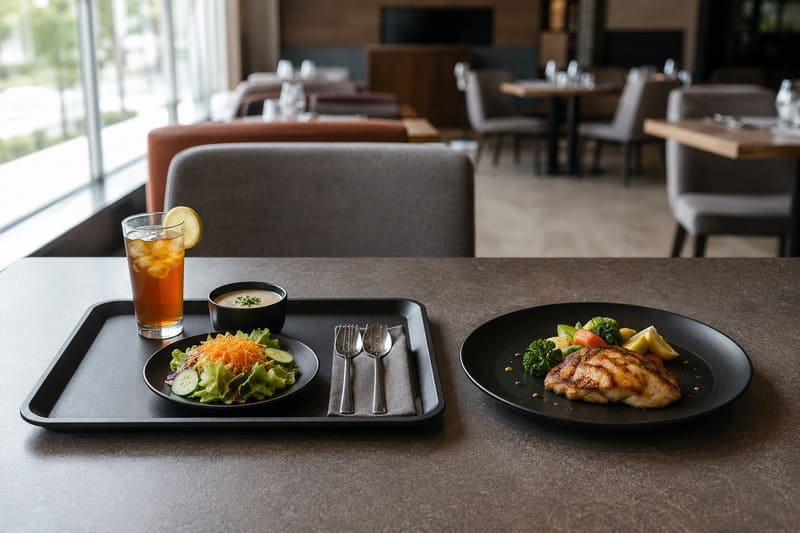
I have had this conversation many times with restaurant buyers, hotel procurement managers, and importers who are building a product line for the first time. The confusion is understandable. Both trays and plates can be made from food-contact melamine material, and both may look flat in a catalog photo. But once you put them into real service conditions, the difference becomes clear very fast.
When I review a tray sample, I do not only check the top size. I check edge height, hand grip, load feel, stacking gap, surface finish, and whether the tray fits the buyer’s trolley or service shelf. For plates, I check portion area, rim shape, knife use, stacking, and table presentation.
Tray or Plate? The Service Task Decides
The easiest way to choose is to stop asking which item looks similar and start asking what job the product must perform.
A tray is a movement tool. A plate is a dining tool. If staff or customers need to carry several items, use a tray. If one guest needs to eat one portion at the table, use a plate.
| Service Task | Better Choice | Why |
|---|---|---|
| Carrying drinks and dishes | Serving tray | Holds multiple items in transit |
| Individual meal presentation | Regular plate | Frames one guest’s food |
| Room service delivery | Serving tray | Supports full order movement |
| Buffet grouping | Serving tray | Groups dishes, cups, or small bowls |
| Steak or entrée service | Regular plate | Gives cutting space and portion framing |
| Café counter service | Serving tray | Lets customers carry their own items |
| Hotel breakfast setup | Tray + plate combination | Tray carries the set; plate presents the meal |
| Retail dinnerware set | Regular plate | Fits normal household dining behavior |
This is the most important distinction for B2B buyers. A product that looks similar in a catalog may behave very differently in restaurant service.
Last Updated: June 2th, 2026 | Estimated Reading Time: 8 minutes
By Lance, Marketing Director at Duramela
Is a Melamine Serving Tray Just a Bigger Plate?
This is probably the most common misconception I run into. A buyer sees a large rectangular melamine tray and says, “So it is just a big plate, right?” Not exactly.
A serving tray is built for a different job. It has a larger carrying surface, low or raised edges to keep items from moving, a shape designed for gripping, and a structure that handles the combined load of multiple dishes, cups, or glasses at the same time.
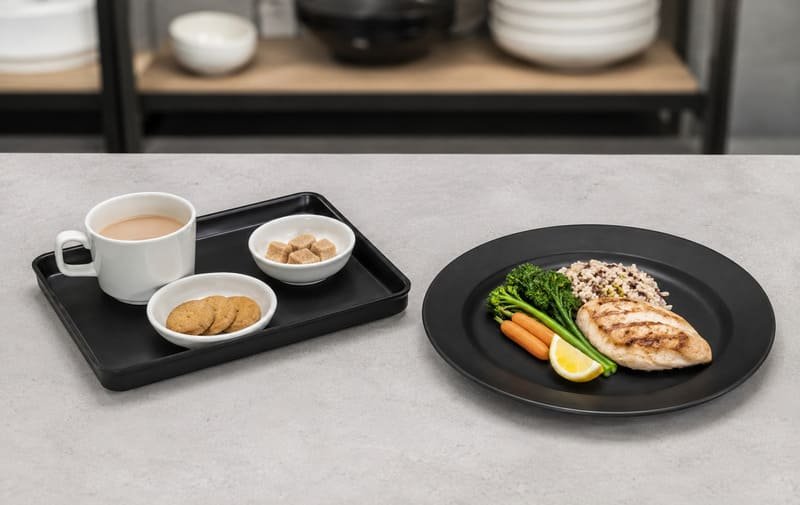
The structural differences matter a lot in daily use. A regular plate has a slightly concave center and a defined rim. That design works well for one person’s meal. It frames the food, keeps sauce or sides in place, and gives the guest a proper eating surface.
A tray has a flatter and wider surface. Some trays also use a non-skid texture or rubber-tipped base. Its edges are designed to contain movement, not to define a portion. A tray is meant to carry objects before they reach the table. A plate is meant to present food after it reaches the table.
Here is a practical structure comparison:
| Feature | Melamine Serving Tray | Regular Melamine Plate |
|---|---|---|
| Primary function | Carrying and transporting multiple items | Holding a single meal at the table |
| Surface design | Wide, flat, sometimes textured | Concave center, defined food rim |
| Edge height | Low or raised to contain items | Shallow rim to frame food |
| Shape options | Rectangular, oval, round | Round, square, oval |
| Typical size range | 30 cm–60 cm+ | 18 cm–32 cm |
| Load handling | Multiple dishes, cups, or glasses | One serving of food |
| Anti-slip options | Often available | Rarely needed |
| Stacking design | Built for stable tray stacking | Designed to stack neatly in dinnerware sets |
| Logo placement | Center, side, corner, or handle area | Rim, center, or back stamp depending on use |
When I talk to buyers about this, I always start here. Once they see the structural logic, the right choice becomes much easier.
If your project is built around carrying, grouping, or hotel service, a Melamine Serving Tray is usually the correct product family to review first. If the priority is plated dining, then a standard malamine plate range will make more sense.
How Does Your Service Workflow Actually Decide This?
Before anyone selects a product, I usually ask one question first: what task does this item need to perform in your space?
If staff are carrying drinks and dishes from the kitchen to the table, that is a tray task. If a guest is eating a single meal at the table, that is a plate task. The moment you reverse these two, your service workflow either slows down or looks wrong.

This sounds simple, but I have seen buyers order plates when they actually needed trays — and then staff end up making three trips instead of one. I have also seen buyers order oversized trays for table settings, which makes the dining experience look awkward and out of place.
Here is a practical way to think about which product fits which task:
| Service Scenario | Better Choice | Why |
|---|---|---|
| Carrying drinks + dishes to a table | Serving tray | Flat surface, grip edge, load handling |
| Individual plate setting at a restaurant table | Regular plate | Portion framing and clean presentation |
| Buffet line with multiple small dishes | Serving tray | Groups and displays multiple items |
| Hotel breakfast presentation | Serving tray or plate combo | Depends on service style |
| Kids’ meal set at a café | Regular plate | Appropriate portion size and format |
| Counter service at a fast food or casual café | Serving tray | Customers carry their own items |
| Room service tray delivery | Serving tray | Holds the full order in transit |
| Outdoor terrace dining | Usually plates, plus trays for service | Plates present meals; trays move items |
Most foodservice operations end up needing both. The question is usually how many of each, what sizes, and whether the buyer wants a coordinated look across the two product types.
What Happens When You Use the Wrong One?
Using the wrong item may not look serious at first, but it creates daily service friction.
| Wrong Use | What Can Happen |
|---|---|
| Using a plate as a tray | Staff make more trips, drinks slide, cups feel unstable |
| Using a tray as a dinner plate | Table setting looks oversized or cafeteria-like |
| Using a flat plate for multiple drinks | Higher spill risk during movement |
| Using an oversized tray for individual dining | Poor portion framing and awkward guest experience |
| Using a decorative tray for heavy carrying | Tray may flex, feel unstable, or be hard to grip |
| Using a plate where anti-slip is needed | Items move more easily during counter or room service |
This is why I call trays and plates different service tools. They are not interchangeable just because they are both flat.
Does the Material Change the Decision?
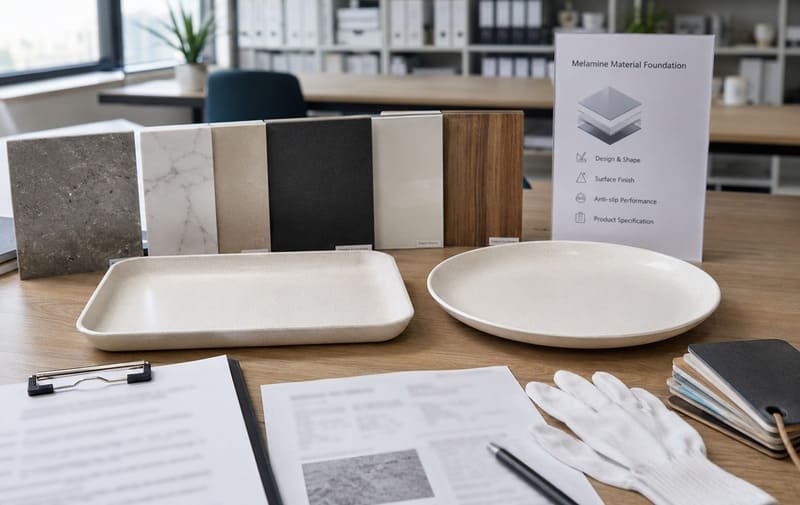
Melamine material is important, but it does not make the choice for you. Both trays and plates can be made from food-contact melamine material, and both can offer durability, impact resistance, and easy cleaning for commercial use.
The material gives you the foundation: durability, food-contact suitability, surface finish, and normal serving performance. But the size, shape, rim design, surface texture, and weight still depend on the specific tray or plate design, not only on the fact that it is melamine.
A few things I always mention when buyers confirm specifications:
Temperature Handling
Melamine is for serving, not cooking or reheating. It should not be used in microwaves, ovens, direct flame, or high-heat cooking environments.
The U.S. FDA advises that foods and drinks should not be heated on melamine-based dinnerware in microwave ovens and discusses melamine tableware safety in its melamine tableware Q&A. The Centre for Food Safety in Hong Kong also advises that melamine-ware should not be used for cooking, microwave heating, conventional oven heating, hot oil, deep-fried foods, or storage of highly acidic foods (CFS).
Surface Finish
Both trays and plates can come in matte, glossy, wood-grain, marble-effect, stone-effect, or solid color finishes. The finish affects appearance, grip, and cleaning.
For trays, surface texture may affect item movement. For plates, the finish affects food presentation and table image.
Anti-Slip Surface
For trays that will be carried by staff or used on counters, an anti-slip surface texture or rubber-tipped base is worth discussing. This is a specification item that must be confirmed per project.
Anti-slip is usually a tray issue, not a plate issue. A dinner plate usually needs a smooth food presentation surface, while a tray may need surface grip.
Food-Contact Documentation
Food-contact documents should match the destination market and exact product. FDA-related documentation, EU or LFGB-style testing, BPA-Free declarations, and other market documents are not interchangeable.
FDA guidance on food-contact substances emphasizes that food-contact safety depends on chemistry, intended use, and potential migration evaluation (FDA Guidance). For EU buyers, food-contact material requirements should be checked against the destination market’s framework, such as the European Commission’s information on food contact materials.
Dishwasher Suitability
Many commercial A5 melamine products are designed for dishwasher cleaning, but buyers should confirm the exact supplier specification for temperature, detergent, drying, and stacking.
The FDA Food Code emphasizes that foodservice equipment and utensils should be cleanable, maintained, and kept in good repair for safe operation (FDA Food Code). In practical terms, damaged trays or plates should be removed from service.
The material gives you the starting point. The product design and specification give you the real performance.
What Should Buyers Watch Out For When Choosing?
For importers, wholesalers, restaurant groups, hotel buyers, and product-line planners, the choice between trays and plates is also a procurement risk question.
Buying plates when your customers need trays, or buying trays when your customers need plates, creates a mismatch that is hard to fix after production. Getting the service task right before placing an order helps reduce returns, complaints, and wasted budget.

From what I have seen working with importers and distributors, the risk usually comes from one of three situations.
1. Sourcing Without Confirming the End User’s Service Model
A wholesale buyer may choose a range of melamine trays and plates for resale without checking how restaurant or hotel customers actually run their service. The sizes or shapes do not fit the workflow, and the buyer ends up with slow-moving inventory.
2. Treating Trays and Plates as Interchangeable
They look similar in a catalog photo. But when a hotel sets a table with a tray instead of a plate, or a café tries to use a dinner plate as a carrying surface, the result does not work operationally or visually.
3. Underestimating Customization Requirements
Both trays and plates support logo printing, surface artwork, custom colors, and packaging. Buyers sometimes assume customization is straightforward without checking mold availability, artwork requirements, or sampling steps. The earlier these are confirmed, the smoother the production process becomes.
For customization, both trays and plates can be produced from existing molds with surface printing or color changes, or developed with new molds for exclusive shapes. Mold development costs and timelines depend on the design, number of molds, and supplier arrangement.
For projects that need a smaller starting quantity, some suppliers — including us in certain cases — can support smaller batches around 1,000 pieces, but this depends on the specific project and must be confirmed upfront.
Sample costs for standard product evaluations may be around USD 120 per sample set, depending on what is being sampled. New mold development may be in the USD 890–950 range per mold, but these are project examples, not universal pricing.
Pre-Order Checklist for Trays and Plates
| Item to Confirm | Serving Tray | Regular Plate |
|---|---|---|
| Main task | Carrying, grouping, transporting | Eating, portioning, presentation |
| Size | Must match carried items and trolley/shelf | Must match menu portion size |
| Edge or rim | Grip and containment | Food framing and table presentation |
| Surface | Anti-slip optional, depending on use | Smooth food surface usually preferred |
| Weight | Should feel stable but not heavy for staff | Should feel appropriate for guest dining |
| Stackability | Must fit storage, carts, and service stations | Must fit dish racks and tableware storage |
| Logo placement | Corner, side, handle area, or center | Rim, center, or back stamp depending on use |
| Dishwasher use | Confirm product specification | Confirm product specification |
| Test reports | Must match target market and product | Must match target market and product |
| Packaging | Large flat trays need strong protection | Plates need stack and edge protection |
This checklist helps buyers avoid the most common mistake: approving a product that looks right but fails in daily service.
Common Buyer Questions About Melamine Trays and Plates
Buyers often ask similar questions before confirming a tray or plate order. These are the practical answers I give most often.
Can a large melamine plate replace a serving tray?
Not reliably. For very light items over a short distance, a large plate may work temporarily, but it is not a reliable tray replacement for commercial service.
A large plate usually lacks the edge containment, grip design, and surface structure that make a tray practical for carrying multiple items. It may also feel unstable when loaded with cups, bowls, or glasses.
Do trays and plates need to match in color and pattern?
Not required, but a coordinated look is often preferred in hotel, restaurant, and branded retail settings.
If you are ordering both for the same venue or product line, it is worth discussing a matching or complementary finish with your supplier during the design stage.
Are melamine trays suitable for hot food contact?
Melamine trays can be used for normal ready-to-serve food contact when product specifications support it. They should not be used for cooking, microwaving, oven heating, hot oil, direct flame, or direct high-heat use.
Always confirm specific temperature guidance with your supplier.
What is the typical MOQ for melamine trays or plates?
Standard MOQ is often around 3,000 pieces per design or SKU, but smaller quantities may be possible depending on the supplier, existing mold, product type, decoration, and project scope.
New molds, custom colors, or complex artwork may require higher MOQs or longer sampling time.
Can I get both trays and plates made in a matching custom design?
Yes. Custom colors, logo printing, surface artwork, and packaging can be applied to both.
The key is to confirm artwork files, existing mold options, logo placement, sample approval, and production requirements early. Tray logo placement and plate logo placement may be different because their use areas are different.
Is a serving tray suitable for table setting?
It can be used as part of a casual, room-service, buffet, or café presentation, but it should not replace a plate for individual dining unless the service concept is designed that way.
A tray can make a table look practical or casual. A plate usually gives a more natural individual dining presentation.
Should I order trays or plates first for a new restaurant?
Start with the menu and service model.
If customers carry their own meals, or staff need to deliver multiple items at once, trays are needed early. If the priority is table presentation, portion framing, and plated dining, plates should be selected first. Most restaurants eventually need both, but the ratio depends on service style.
Conclusion
A melamine serving tray and a regular plate solve different problems. The tray moves food and items through the service workflow. The plate presents food to one guest at the table.
The difference is not just size. It is function, structure, edge design, surface needs, stacking behavior, and the way each item fits into restaurant, hotel, café, room-service, or buffet operations.
My practical advice is simple:
Choose a serving tray when the task is carrying, grouping, or moving multiple items. Choose a plate when the task is individual dining and food presentation. Confirm the service task first, then choose the shape, material, finish, and customization.
