
Parents ask this question every week. Schools and foodservice buyers ask it too. The answer is not as simple as yes or no, and that gray area is exactly where many sourcing mistakes happen.
Food-grade melamine kids bowls can be a safe and practical choice for daily child dining when the material is suitable for food contact, the product has the right documents for the target market, and users follow basic use limits. The key word is “when.” Not all melamine bowls meet these conditions, and buyers need to check before they purchase.
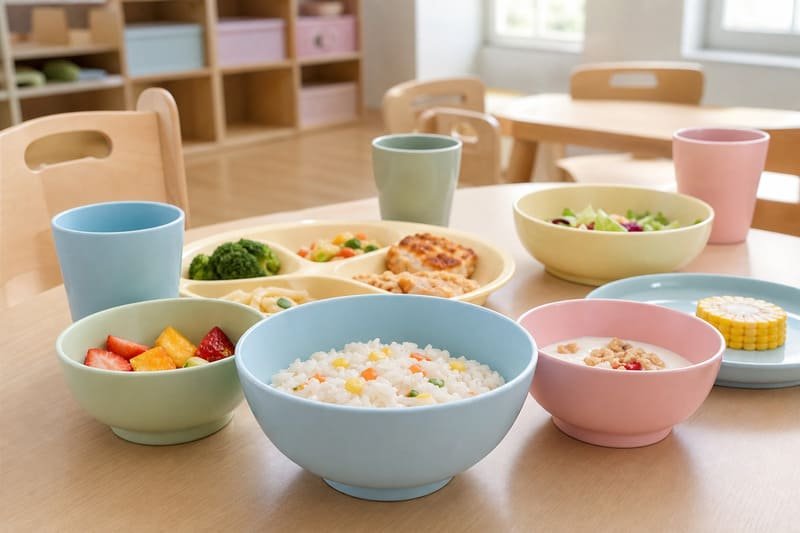
There are many opinions about melamine tableware online. Some people call it a hidden danger. Others say it is perfectly fine without any qualification. Neither position is fully accurate, and both can lead buyers in the wrong direction.
What I want to do here is walk through the real questions that matter for schools, families, foodservice operators, children’s tableware brands, and importers. The goal is not to make melamine sound perfect. The goal is to help you decide when melamine kids bowls make sense, what documents to ask for, how to use them correctly, and when another material may be a better choice.
When I review kids’ bowl samples for buyers, I do not only look at the cartoon pattern. I check rim smoothness, bowl weight, base stability, wall thickness, surface gloss, decal position, and whether the test report matches the exact material and color.
Safety Decision Snapshot for Kids’ Melamine Bowls
For children’s tableware, safety depends on material, testing, intended use, and daily management. A bowl can be suitable in one use case and unsuitable in another if it is heated incorrectly or used after damage.
Melamine kids bowls can be suitable for schools and families when they are made from food-contact melamine, tested for the target market, used only for serving, kept out of microwaves and ovens, and removed from use when cracked, chipped, or deeply scratched.
| Question | Practical Answer |
|---|---|
| Are melamine kids bowls safe? | They can be safe when made from food-contact melamine, supported by proper test reports, and used correctly. |
| Can kids use them for warm food? | Yes, for normal serving conditions. They should not be used for cooking or reheating. |
| Can they go in the microwave? | No. Melamine kids bowls should not be microwaved. |
| Can schools use them daily? | Yes, if staff follow cleaning, inspection, and replacement rules. |
| Are acidic foods a concern? | Normal serving is different from long hot acidic storage. Avoid long-duration hot acidic contact. |
| What documents matter? | Target-market food-contact reports, material declaration, and correct-use instructions. |
| When should bowls be retired? | When cracked, chipped, deeply scratched, warped, or heavily surface-damaged. |
This is the practical way I explain it to school buyers: melamine is for serving food, not for heating food. If staff understand that rule, many common misuse risks can be avoided.
Last Updated: May 31, 2026 | Estimated Reading Time: 8 minutes
By Lance, Marketing Director at Duramela
Is All Melamine the Same Material?
Most buyers assume melamine is just one thing. It is not, and this is where a lot of confusion begins.
Melamine tableware is usually made from melamine-formaldehyde resin. In sourcing discussions, A5 melamine is commonly used to refer to food-contact melamine material for tableware, but the A5 label alone is not a regulatory certificate. Buyers still need material declarations, test reports, and correct-use instructions for the exact product and target market.
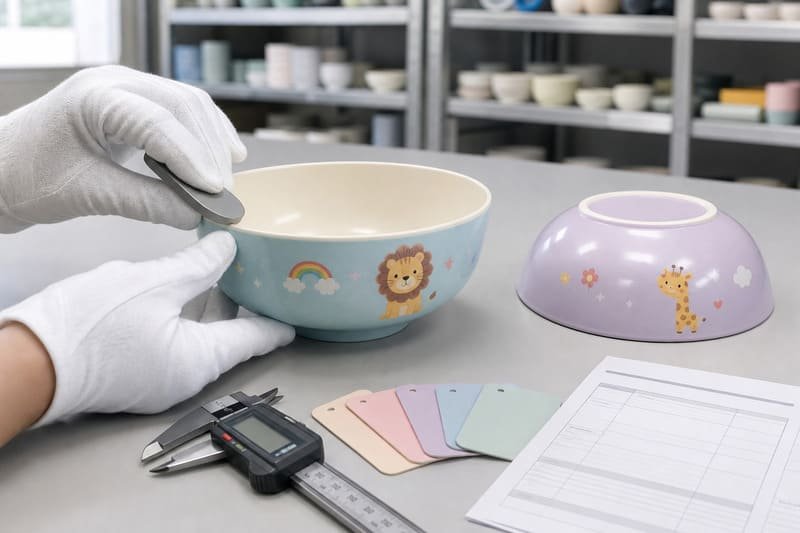
Not every melamine bowl on the market is made from the same material. Some lower-grade or non-food-contact materials may look similar on the outside but can behave differently under heat, acidity, and repeated washing. For children’s tableware, this material distinction is more important, not less.
Children’s bowls are often used with foods such as fruit, yogurt, tomato-based dishes, soups, warm rice, noodles, snacks, and school meals. That means buyers should think carefully about heat, acidity, contact time, washing frequency, and surface durability.
The U.S. FDA explains that foods and drinks should not be heated on melamine-based dinnerware in microwave ovens and discusses melamine tableware safety questions in its melamine tableware Q&A. This is one of the most important use rules for kids’ bowls.
When I handle kids’ tableware inquiries, one of the first things I check is whether the supplier can clearly explain the material. If a supplier cannot confirm the resin specification or cannot provide matching test documents, that is a serious gap for any buyer planning to sell to families, schools, daycare centers, or foodservice operators.
Breaking Down the Material Question
| Factor | What to Check | Why It Matters for Kids |
|---|---|---|
| Material declaration | Confirm food-contact melamine material | The material name alone is not enough |
| Sourcing grade | A5 is commonly discussed for food-contact tableware | A5 is not a standalone certificate |
| Surface finish | Smooth, no cracks, chips, pits, or rough areas | Damaged surfaces can affect hygiene and migration behavior |
| Production control | Proper molding, curing, and inspection | Stable processing helps product consistency |
| Color and decoration | Food-contact-safe pigments and decals | Decoration must also match food-contact requirements |
| Test report match | Product, color, material, and market should match | A generic report may not cover the actual item |
Research has shown that migration behavior can be affected by material quality, temperature, acidity, and use conditions. For example, studies have examined formaldehyde or melamine migration from melamine tableware under different food-contact conditions (PubMed). For buyers, the practical conclusion is simple: do not rely only on a product photo or price. Ask for the exact material and test documents.
When buyers skip this level of checking, they often end up comparing price instead of comparing real product quality. For kids’ tableware, that trade-off is rarely worth it.
What Documents Should Buyers Actually Ask For?
This is probably the question I get most often from importers, school procurement teams, children’s tableware brands, and foodservice buyers. They know they need documents, but they are not always sure which documents apply.
The documents depend on the target market. FDA-related documentation, EU or LFGB-style food-contact testing, BPA-Free declarations, and California Proposition 65 reviews are not interchangeable. Buyers should verify that each document covers the actual bowl, material, color, production process, and intended use.
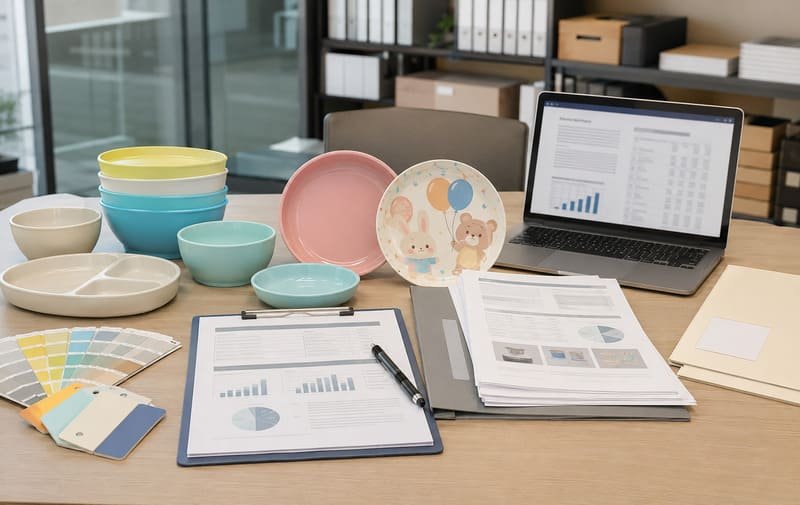
I want to be direct here: having a certificate does not automatically mean a product is suitable for your market. The document must match the product specification, material batch, color, and intended use.
A document that covers adult tableware is not automatically sufficient for a product marketed to children. A report from several years ago may not reflect current production. A report for a white bowl may not cover a heavily decorated bowl if the decal and pigment system are different.
For school procurement teams and kindergartens, this is not only a food safety issue. It is also about parent trust, institutional reputation, and avoiding complaints or recalls.
FDA guidance on food-contact substances emphasizes that food-contact safety depends on chemistry, intended use, and migration evaluation (FDA Guidance). For EU buyers, food-contact material requirements should be checked through the destination market’s framework, such as the European Commission’s information on food contact materials.
Document Reference by Market
| Target Market | Documents or Checks to Discuss | Notes |
|---|---|---|
| United States | FDA-related food-contact documentation | Confirm it covers the exact product and intended use |
| European Union | EU food-contact requirements; LFGB testing may be requested for Germany or some retailers | Migration testing must match material and test conditions |
| United Kingdom | UK food-contact requirements as applicable | Do not assume EU documents automatically satisfy every buyer |
| California | Proposition 65 review may be relevant | Check official OEHHA information and buyer requirements |
| General retail markets | BPA-Free declaration may be requested | BPA-Free does not replace food-contact migration testing |
| Schools / kindergartens | Local procurement rules, labeling, and usage instructions | Check with local authorities or institutional requirements |
If selling into California, buyers should review official Proposition 65 information from OEHHA and confirm whether any warning or evaluation is required.
Suppliers who handle regular export production should be able to provide relevant documentation for their standard product range. If a supplier hesitates, or offers documents that clearly do not match the product you are ordering, treat that as a signal to ask more questions.
For buyers developing children’s tableware lines, the same logic applies to kids plates, bowls, cups, trays, and complete dinner sets. The test report must match the real product, not just the product category.
How Should Melamine Kids Bowls Be Used and What Should Be Avoided?
Even when a melamine kids bowl is made from suitable food-contact material and comes with proper documentation, users still need to understand the use limits clearly.
Melamine kids bowls should be used for serving, not cooking or reheating. They should not be used in microwaves, ovens, direct flame, boiling processes, hot oil, or long storage of highly acidic foods. Warm food service is different from high-heat cooking or microwave reheating.
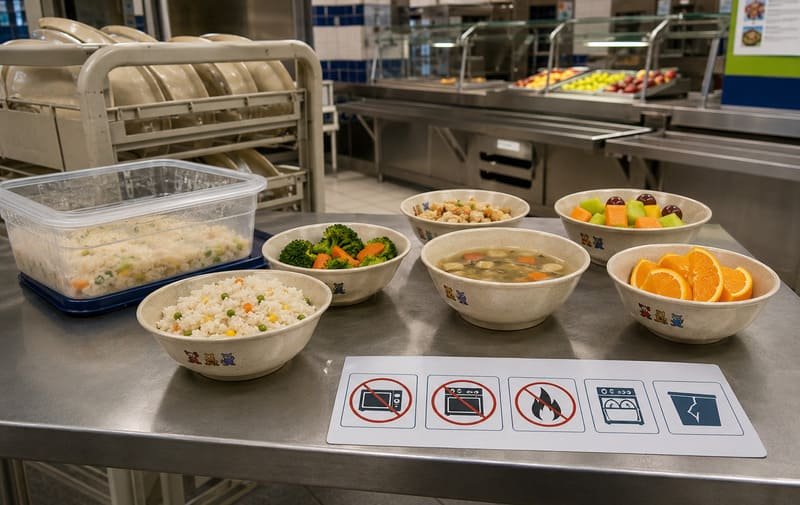
This is a point I think deserves more attention in product education. It is not that melamine is dangerous under normal serving conditions. The concern comes when the product is pushed outside its intended use.
Microwaving melamine, leaving hot acidic food in the bowl for long periods, using the bowl for cooking, or continuing to use cracked and chipped bowls can all increase risk.
The Centre for Food Safety in Hong Kong gives practical guidance for melamine-ware, including that it should not be used for cooking, microwave heating, conventional oven heating, hot oil, deep-fried foods, or storage of highly acidic foods (CFS). This is highly relevant for children’s tableware because schools and families need simple, clear rules.
For schools and foodservice operators, many melamine bowls are designed for dishwasher cleaning, but this should still be confirmed by the supplier’s product specification. Water temperature, detergent, drying, stacking, and surface finish can all affect long-term appearance and performance.
Use Conditions: What Helps and What to Avoid
| Situation | Guidance |
|---|---|
| Warm food at normal serving temperature | Generally suitable when product is food-contact compliant and used correctly |
| Microwave reheating | Do not use melamine kids bowls in microwaves |
| Dishwasher cleaning | Often suitable, but follow supplier instructions |
| Highly acidic food for long contact | Avoid long-duration hot acidic storage |
| Cracked or chipped bowls | Remove from use |
| Boiling or cooking directly | Not intended for cooking |
| Oven or steam oven use | Not suitable unless explicitly approved, which is uncommon |
| Hot oil or fryer-direct food | Not suitable |
| Abrasive cleaning pads | Avoid because they can damage the surface |
| Strong chemical abuse | Avoid unless confirmed by the supplier |
For families, schools, and foodservice operators, clear use guidance should appear on packaging, product pages, training documents, or procurement files. This matters more for children’s tableware than adult tableware because adults may read a label, but children will not.
For school projects, I usually ask whether staff will ever reheat food in the bowl. If the answer is yes, I stop the discussion and explain that melamine is for serving, not reheating. It is better to clarify that before purchase than after daily habits are already established.
What Should Buyers Check Beyond Safety Documents?
For importers, wholesalers, schools, and children’s tableware brands, safety compliance is the foundation. But practical product quality matters just as much when the bowls are actually in use.
The buyers sourcing melamine kids bowls should evaluate smooth rounded edges, consistent wall thickness, stable base design, easy-clean surfaces, child-appropriate size and weight, safe decoration placement, and packaging instructions. These design details affect daily usability and parent satisfaction.
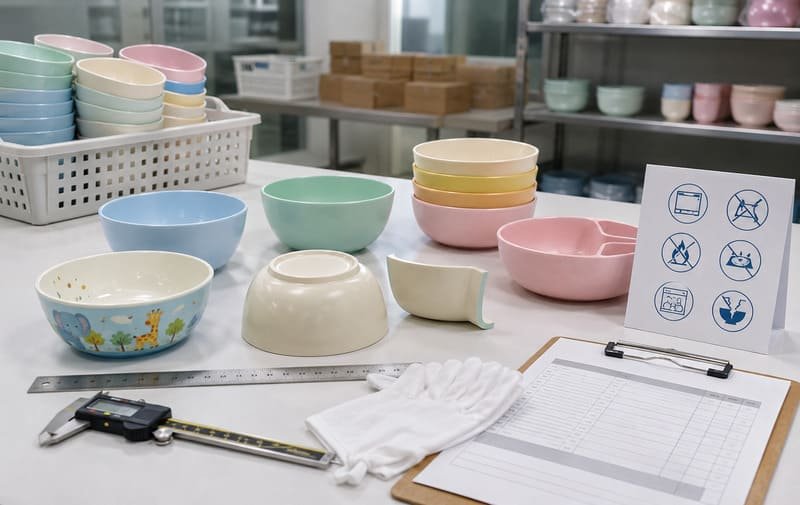
From a manufacturing perspective, these are not luxury requirements. They are basic product design decisions that separate tableware designed for children from standard adult tableware that has simply been made smaller.
A bowl that tips easily, has a rough edge around the rim, or feels too heavy for small hands creates daily frustration even if it passes every safety test.
For private-label brands and e-commerce sellers, design differentiation in the children’s segment often comes from color, pattern, and character artwork. These decorative elements also need to use food-contact-safe materials where applicable and should be checked as part of the same documentation process.
Wholesale Buyer Checklist for Kids’ Melamine Bowls
| Evaluation Area | What to Look For |
|---|---|
| Material | Food-contact melamine material, confirmed by supplier |
| Documentation | Market-specific reports and declarations |
| Edge quality | Smooth, rounded, no sharp points or rough finishing |
| Wall thickness | Consistent and suitable for daily child use |
| Base stability | Wide or stable base to reduce tipping |
| Surface condition | Smooth, easy to clean, no visible defects |
| Decoration materials | Food-contact-safe inks, decals, or glaze layer as required |
| Child sizing | Weight and diameter appropriate for the target age group |
| Color consistency | Stable colors across production batch |
| Packaging | Clear care instructions and protection for shipping or retail |
| Inspection standard | Defined AQL or buyer inspection criteria before shipment |
When I check children’s bowls, I pay special attention to the rim and base. A smooth rim affects comfort. A stable base affects tipping. A good cartoon design may attract attention, but if the bowl slides, tips, or scratches easily, parents and schools will notice the problem quickly.
If you are building a coordinated children’s dinnerware line, it is better to review bowls together with children’s dinner sets so the size, weight, artwork, packaging, and care instructions stay consistent.
What Should Schools Do After Buying Melamine Kids Bowls?
Buying the bowls is only the first step. Schools, daycare centers, and foodservice operators also need simple daily management rules.
Schools should train staff not to microwave melamine bowls, inspect bowls regularly, remove damaged items, use suitable cleaning methods, and keep supplier documents on file. Safe product use depends on both product quality and daily operation.
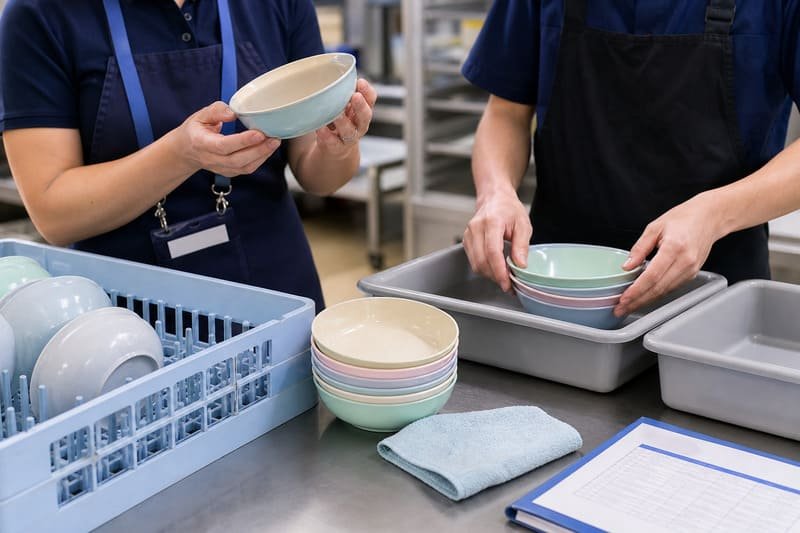
This is where school procurement differs from normal household buying. In a school or kindergarten, the same bowls may be washed and reused many times. Multiple staff members may handle them. New staff may not know the use limits. Parents may ask questions about the material.
A simple management system helps reduce risk.
School Use Management Checklist
| School Action | Why It Matters |
|---|---|
| Train staff: no microwave | Prevents the most common misuse |
| Use bowls only for serving | Keeps melamine out of cooking and reheating processes |
| Inspect weekly or regularly | Finds cracks, chips, deep scratches, or heavy wear |
| Remove damaged bowls | Damaged surfaces should not remain in foodservice use |
| Avoid abrasive pads | Helps protect the surface finish |
| Follow dishwasher guidance | Reduces premature surface wear |
| Separate from cooking containers | Avoids accidental heating or misuse |
| Keep test reports and supplier documents | Supports parent, auditor, or authority questions |
| Use clear labels or internal instructions | Helps new staff follow the rules |
| Review replacement schedule | Keeps the bowl set consistent and safe-looking |
The FDA Food Code emphasizes that foodservice equipment and utensils should be cleanable, maintained, and kept in good repair for safe operation (FDA Food Code). In practical school use, this means damaged bowls should be removed instead of kept in circulation.
For schools, this is also about trust. A parent may not ask about melamine chemistry, but they will notice chipped bowls, faded surfaces, or unclear product instructions. Good management protects both children and the school’s reputation.
When Should Buyers Choose Another Material Instead?
Melamine kids bowls are practical in many daily serving situations, but they are not the right material for every use case.
Buyers should choose another material if the bowl must be used for microwave reheating, oven heating, cooking, boiling, hot oil, long hot acidic storage, or environments where staff cannot follow basic use instructions. A safe sourcing decision includes knowing when not to use melamine.
| Situation | Better Alternative | Why |
|---|---|---|
| Microwave reheating is required | Microwave-safe ceramic, glass, or approved plastic | Melamine should not be microwaved |
| Oven or steam oven use is required | Ceramic, stainless steel, or heat-rated cookware | Melamine is not cookware |
| Cooking or boiling in the bowl | Proper cookware | Melamine is for serving |
| Hot oil or fryer-direct foods | Metal or heat-rated servingware | Avoid extreme heat and oil exposure |
| Long hot acidic storage | Suitable storage container | Avoid long-duration acidic contact |
| No testing documents available | Choose a documented supplier or different product | Unknown compliance is a sourcing risk |
| Heavy cutting with knives | Ceramic or another more suitable surface | Melamine can scratch under sharp abuse |
| High-temperature sterilizing cabinet use | Confirm with supplier or choose heat-rated material | Many melamine products are not designed for this |
This section is important because it keeps the recommendation honest. If a supplier says melamine kids bowls are perfect for every child dining situation, I would be cautious. The right answer depends on use conditions.
FAQ: Common Questions About Melamine Kids Bowls
Parents, school buyers, importers, and foodservice operators often ask similar questions. These are the practical answers I give most often.
Are melamine kids bowls safe for children?
They can be safe under normal serving conditions when made from food-contact melamine, supported by target-market test reports, and used correctly. They should not be microwaved, cooked in, or used after cracking, chipping, or heavy surface damage.
Can melamine kids bowls go in the microwave?
No. Melamine kids bowls should not be used in microwaves.
Heat food in microwave-safe cookware first, then transfer it to the melamine bowl for serving. This rule should be clearly stated on packaging, product listings, and school staff instructions.
What is the difference between A5 melamine and lower-grade melamine?
A5 is a common sourcing term used for food-contact melamine tableware, but it is not a certificate by itself. Lower-grade or non-food-contact materials may look similar but can behave differently under heat, acidity, and repeated washing.
Buyers should confirm actual material declarations and food-contact test reports instead of relying only on the grade name.
Can melamine kids bowls go in the dishwasher?
Many A5 melamine kids bowls are designed for dishwasher cleaning, but buyers should follow supplier instructions for water temperature, detergent, drying, and stacking.
Avoid abrasive pads, harsh chemicals, and continued use of bowls with cracks, chips, or deep scratches.
What certifications should I ask for when importing melamine kids bowls?
Ask for documents required by the destination market. FDA-related documentation, EU or LFGB-style testing, BPA-Free declarations, and Proposition 65 reviews are not interchangeable.
The report should match the actual bowl, material, color, decoration, production process, and intended use.
Are melamine kids bowls suitable for schools?
Yes, they can be suitable for schools when the bowls are food-contact compliant, clearly labeled, used only for serving, cleaned according to supplier guidance, and inspected regularly for damage.
Schools should also train staff not to microwave or cook with melamine bowls.
At what point should melamine bowls be retired from use?
When the surface shows significant cracking, chipping, warping, deep scratches, or heavy surface wear, the bowl should be removed from use.
Damaged surfaces can affect hygiene, cleaning, and food-contact behavior. In school or foodservice use, keeping damaged bowls in circulation is not worth the risk.
Should schools tell parents that they use melamine bowls?
This depends on the school’s policy and local expectations, but transparency is helpful. If parents ask, schools should be able to explain that the bowls are used only for serving, not microwaving or cooking, and that damaged bowls are removed from service.
Keeping supplier documents and use instructions on file makes that conversation easier.
Conclusion
Food-grade melamine kids bowls are a practical choice when buyers check material, verify market documents, and follow basic use limits. When these steps are skipped, the risk is real.
For schools, families, foodservice buyers, and children’s tableware brands, the safest approach is to treat melamine as a serving material, not a cooking or reheating material. Do not microwave it. Do not use it in ovens. Do not keep damaged bowls in circulation. Do not rely on the word “A5” alone without matching reports.
My practical advice is simple:
Choose melamine kids bowls when you need lightweight, durable, child-friendly serving ware — but only after confirming food-contact documents, correct-use instructions, surface quality, and a clear replacement rule for damaged items.
