
Your kitchen is likely filled with plastic: cooking spoons, spatulas, trays, stirrers, disposable cutlery, and storage accessories. If you want to make a practical change without replacing everything at once, solid bamboo utensils are a simple place to start.
Yes, solid bamboo utensils are a useful first step for reducing plastic in the kitchen. When they are made from real bamboo rather than bamboo-plastic or bamboo-melamine composites, they can replace many everyday plastic tools. The key is choosing the right type of bamboo product and caring for it differently from plastic.
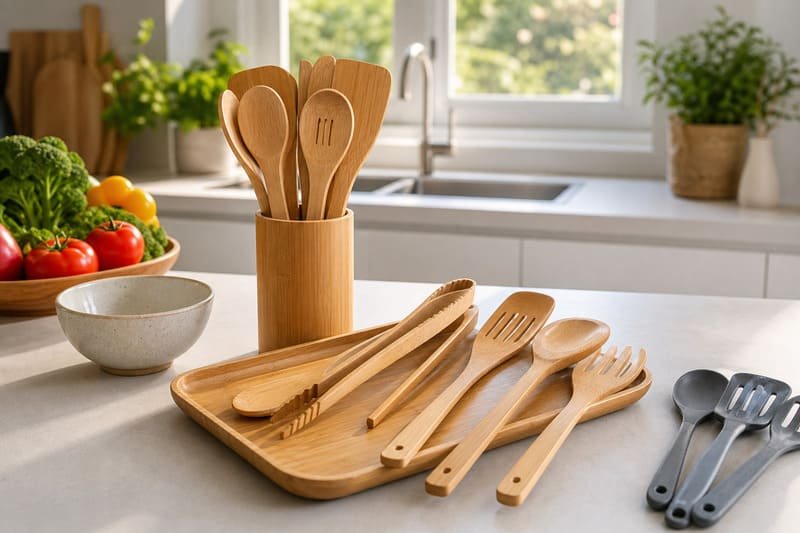
Making the switch from plastic to bamboo is more than just buying a new set of spoons. It is a small shift in daily habits. Bamboo is a natural, wood-like material with its own character, care requirements, and limitations.
A quick note before we start: in this article, I am mainly talking about solid bamboo utensils and serving pieces, not bamboo fiber tableware made with melamine or plastic resin. If a product feels like plastic, is brightly colored, or is molded like plastic dinnerware, it may be a bamboo composite rather than solid bamboo. That distinction matters for safety, sustainability claims, and target-market compliance.
In my work with restaurants, hotels, retailers, and private-label brands, I often see the same pattern. Buyers want a product that feels natural and helps reduce plastic, but they also need it to be practical, brandable, and easy to explain to customers. Bamboo utensils can do that very well when expectations are clear from the beginning.
Quick Answer
| Question | Short Answer |
|---|---|
| Can bamboo utensils reduce plastic in the kitchen? | Yes. Solid bamboo utensils can replace many plastic spoons, spatulas, trays, stirrers, and serving tools. |
| Are all bamboo utensils plastic-free? | No. Solid bamboo can be plastic-free, but bamboo fiber composites may contain plastic or melamine resin. |
| Can bamboo utensils go in the dishwasher? | Handwashing is recommended because heat, detergent, and moisture can shorten their lifespan. |
| Can bamboo utensils touch hot food? | Yes for normal stirring and serving, but bowls or cups for hot liquids need product-specific testing. |
| Can bamboo utensils be customized? | Yes. Laser engraving is the most common method for clean, natural branding. |
Last Updated: May 19, 2026 | Estimated Reading Time: 8 minutes
By Lance, Marketing Director at Duramela
Why Are Bamboo Utensils a Good Starting Point for Reducing Plastic?
You are surrounded by “eco-friendly” claims, and it can be difficult to know which changes actually matter. Bamboo is not a magic solution for every kitchen product, but it is a practical material for replacing many high-contact plastic tools.
Solid bamboo utensils are a good starting point because they replace everyday plastic tools with a renewable, wood-like material. Bamboo grows quickly and can be harvested repeatedly when managed properly, but buyers should still check the finish, adhesive, and whether the product is truly solid bamboo rather than a bamboo-plastic composite.
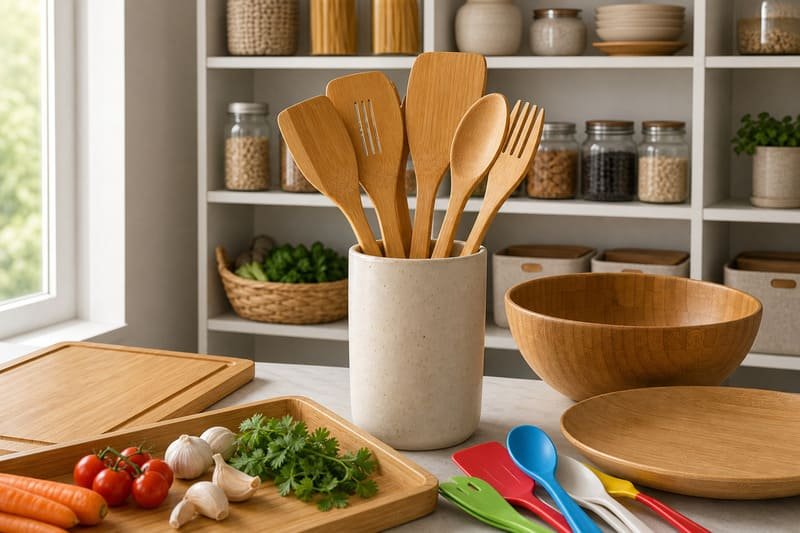
When I talk to clients, the conversation often begins with the environment. People want to know if their choice actually makes a difference. With solid bamboo, the story is easier to understand than with many mixed-material products.
First, bamboo is not a slow-growing hardwood tree. It is a type of grass, and some species are known for extremely rapid growth under favorable conditions. Research on Moso bamboo, for example, discusses its remarkable growth characteristics and biological structure, which is one reason bamboo is widely promoted as a renewable material source (PMC).
Second, bamboo can often be harvested by cutting mature culms while the root or rhizome system remains alive, allowing new shoots to grow again. That does not mean every bamboo supply chain is automatically sustainable, but it does mean bamboo has strong potential as a renewable raw material when responsibly managed.
This is very different from conventional plastic utensils, which are commonly made from petrochemical feedstocks derived from petroleum or natural gas. The U.S. Energy Information Administration explains that plastics are linked to fossil fuel feedstocks, including petroleum and natural gas liquids (EIA).
Third, solid bamboo avoids many plastic-related concerns. For example, BPA is mainly associated with some plastics and resins, not with solid bamboo itself. However, I do not recommend saying “no chemical risk” or “100% safe” without qualification. For food-contact products, buyers should still check:
- the food-safe finish;
- any adhesive used in laminated bamboo;
- coating durability;
- intended use temperature;
- food-contact test reports if required for the target market.
This is especially important for B2B buyers. A home user may only care whether a bamboo spoon feels good in the kitchen. A retailer, restaurant, or hotel also needs to think about product labeling, customer instructions, compliance documents, and after-sales complaints.
Which Plastic Kitchen Items Can Bamboo Utensils Replace First?
Many people want to reduce kitchen plastic but do not know where to begin. The easiest first step is to replace simple, high-contact plastic tools that do not require airtight sealing, high heat resistance, or complex engineering.
The easiest plastic items to replace first are spoons, spatulas, stirrers, disposable cutlery, trays, and simple serving tools. Bamboo is especially useful for stirring, serving, presenting, and branding, but it is not a direct replacement for every plastic container or heat-resistant kitchen tool.
Here is a practical starting list:
| Plastic Item to Replace | Bamboo Alternative | Best Use |
|---|---|---|
| Plastic cooking spoon | Bamboo spoon | Stirring, serving, daily cooking |
| Plastic spatula | Bamboo spatula | Light cooking and non-stick cookware |
| Plastic serving tray | Bamboo tray | Cafes, hotels, restaurants, home serving |
| Disposable plastic cutlery | Bamboo cutlery | Takeaway, catering, events, airlines |
| Plastic coffee stirrer | Bamboo stirrer | Cafes, offices, hotels |
| Plastic appetizer picks | Bamboo picks | Catering, buffets, events |
| Plastic display board | Bamboo serving board | Cheese, bread, fruit, sushi, snacks |
In our factory communication, I always ask buyers where the product will be used. A bamboo spoon for home cooking, a branded bamboo tray for a cafe, and a retail bamboo utensil set need different thickness, finishing, packaging, and care instructions.
For example, a restaurant may need durable serving tools that staff can wash quickly by hand. A retail brand may care more about gift packaging, natural appearance, and clear care labels. A hotel may want bamboo trays or amenity accessories that support a more natural room experience.
If you are sourcing for a brand or foodservice business, start with products that match bamboo’s strengths: presentation, touch, warmth, and simple utility.
Do Bamboo Utensils Require Special Care Compared to Plastic?
You just brought home a beautiful set of bamboo utensils, but now you are afraid to ruin them. Do not worry. A few simple care habits will keep them looking good for a long time.
Yes, bamboo utensils need different care from plastic. You should avoid the microwave, avoid long soaking, and choose handwashing over the dishwasher. Bamboo behaves more like a wooden spoon than a plastic tool, so heat and prolonged moisture can shorten its lifespan.
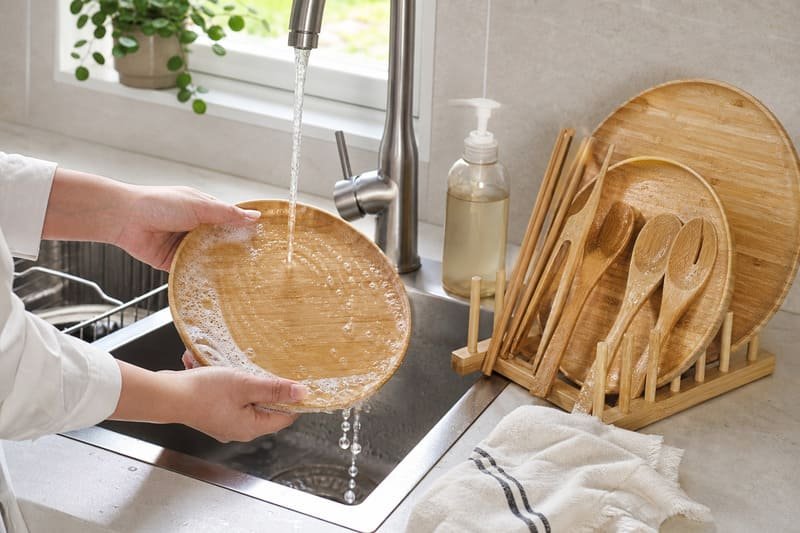
In my experience, this is the most important topic I discuss with new users, whether they are families buying their first bamboo kitchen set or restaurants considering bamboo serving pieces. The expectation that bamboo will behave exactly like plastic is the number one reason for disappointment.
Bamboo is a natural lignocellulosic material. Like wood, it has fibers and pores that can absorb moisture. Repeated exposure to high heat, strong detergent, and prolonged wet conditions can cause swelling, roughness, cracking, or warping over time.
The right care routine is simple:
- Wash with warm, soapy water after use.
- Rinse well.
- Dry with a towel or let it air dry in a well-ventilated place.
- Avoid soaking overnight.
- Avoid microwave, oven, and high-temperature sterilizing cabinets.
- Apply food-grade mineral oil occasionally if the surface becomes dry.
Food-safety guidance for wood-like kitchen items often recommends washing with soapy water and drying properly after use. Michigan State University Extension, for example, provides practical cleaning advice for cutting boards and food safety (MSU Extension). While cutting boards are not identical to utensils, the care logic is similar because both are food-contact, wood-like materials.
Here is a clear comparison:
| Care Action | Bamboo Utensils | Plastic Utensils | Why It Matters |
|---|---|---|---|
| Washing | Handwash recommended | Often dishwasher safe | Bamboo can absorb moisture and may crack over time |
| Dishwasher Use | Not recommended for long life | Usually acceptable if labeled safe | Heat and detergent can damage bamboo finish |
| Microwave Use | No | Depends on plastic type and label | Heat can damage bamboo, coatings, and adhesives |
| Soaking in Water | Avoid prolonged soaking | Generally less sensitive | Long soaking can cause swelling and odor |
| Drying | Dry promptly | Less sensitive | Good drying reduces cracking and mildew risk |
| Oiling | Optional, when dry | Not needed | Helps maintain a smooth bamboo surface |
For brands and restaurants, I recommend printing care instructions on the package, insert card, or product page. A simple “Hand wash only. Do not soak. Do not microwave.” message can prevent many customer complaints.
Is Every Bamboo Utensil Supposed to Look a Little Different?
You just unpacked a new set of bamboo utensils or bowls and notice they do not match perfectly. You may wonder if you received a defective batch. In many cases, this variation is not a flaw; it is a sign of natural material.
Yes, solid bamboo utensils often show slight differences in color, grain pattern, and node marks. Unlike machine-molded plastic, bamboo is a natural material, so each piece can look slightly different depending on the bamboo age, section of the stalk, and natural structure.
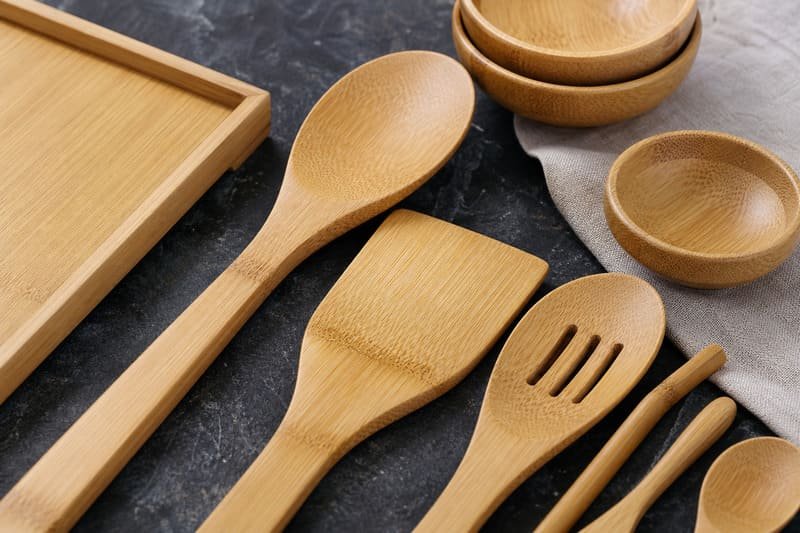
I often get questions from customers, especially B2B buyers who are used to the perfect uniformity of melamine, ceramic, or molded plastic tableware. A restaurant owner may ask why one bamboo tray is slightly darker than another. A retail buyer may point to a small line on a bamboo spoon and ask if it is a defect.
My answer is usually simple: that is how you know it is real bamboo.
Sources of Natural Variation
Age of the Bamboo
Bamboo harvested at different ages can show different tones, from pale yellow to warmer honey beige. This can affect how the final utensil looks after sanding and finishing.
Part of the Stalk
A bamboo stalk does not have exactly the same texture from bottom to top. Pieces made from different sections may show different grain density, tone, and markings.
Bamboo Nodes
The rings or joints visible on bamboo stalks are called nodes. These denser parts of the plant may appear as darker linear marks in finished products. Scientific research on bamboo anatomy discusses how bamboo structure varies by position and geography, which helps explain why visible variation is normal in bamboo materials (PMC).
For retail brands, I recommend explaining natural bamboo variation on the product page or packaging. Otherwise, customers may mistake grain marks, nodes, or color differences for defects.
Instead of treating these details as imperfections, you can present them as part of the product’s natural character. Each piece is slightly unique, which is something synthetic materials cannot fully replicate.
How Can Bamboo Utensils Be Customized for a Brand or Restaurant?
You want branded tableware that reflects your company’s natural or eco-conscious image, but plastic printing feels too ordinary. Bamboo offers a subtle and premium way to show your brand.
Bamboo customization is best for simple, clean branding. The most common method is laser engraving a logo or design onto the surface. This creates a permanent, natural-looking mark, but bamboo is not ideal for complex full-color patterns like those used on melamine or plastic.
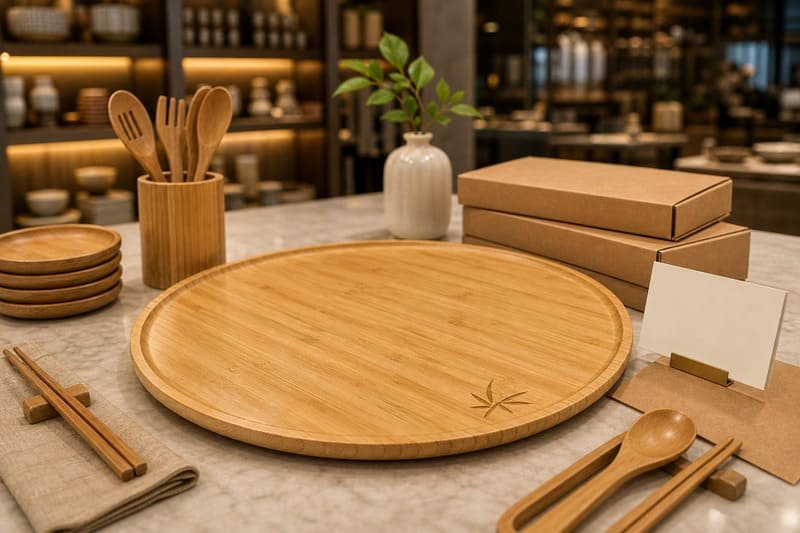
When a restaurant, hotel, cafe, or private-label brand approaches me about bamboo products, the discussion usually focuses on two things:
- choosing the right product shape and thickness;
- applying the brand identity in a way that matches the natural material.
With bamboo, customization is less about adding bright color and more about working with the material itself.
The most popular method is laser engraving. This process lightly burns the logo or design into the bamboo surface. The result is a clean, sharp, slightly darker mark that looks natural and premium. It is ideal for:
- restaurant logos;
- hotel names;
- cafe branding;
- private-label marks;
- gift sets;
- simple icons;
- short text;
- product series names.
For business buyers, custom bamboo utensils work especially well when the design is simple and the brand wants a natural, warm, tactile product experience.
Another strong option is custom sizing. For flat items like boards, trays, and coasters, bamboo can often be produced in specific dimensions without the same mold investment required for molded melamine or plastic. This is useful when a restaurant needs a serving board to fit a plate, a hotel wants a specific room tray size, or a brand wants a unique gift set.
For example, laser engraved bamboo trays are popular for hotels, cafes, restaurants, and retail gift packaging because they combine function with subtle branding.
What does not work well? Complex, multi-color surface printing. The natural and slightly porous surface of bamboo does not perform like melamine or ceramic for full-surface decal printing. The result may be inconsistent and less durable during washing.
Here is a practical reference:
| Customization Type | Is It a Good Fit for Bamboo? | Best For |
|---|---|---|
| Laser engraved logo | Yes, excellent | Brand logos, text, simple icons |
| Custom size or thickness | Yes, especially for flat items | Trays, boards, coasters, serving pieces |
| Full-color pattern | Not recommended | Melamine or ceramic is better |
| Custom solid color | Not ideal | Bamboo’s natural color is the main appeal |
| Retail packaging | Yes | Gift sets, eco-style kitchen sets, private label |
| Simple insert card | Yes | Care instructions, brand story, sustainability message |
For any business wanting to project a natural, premium, or eco-focused image, the subtle elegance of a laser-engraved bamboo product is usually more effective than a colorful plastic one.
What Should Buyers Check Before Making Plastic-Free Claims?
Plastic-free and eco-friendly claims can help customers understand your product, but they must be accurate. This is especially important if you sell through retailers, marketplaces, or regulated markets.
Before calling a bamboo product plastic-free, confirm that it is solid bamboo and not a bamboo fiber composite made with plastic, melamine, or another resin binder. Also check whether the coating, adhesive, and packaging support the claim you want to make.
This is where many brands make mistakes. A product may contain bamboo powder and still be a plastic composite. Several regulators have raised concerns about plastic food-contact materials containing bamboo or other plant-based fillers.
For example, the UK Food Standards Agency has advised businesses about plastic food-contact articles containing bamboo and similar plant-based materials, especially because of possible melamine and formaldehyde migration concerns in certain plastic composites (FSA). The European Commission has also discussed enforcement action against illegal plastic food-contact materials containing bamboo powder or similar unauthorized plant additives (European Commission).
The key distinction is simple:
| Product Type | Can It Support a Plastic-Reduction Story? | Buyer Caution |
|---|---|---|
| Solid bamboo spoon or spatula | Yes, if no plastic coating or resin is used | Check finish and food-contact suitability |
| Solid bamboo tray or board | Yes, good for serving and presentation | Check adhesive, coating, and care instructions |
| Bamboo fiber composite plate | Not automatically | May contain melamine or plastic resin |
| Bamboo-melamine product | High caution | Check target-market regulations and migration tests |
| Plastic product with bamboo powder | Not suitable for simple plastic-free claims | May be considered a plastic food-contact material |
My practical advice is: do not rely only on the word “bamboo.” Ask for the material composition first.
For B2B buyers, this is not just a technical detail. It affects packaging claims, product listings, customs documents, retail compliance, and customer trust.
Frequently Asked Questions About Switching to Bamboo
Switching to a new material naturally comes with questions. Here are the most common ones I hear from families, restaurants, retailers, and private-label buyers.
Q1: Are bamboo utensils really better for the environment?
They can be a better choice when they are made from solid bamboo and responsibly finished. Bamboo is fast-growing and renewable, and solid bamboo utensils can replace many petroleum-based plastic tools. However, the real environmental impact also depends on harvesting, adhesives, coatings, packaging, transport, product lifespan, and how the item is used.
Q2: Can I put hot soup or coffee in bamboo bowls and cups?
Solid bamboo utensils can usually handle normal contact with hot food, such as stirring soup or serving cooked dishes. For bamboo bowls or cups used with hot liquids, buyers should check whether the coating, adhesive, and finished product have been tested for that use. Avoid microwave heating, and be especially cautious with bamboo-plastic or bamboo-melamine composite products used for hot or acidic drinks.
Q3: Will bamboo utensils stain from foods like tomato sauce or curry?
Like wooden spoons, bamboo can develop light staining from strongly pigmented foods if left in contact for too long. The food-safe finish on many products provides some protection, but the best defense is to wash utensils promptly after use. For restaurants, this should also be included in staff care instructions.
Q4: Are bamboo utensils dishwasher safe?
Handwashing is recommended. A dishwasher exposes bamboo to prolonged moisture, detergent, and heat, which can shorten its lifespan and cause cracking, roughness, or warping. If you sell bamboo utensils as a brand, include clear handwash-only care instructions on the package or product page.
Q5: How can I tell if a product is solid bamboo or bamboo fiber composite?
Solid bamboo usually shows natural grain, nodes, and color variation. Bamboo fiber composite products often feel smoother and more plastic-like, and they may be brightly colored or molded into shapes similar to plastic dinnerware. For B2B orders, always ask the supplier for material composition before making eco-friendly or plastic-free claims.
Conclusion
Switching to bamboo is a simple and practical way to reduce plastic in the kitchen, especially when you start with everyday tools like spoons, spatulas, stirrers, trays, and serving pieces.
The most important point is to choose the right type of bamboo product. Solid bamboo utensils can support a strong plastic-reduction story, but bamboo fiber or bamboo-melamine composites are different materials and should not be treated the same way.
Bamboo also requires different care from plastic. Handwash it, dry it properly, avoid soaking, and never put it in the microwave. Once customers understand these simple habits, bamboo can become a durable, attractive, and natural part of the kitchen.
For brands, restaurants, hotels, and retailers, bamboo utensils are not just a replacement material. They are also a way to communicate a warmer, more natural product experience through touch, appearance, and subtle branding.
My practical advice is simple: start with the plastic items that bamboo replaces best, explain the care instructions clearly, and make sure your material claims match the actual product.
