

In the highly competitive restaurant industry, dinnerware is more than just a container for food; it is an extension of the brand experience. Many quality-focused chain restaurants, like Café Zupas, face a common challenge: standard “off-the-shelf” products simply cannot meet their precise requirements for size, curvature, and brand tonality.
Chain restaurants customize exclusive dinnerware by partnering with manufacturers who can engineer specific shapes and materials to solve operational problems. Through the Duramela x Café Zupas case study, we reveal how precise mold engineering, “soup-proof” glazing, and smart logistics transform a design file into a durable, brand-enhancing reality across hundreds of locations.
As experts in melamine manufacturing with decades of experience, Duramela is here to transparently break down exactly how a custom project transforms from a simple design file into a tangible product. We will go beyond the basics and dive into the “invisible” engineering that makes a project like this successful, using real-world data and expert insights..
Last Updated: Dec 15th 2025 | Estimated Reading Time: 12 Minutes
Project Data at a Glance: Your Procurement Baseline
To help you quickly assess the feasibility of your own project, we have organized the core data from the Café Zupas case. These aren’t just numbers; they are your baseline for planning a procurement budget.
| Key Metric | Data Details | Strategic Explanation |
|---|---|---|
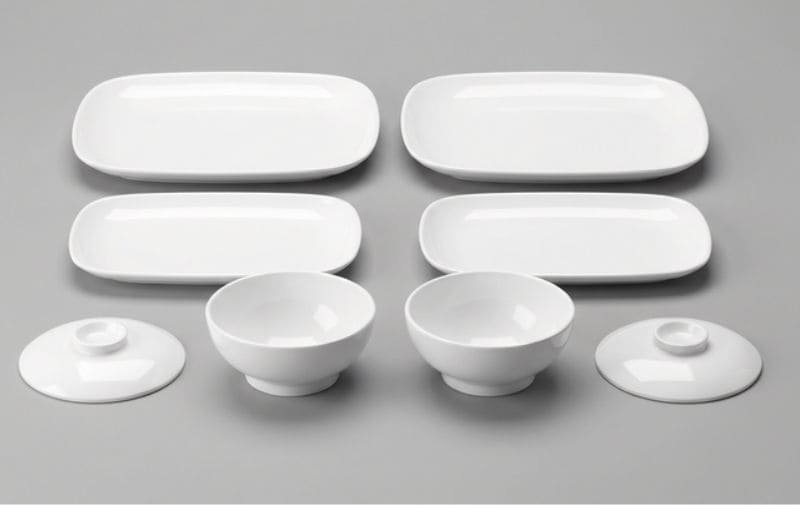
| Project Scope | 3 Custom Bowls + 1 Custom Tray | Covers core front-of-house dining scenarios (Soup, Salad, Combo). |
| Mold Cost | Approx. US$3,000 (Full Set) | Includes 3 melamine bowl molds + 1 melamine tray mold. |
| Mold Time | 18 Days (Approx.) | From blueprint confirmation to the first physical sample. |
| Production Time | 3-4 Weeks | Calculated after the “Golden Sample” is approved. |
| Shipping Time | 3-4 Weeks (Sea Freight) | From China factory to USA warehouse (Door-to-Door). |
| MOQ | Standard 3,000 pcs/item | We support Low MOQ custom bowls (1,000 pcs) for startups. |
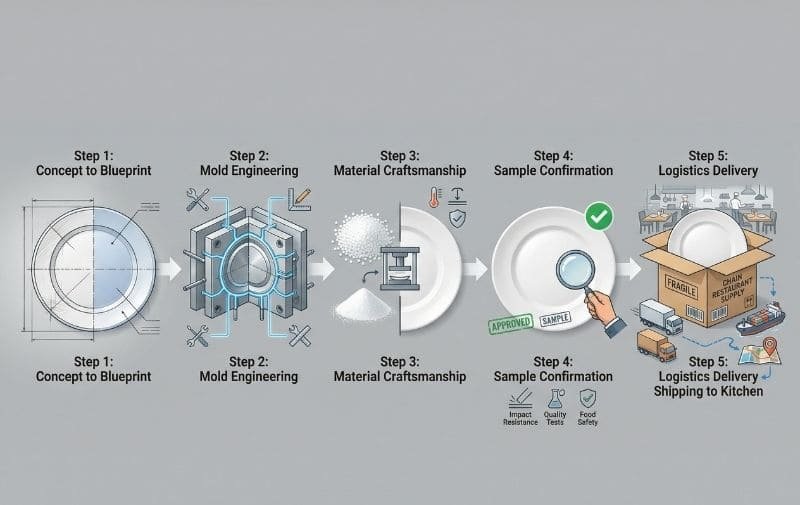
Step 1: From Concept to Blueprint — More Than Just “Sending a File”
The first step in customization is precisely defining the requirements. For a client like Café Zupas, their demands were specific:
- Functionality First: Surfaces must be extremely easy to clean and stain-resistant to withstand high-frequency commercial use.
- Visual Effect: Off-white color with a matte finish to mimic the look of ceramic (“porcelain-like”) without the fragility.
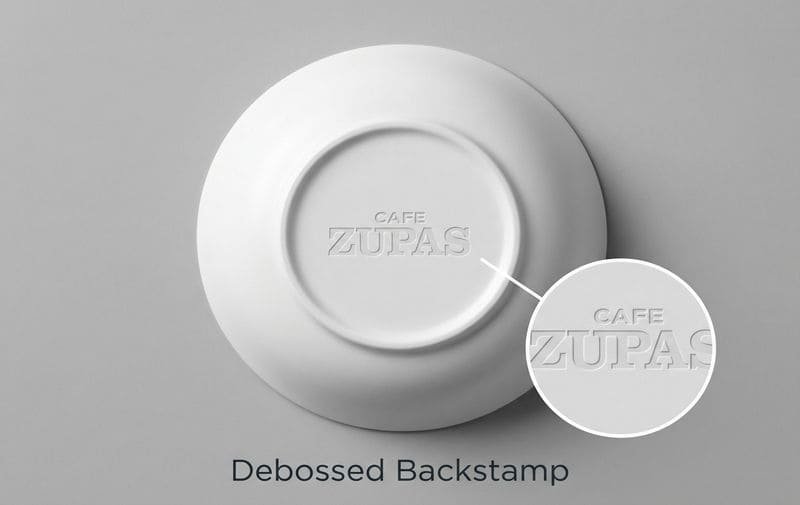
- Subtle Branding: No loud prints on the eating surface. They required the logo to be engraved on the bottom using the mold itself.
How did we execute this? The client provided vector design files (AI/PDF format). Our engineers didn’t just use them blindly; they performed a secondary audit:
- Size Calculation: We confirmed the “Golden Sizes” for the three bowls (φ15.8cm, φ19.6cm, φ22.5cm) and the tray (18.4×18.4cm) to ensure they perfectly fit the restaurant’s existing dishwasher racks.
- File Optimization: We ensured the vector lines were sharp when zoomed in, which is critical for the crispness of the bottom logo engraving.
The “Ceramic Illusion”: Mastering the Off-White Aesthetic
The first challenge in the Zupas project was visual. The client required the durability of plastic but the aesthetic soul of ceramic. This is where most manufacturers fail—they produce “Super White” melamine, which reflects light too uniformly and looks undeniably cheap and “plasticky.”
The “Ceramic Illusion”: Rice White vs. Plastic White
One of the most critical decisions in this phase was color. The client requested “Rice White” (Off-White).
- Aesthetic Nuance: Pure “Super White” melamine often looks cheap and plastic-like because it reflects light too uniformly. “Rice White” or “Ivory” formulations contain specific pigments that absorb slightly more light, mimicking the depth and visual softness of Bone China or Stoneware.
- The Tap Test: When combined with high-gloss glazing, customers often tap the bowl with a spoon just to check if it’s ceramic. This color matching is critical for the “fresh” brand image of Zupas.
Pro Tip: Never approve a color based on a computer screen or even a Pantone code alone. Melamine reacts to light differently than paper. Always request a physical “color chip” or a prototype sample to view under your restaurant’s actual lighting conditions (warm vs. cool light).
The “Backstamp” Strategy: Why Debossing Beats Printing for Chains
In the design phase, the client made a crucial decision regarding their logo placement. Instead of a colorful print on the rim, they opted for a logo engraved (debossed) on the bottom of the bowl.
Why this is the superior choice for chains:
- Infinite Durability: In a high-traffic environment, bowls are stacked, slid, and washed thousands of times. A surface print will eventually scratch or fade due to friction. A molded logo is physically part of the bowl’s structure—it lasts forever.
- Hygiene & Safety: Unlike stickers or poorly applied silk screens, a molded logo (with smooth draft angles) has no edges to lift or trap bacteria.
- Brand Perception: This mimics the “backstamp” found on high-end pottery and porcelain. It subtly signals to the customer that this piece was custom-made for the brand, elevating the perceived value far more than a loud, printed logo ever could.
Why Zupas Chose a Molded (Debossed) Logo Instead of Printing
| Feature | Printed Logo | Molded (Debossed) Logo |
|---|---|---|
| Durability | Wears off over time due to friction and stacking. | Lasts forever; it is physically part of the bowl. |
| Hygiene | Can develop edges that trap bacteria once the print degrades or peels. | Smooth draft angles ensure easy cleaning and better food safety. |
| Perception | Can look like a temporary promotional sticker. | Mimics the backstamp of high-end pottery, elevating brand value and professionalism. |
Step 2: Mold Engineering & Cost Transparency — Where Does the Money Go?
When clients hear “customization,” their biggest fear is often “hidden costs.” At Duramela, we insist on total transparency. In this case, the client needed entirely new shapes developed.
Total Mold Cost: Approximately US$3,000. This covers the CNC machining fees for three sets of high-precision steel bowl molds and one tray mold.
Timeline: Our engineers took 18 days to complete the mold making. This is faster than the industry average of 25 days because we operate our own in-house molding facility.
Family Mold Economics: How to Optimize Tooling Costs
How did we keep the cost to ~$3,000 for 4 molds? The secret is “Family Mold” economics.
- The Engineer’s Trick: Instead of building 4 completely separate, massive steel blocks, we utilized a “Master Frame” system where interchangeable mold cores share a standard base housing.
- The Savings: This reduces steel consumption and CNC machining time significantly. A less experienced factory might charge you $1,500 per bowl (totaling $6,000), essentially doubling your startup costs. We optimize the tooling to fit your budget.
Pro Tip: If you are a startup brand and find mold fees daunting, ask us about our existing stock molds. We have thousands of open molds that might be 90% similar to your design, requiring zero tooling investment. You can customize them by changing the color or adding a decal, avoiding mold fees entirely.
| Cost Factor | Traditional Mold Setup | Duramela “Family Mold” Strategy |
|---|---|---|
| Steel Usage | High (4 separate blocks) | Low (1 base + 4 cores) |
| Setup Time | High (Change entire mold) | Medium (Change cores) |
| Cost to Client | ~$6,000+ | ~$3,000 |
| Production Speed | Fast (Can run 4 machines at once) | Moderate (Runs sequentially) |
Step 3: Material & Craftsmanship — Why 100% Melamine?
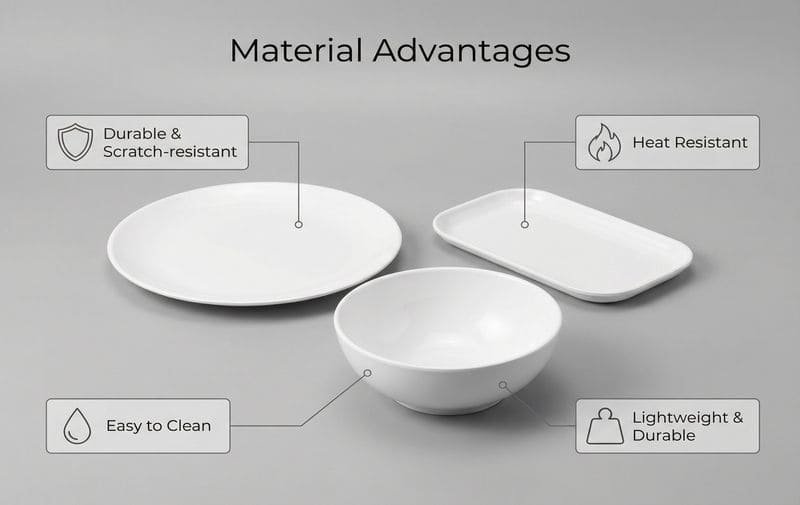
To achieve the client’s requested “ceramic look” combined with “extreme durability,” we locked in 100% Food-Grade Melamine (A5) material.
- Safety: Fully FDA and LFGB compliant, BPA-free, and perfectly safe for hot soups and acidic salad dressings.
- Durability: We opted for a thickened design. Unless you forcefully scratch it with a knife, it will maintain its finish for years, even under the stress of commercial dishwashers.
The “Soup-Proof” Secret: Solving the Staining Nightmare
This is the single biggest industry pain point for soup chains. Café Zupas serves tomato-based soups and acidic dressings. Standard melamine is porous enough that after 50 washes, these foods leave a permanent orange/yellow ring.
- The Duramela Solution: We didn’t just use standard A5 melamine. We applied a “Double Glazing” technique (LG Powder Overlay).
- How It Works: After the initial molding, we sprinkle a pure, clear melamine glazing powder over the formed bowl and press it again. This creates a glass-hard, non-porous shield that is significantly more resistant to acidic staining than standard molded melamine. This “invisible shield” is the only reason a soup chain can safely use off-white bowls without them turning orange in a month.
Step 4: Sample Confirmation & Mass Production — The Final Line of Defense
At Duramela, “No Approval, No Production” is our ironclad rule.
- Trial Run: Once molds were ready, we produced 10 samples of each item.
- Express Delivery: Samples were sent via UPS/FedEx directly to the client in the USA.
- Production Start: Mass production only began after the client physically touched the samples, confirmed the weight, thickness, and logo details, and signed off on them.
- Lead Time: Mass production typically takes 3-4 weeks.
Pro Tip: If your order coincides with Christmas (Oct-Dec production) or Chinese New Year (Jan-Feb production), please allow an extra 1-2 weeks buffer. Factories are extremely busy during these windows.
The Hidden Cost of Low MOQ: A Machine-Level Explanation
“We are a new concept. An MOQ of 3,000 is too high. Can we do 1,000?” This is the most common question we receive. The answer is yes, but we believe in transparency regarding the cost.
Why does 1,000 pcs cost 10-15% more per unit?
It isn’t just about losing a “volume discount.” It’s about the “Purging Cost.” To run your custom “Rice White” bowls, we use a 200-ton hydraulic press heated to 160°C.
- The Scenario: If the previous order on that machine was black or dark blue, the internal components of the screw and barrel are coated in dark powder.
- The Purge: We must disassemble and clean the machine, then run 20-30kg of raw white material through it just to “scrub” the internals. This material is wasted.
- The Math: On a 3,000-piece order, this waste is amortized over many units, adding pennies to the cost. On a 1,000-piece order, this fixed waste cost significantly impacts the per-unit price.
We offer Low MOQ custom trays and bowls to support your growth, but understanding this machine reality helps you see where your money goes.
Step 5: The Last Mile — Logistics for Beginners
This is the part that gives many restaurant owners headaches: Customs, tariffs, paperwork… it sounds overwhelming. Most restaurant managers are experts in food cost, not Incoterms, Tariffs, or ISF filings.
Duramela’s Solution: DDP (Delivered Duty Paid) For US-based clients like Café Zupas, we provided an all-inclusive logistics service. We moved beyond FOB (Free on Board) and acted as the importer of record. We provided a full Restaurant Supply Chain Solution.
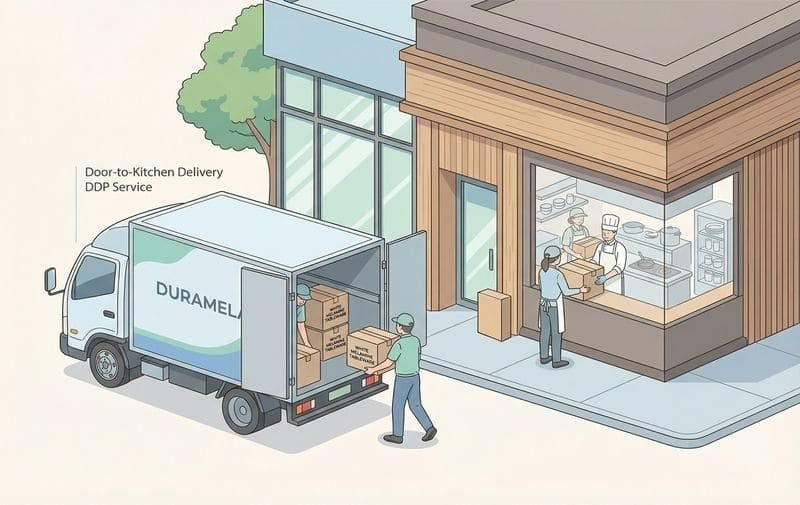
Logistics as a Service: The “Door-to-Kitchen” Solution
| Service Level | What You Do | What We Do |
|---|---|---|
| FOB (Standard) | You hire a freight forwarder, handle customs, pay duties, and arrange trucking. | We deliver to the port in China. |
| DDP (Duramela Premium) | You sign for the pallets at your warehouse. | We handle sea freight, ISF filing, Customs Bond, Duty payments, and final trucking. |
This “Door-to-Kitchen” service eliminates the fear of goods getting stuck at the port, which is invaluable for a chain with a strict restaurant opening schedule.
Pro Tip: Always plan your logistics with a buffer. If your opening is near Christmas or Chinese New Year (January/February), add at least 2 weeks to your lead time. Ports get congested, and truck availability drops.
Conclusion: Building Your Brand Moat
The Duramela x Café Zupas project proves that custom dinnerware is not just a vanity expense; it is a strategic asset. By investing in custom molds, “soup-proof” glazing, and smart logistics, the brand created a unique dining experience that competitors using standard white plates cannot copy.
Whether you need custom melamine bowls, trays, or a full dinnerware suite, the key is partnering with a manufacturer who understands the engineering behind the aesthetics.
Ready to start your project? Don’t just send a file; start a conversation with our engineers. Let’s build your brand moat today.
Frequently Asked Questions (F.A.Q.)
1. We are a new concept restaurant. An MOQ of 3,000 is too high. What can we do?
We completely understand. While the standard industrial MOQ is 3,000 pcs to maximize efficiency, we have opened a special low-MOQ channel of 1,000 pcs to support startups. The unit price will be slightly higher (typically 10-15%) to cover the “purging” and setup costs described in the article, but it lowers your inventory risk significantly.
2. Can I get a sample before paying for the full production run?
Yes, absolutely. For custom molds, we always produce a “pre-production sample” for your approval after the mold is finished. We will not begin mass production until you have physically inspected and signed off on this sample.
3. Does the “Double Glazing” technique cost extra?
Yes, it does add a small amount to the unit cost because it requires a secondary step in the molding process and uses more expensive glazing powder. However, for restaurants serving acidic foods (tomato sauce, curry, dressings), it is an investment that pays for itself by doubling the lifespan of the bowl.
4. Can the packaging be customized?
Absolutely. The standard practice is a neutral white or kraft inner box per dozen (12 pcs). If you are selling these as retail gifts, we can customize full-color printed boxes for you. Note that custom packaging usually requires a minimum order of 1,000 boxes.
5. How do I know if my design file is good enough?
Don’t worry. Send us whatever you have (PDF, AI, or even a sketch). Our engineering team will review it. If it needs to be converted to vector format or optimized for mold engraving, we will help you do that as part of the service.
6. What happens if the bowls arrive broken?
While melamine is extremely durable, shipping accidents can happen. With our DDP service, we take responsibility for the goods until they reach your door. If there is breakage during transit, we will compensate you or replenish the stock. We pack our cartons with reinforced layers to minimize this risk.
7. What exactly is the difference between A5 and A1 melamine?
A1 melamine contains 30% melamine resin and 70% additives/fillers. It is NOT safe for direct food contact (often sold as “storage” or “pet” grade) and is banned for tableware in many countries. A5 melamine is 100% pure melamine resin. It is FDA/LFGB compliant, BPA-free, odorless, and safe for temperatures from -20°C to 120°C. Duramela strictly uses only A5 material for all restaurant projects.
8: Is the mold fee a one-time cost?
Yes! Once you pay the ~$3,000 mold fee (for a set like Zupas), those molds belong to you. We store and maintain them at our factory for free. For all future re-orders, you only pay the unit price of the product. The molds typically last for 300,000 to 500,000 shots, which covers years of supply.
9: What if I need a pattern printed on the bowl?
We use a Decal Printing process. Unlike surface printing, we print your design on special paper and fuse it into the melamine during molding. This creates a protective layer over the ink. It is safe for food contact and will not scratch off. We can do anything from simple logos to complex, full-color photographic designs.
10. Can you handle shipping to multiple locations?
Yes. While the most cost-effective method is shipping to a single central warehouse (as we did for Zupas), we can arrange split shipments to different distribution centers. However, shipping directly to hundreds of individual restaurant locations is usually prohibitively expensive due to “Last Mile” trucking costs. We recommend consolidating to a central hub.
Recommended Links:
U.S. FDA – Melamine in Tableware Questions & Answers (Authoritative Source on Safety)
Wikipedia: Melamine Resin – Understanding the chemistry behind the durability.
Logistics Glossary: Understanding Incoterms (DDP, FOB, EXW) (Wikipedia Resource)
U.S. Customs and Border Protection: Basic Importing and Exporting – Official guide on the importing process.
Café Zupas Official Site – See the brand aesthetic in action.
